Ecotourism and conservation at Higher Level: This statement is Higher Level only. You weigh how ecotourism in a named protected area pays for conservation and ties local people to it, against the harm it can do to people and nature.
Practise this as you read
- Name one protected area and its numbers.
- Weigh gains and harms for people and nature.
Free preview
This is the free notes preview
You're reading the free notes. Aimnova Pro unlocks the full study experience — and you can try it with your first topic free to keep:
- FlashcardsLock in vocabulary and key terms with spaced repetition.
- Practice questionsAnswer exam-style questions and get instant AI marking.
- Mock exams & past-paper vaultSit full mocks and see exactly how examiners award marks.
- Personalised study planA daily plan built around your exam date and weak areas.
Wildlife worth more alive: Ecotourism turns living wildlife into income. That income can pay to protect the area and give local people a reason to protect it too.
How ecotourism funds protection
- Ecotourism is responsible travel to natural areas that conserves nature and benefits local people.
- Visitors pay permits, entry fees and lodge prices: income from living wildlife.
- That money funds protection: rangers, anti-poaching patrols, research, habitat restoration.
- A species worth money alive gives governments a reason to protect its habitat.
- Charismatic flagship species draw visitors, and protecting them protects everything around them.
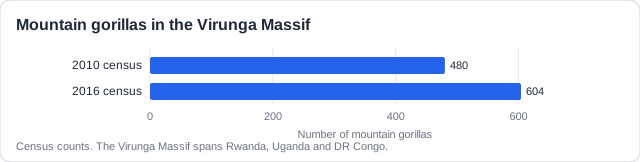
Real example: in Volcanoes National Park, each visitor has paid US$1,500 since 2017 for one hour with a family of mountain gorillas. The money pays for rangers and vets. In 2018 the species was moved from Critically Endangered to Endangered.
Get feedback like a real examiner
Submit your answers and get instant feedback — what you did well, what's missing, and exactly what to write to score full marks.
The guide says ecotourism can increase interdependence of local communities. Here is how.
How ecotourism links people and the park
- Local people get jobs: guides, trackers, porters, lodge staff, craft sellers.
- A share of park income pays for schools, clinics and water supplies nearby.
- People who earn from wildlife protect it: some former poachers become guides.
- The park depends on the villages' support, and the villages depend on the park: interdependence.
- Income from ecotourism can be an alternative to farming, hunting or logging in the habitat.
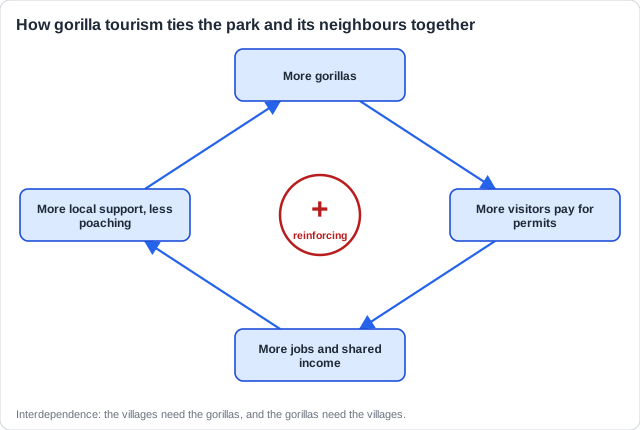
Remember it as: Gorillas pay the village; the village guards the gorillas.
Real example: since 2017 Rwanda has shared 10% of the park's tourism income with the villages around it, paying for schools, health centres and water tanks. Local people work as trackers, guides and porters, and some former poachers now carry visitors' bags up the volcanoes.
Ecotourism also has costs for people, even in a well-run park.
Negative impacts on people
- Leakage: much of the money goes to foreign-owned lodges, airlines and tour firms.
- Unequal benefits: a few gain jobs while others bear the costs.
- Park animals raid crops, and fences or rules limit people's use of the land.
- Parks may grow and move families off their land.
- Local culture can be turned into a show for tourists; prices rise for locals.
Real example: around Volcanoes National Park, many of the most expensive lodges belong to international companies, so much of the money leaves Rwanda. Buffalo and gorillas from the park raid potato and bean fields next to it, and plans to enlarge the park would move thousands of families from their land.
Learn what examiners really want
See exactly what to write to score full marks. Our AI shows you model answers and the key phrases examiners look for.
Visitors can harm the very wildlife they come to see.
Negative impacts on nature
- Disease: people can pass illnesses to wildlife, such as colds to gorillas.
- Disturbance: animals get stressed, change their behaviour or leave breeding sites.
- Trampling, litter and waste; lodges and roads clear habitat.
- Boats and planes bring invasive species; long flights add carbon emissions.
- Too many visitors can pass the area's carrying capacity: limits and fees are needed.
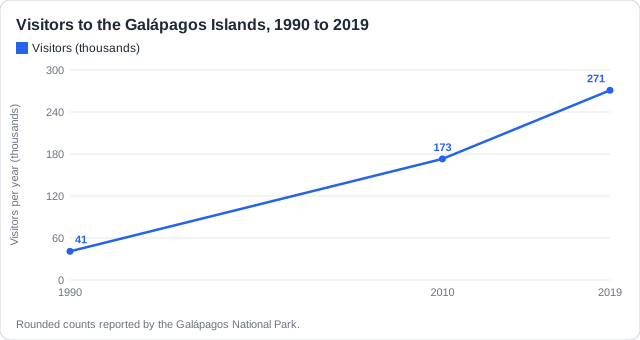
Real example: gorillas share most of our genes and can catch our colds, which can kill them, so in Rwanda groups are limited to 8 visitors for one hour, kept 7 metres away. In the Galápagos, visitor numbers grew over six times from 1990 to 2019, bringing in insects and seeds that threaten native species. In 2024 the entry fee doubled to US$200.
How do you find out whether ecotourism helps or harms a place, and what values it promotes? Ask the people involved with a questionnaire.
Assessing ecotourism with a questionnaire
- A questionnaire asks many people the same questions, so answers can be counted and compared.
- Ask residents: jobs, income, crop damage, whether they support the park.
- Ask visitors: why they came, what they spent, what they learned, whether they would pay more.
- Mix closed questions (tick a box, a 1 to 5 scale) with a few open ones.
- Use a large, mixed sample and neutral wording, so the results are reliable.
| Question | Type | What it shows |
|---|---|---|
| Does anyone in your home work in tourism? | Closed: yes / no | Economic impact |
| How much has the park helped your village? (1 to 5) | Closed: scale | Local support |
| Have park animals damaged your crops this year? | Closed: yes / no | Social cost |
| Why did you choose this park? | Open | Values visitors hold |
Real example: a questionnaire in villages next to Volcanoes National Park could ask the same questions in homes near the park edge and in homes further away. If support is lower near the edge, where crop raiding is worst, the park knows where to spend its shared income first.
Never wonder what to study next
Get a personalized daily plan based on your exam date, progress, and weak areas. We'll tell you exactly what to review each day.
How this comes up: Paper 2, Section B: (a) [4] outline ways ecotourism helps or harms; (b) [7] evaluate ecotourism in a named protected area; (c) [9] evaluate the role of ecotourism in conservation. Paper 1: tourism data about a park.
Visitors to Volcanoes National Park in Rwanda pay US$1,500 each to spend one hour with a family of mountain gorillas.
Evaluate the use of ecotourism to conserve biodiversity in a named protected area.
Model answer plan
See the mark-by-mark plan — for / against / judgement, with marking guidance — in study mode.