Rewilding benefits and limits at Higher Level: This statement is Higher Level only. You weigh what rewilding gives nature and people against what it costs, above all the land it takes from food, and judge a project's success from data.
Practise this as you read
- Weigh food production against rewilding.
- Judge success against the national trend.
Free preview
This is the free notes preview
You're reading the free notes. Aimnova Pro unlocks the full study experience — and you can try it with your first topic free to keep:
- FlashcardsLock in vocabulary and key terms with spaced repetition.
- Practice questionsAnswer exam-style questions and get instant AI marking.
- Mock exams & past-paper vaultSit full mocks and see exactly how examiners award marks.
- Personalised study planA daily plan built around your exam date and weak areas.
Benefits for nature: You know what rewilding is: letting natural processes take over again. At Higher Level you weigh what it gains against what it costs. Start with what it gives nature.
Benefits for nature
- Species return, including rare and declining ones: biodiversity rises.
- Grazing animals create a mosaic of grassland, scrub and trees: many habitats in one place.
- Natural processes restart: grazing, flooding, decay, seed spreading.
- Ecosystem services improve: carbon stored, floods slowed, soils rebuilt, water cleaned.
- Larger, connected areas help wildlife move and adapt to climate change.
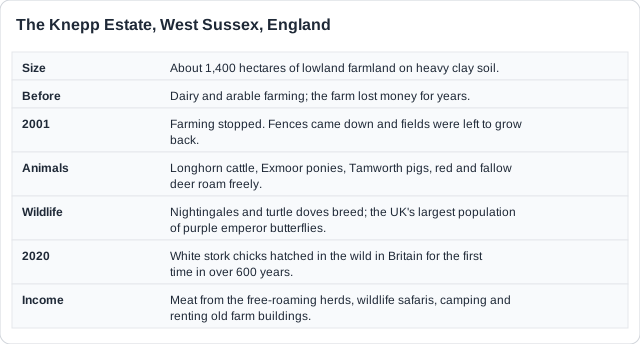
Real example: at the Knepp Estate in England, farming stopped in 2001 on land that had lost money for years. Grazing animals now shape a patchwork of grass, thorny scrub and trees. Nightingales and turtle doves breed there, and in 2020 white stork chicks hatched in the wild in Britain for the first time in over 600 years.
Know your predicted grade
Take timed mock exams and get detailed feedback on every answer. See exactly where you're losing marks.
Rewilding can also pay, and not only in money.
Benefits for people
- New income: nature tourism, safaris, camping, meat from free-roaming herds.
- New jobs: guides, ecologists, hospitality; often more than a failing farm gave.
- Poor farmland that lost money can pay again.
- People gain wellbeing, education and a place to see wildlife.
- It can rebuild local pride and cultural links with nature.
Remember it as: Wildlife back, money back: meat, safaris, camping.
Real example: Knepp now earns its income from selling meat from its free-roaming cattle, pigs and deer, from wildlife safaris and camping, and from renting out old farm buildings as offices. The estate employs more people than the dairy farm did, and thousands of visitors come each year.
The biggest question is land: should it grow food or wildlife? Rewilding also has limits of its own.
Limitations
- Less food: land taken out of farming grows less food, so more may be imported.
- Farmers may lose jobs and a way of life; some see it as outsiders taking land.
- Without predators, grazing animals must be culled or they starve: it still needs managing.
- Returned predators and beavers can harm livestock, crops or drained fields.
- Results are slow and uncertain; the old ecosystem may not return.
- It needs large areas, so land prices and many owners make it hard.
Land for food
- Feeds people nearby.
- Farm jobs and culture.
- Less need for imports.
Land for rewilding
- More species return.
- Tourism jobs.
- Carbon, water, soils.
Real example: the Oostvaardersplassen was stocked with deer, horses and cattle but no predators. In the hard winter of 2017 to 2018, over 3,000 animals starved or were shot, causing a public outcry. In Scotland's Affric Highlands, a 30-year plan from 2021 covering about 200,000 hectares must cull deer and win over many landowners and sheep farmers.
The land-use trade-off: Rewilding poor land that loses money costs little food; rewilding the best farmland costs more.
Get feedback like a real examiner
Submit your answers and get instant feedback — what you did well, what's missing, and exactly what to write to score full marks.
How do you know if a rewilding project is working? Use data that others have already collected: secondary data.
Assessing success with secondary data
- Use secondary data: counts from bird surveys, national databases or the project's own records.
- Compare before and after: the same species, same method, same season.
- Compare with the national trend: a rise where the country shows a fall is strong evidence.
- Check the method: who counted, how often, and was the effort the same each year?
- One species rising is not success: look at several species and habitats.
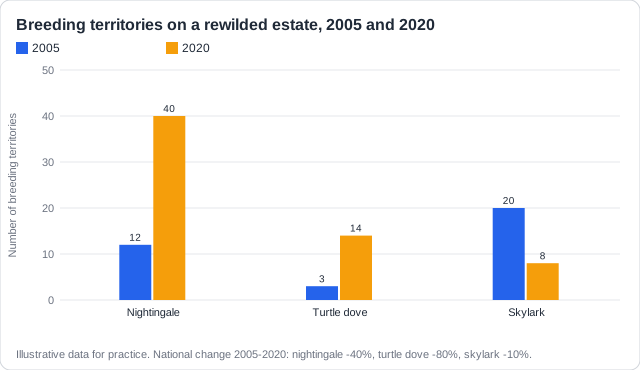
Real example: reports from Knepp show nightingales and turtle doves increasing while both fall across Britain. But birds of open farmland, such as skylarks, lose out as scrub grows: every rewilding creates winners and losers.
How this comes up: Paper 2: evaluate a named rewilding project [7], or to what extent land should be rewilded rather than farmed [9]. Paper 1: discuss a rewilding plan from a fact file [6], or assess success from survey data.
The Knepp Estate in West Sussex, England, stopped farming its 1,400 hectares in 2001 and let free-roaming cattle, ponies, pigs and deer shape the land.
Evaluate the Knepp Estate as a rewilding project.
Model answer plan
See the mark-by-mark plan — for / against / judgement, with marking guidance — in study mode.