Feedback loops that restore biodiversity at Higher Level: This statement is Higher Level only. It uses feedback and tipping points to explain why some damaged places stay damaged, and how rewilding and restoration can set off a loop that brings life back.
Practise this as you read
- Draw each loop as a closed circle.
- Link plant growth to the food web.
Free preview
This is the free notes preview
You're reading the free notes. Aimnova Pro unlocks the full study experience — and you can try it with your first topic free to keep:
- FlashcardsLock in vocabulary and key terms with spaced repetition.
- Practice questionsAnswer exam-style questions and get instant AI marking.
- Mock exams & past-paper vaultSit full mocks and see exactly how examiners award marks.
- Personalised study planA daily plan built around your exam date and weak areas.
Two ways a place can stay: You met positive feedback and tipping points in topic 1. Here they explain why some damaged ecosystems never recover on their own, and how restoration can flip them back.
Alternative stable states
- An ecosystem can have alternative stable states: two very different states that can each last.
- Each state is held in place by its own positive feedback loop.
- So a positive feedback loop is a necessary condition for alternative stable states.
- A degraded state can stay degraded even after the damage stops: it does not recover by itself.
- To restore it, people must push it past a tipping point into the other state.
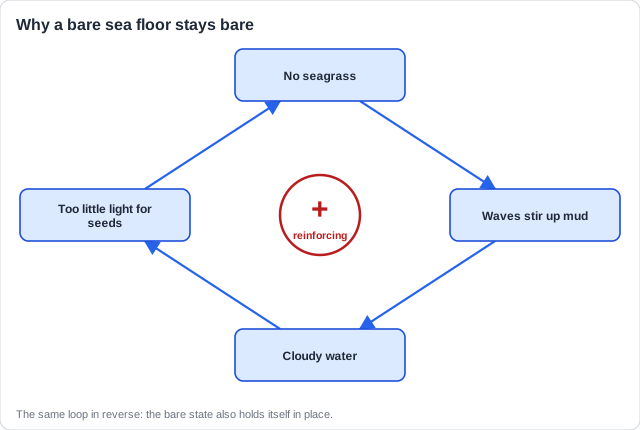
Real example: in the 1930s a disease and a hurricane killed the eelgrass in the coastal bays of Virginia, USA. The water was clean, yet the meadows did not come back for about 70 years: the bare, muddy state had become stable.
Learn what examiners really want
See exactly what to write to score full marks. Our AI shows you model answers and the key phrases examiners look for.
Restoration works by starting the opposite loop, one that builds the healthy state up.
How restoration triggers the loop
- Rewilding or restoration gives the push: seeds sown, trees protected, a species returned.
- The first plants change their surroundings in a way that helps more plants grow.
- More plants change the surroundings even more: the loop reinforces itself.
- Once past the tipping point, the loop runs by itself, with little further help.
- Too small a push fails: small patches are swamped by the old state's loop.
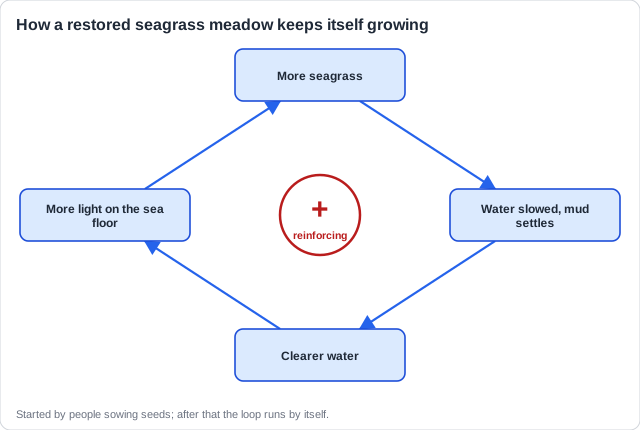
Remember it as: Plants make the place better for plants: the loop runs itself.
Real example: from 1999 scientists and volunteers sowed over 70 million eelgrass seeds on about 200 hectares of the Virginia bays. The meadows cleared their own water and spread by themselves to about 3,600 hectares by 2018: the largest seagrass restoration in the world.
The guide asks how more growth, reproduction and survival change food webs. Follow the energy up from the plants.
Growth, survival and food webs
- More plant growth means more biomass: more food and shelter at the base of the food web.
- More food and shelter raise the survival and reproduction of animals that eat or hide in it.
- More animals bring more species: predators, seed carriers, pollinators.
- Many help the plants back: they spread seeds, pollinate or eat pests, so more plants grow.
- Longer food chains and more links make the community more complex.
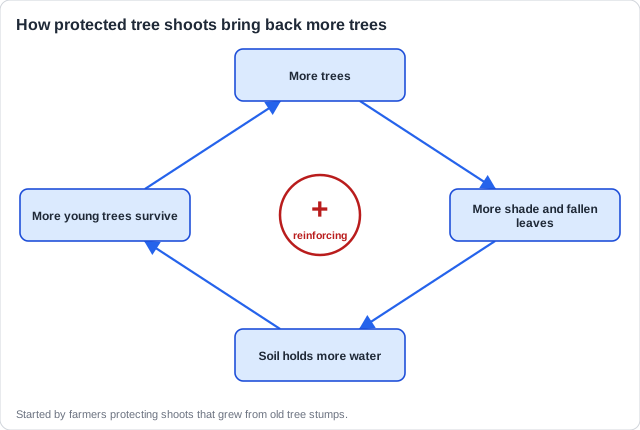
Real example: since the 1980s farmers in Niger have protected the shoots that grow from old tree stumps in their fields, instead of cutting them. Trees have come back on about 5 million hectares. Their shade and leaves improve the soil, more young trees survive, and birds and insects that eat crop pests have returned.
Never wonder what to study next
Get a personalized daily plan based on your exam date, progress, and weak areas. We'll tell you exactly what to review each day.
A positive loop does not run for ever. What stops it, and where does the ecosystem end up?
A new equilibrium
- The loop cannot grow for ever: limiting factors such as space, light and nutrients take over.
- Then negative feedback holds the system steady: a new equilibrium.
- The new state has more biodiversity and is more resilient than the degraded one.
- A big shock (heatwave, storm, disease) can still push it back if it crosses the tipping point again.
Bare, muddy bay
- Cloudy water, little light.
- Few species, short food chains.
- Stable, but degraded.
Seagrass meadow
- Clear water, much light.
- Fish, scallops, grazing birds.
- Stable, and resilient.
Real example: in Virginia the meadows stopped spreading where the water became too deep or too warm for eelgrass. Once the meadows were large, bay scallops, gone from the bays since the 1930s, were returned and began to breed there again.
Positive feedback is not always good: The same kind of loop kept the bay bare for 70 years. 'Positive' means the loop reinforces change, not that the change is good.
How this comes up: Paper 2: explain how positive feedback helps restoration [7], or draw and explain a loop from a graph of a restored habitat in Section A. Section B (c) [9] may ask to what extent restoration can return a former stable state.
Since the 1980s, farmers in Niger have protected the shoots growing from old tree stumps in their fields, and trees have returned to about 5 million hectares.
Explain how positive feedback loops triggered by habitat restoration can increase biodiversity and lead to a new stable equilibrium.
Model answer plan
See the mark-by-mark plan — for / against / judgement, with marking guidance — in study mode.