Who makes conservation succeed at Higher Level: This statement is Higher Level only. You compare international, governmental and non-governmental organizations, and weigh the claim that their success depends on media, speed, diplomacy, money and political influence.
Practise this as you read
- Name a real organization of each kind.
- Weigh the five factors, then judge.
Free preview
This is the free notes preview
You're reading the free notes. Aimnova Pro unlocks the full study experience — and you can try it with your first topic free to keep:
- FlashcardsLock in vocabulary and key terms with spaced repetition.
- Practice questionsAnswer exam-style questions and get instant AI marking.
- Mock exams & past-paper vaultSit full mocks and see exactly how examiners award marks.
- Personalised study planA daily plan built around your exam date and weak areas.
Three kinds of organization: Conservation is done by three kinds of organization. The guide makes a claim about them: how well they succeed depends on five factors. First, meet the three kinds.
The three kinds and the five factors
- International (intergovernmental) organizations are set up by many countries: UNEP, the whaling commission.
- Governmental organizations belong to one country: its ministries, park services and wildlife agencies.
- Non-governmental organizations (NGOs) are independent charities: WWF, Greenpeace.
- Success depends on five things: media, speed, diplomacy, money and political influence.
Remember it as: Media, speed, diplomacy, money, influence: five tools, three players.
Real example: the UN Environment Programme was set up by governments in 1972. The WWF was founded as a charity in 1961. Each country also has its own agencies, such as the US Fish and Wildlife Service.
Learn what examiners really want
See exactly what to write to score full marks. Our AI shows you model answers and the key phrases examiners look for.
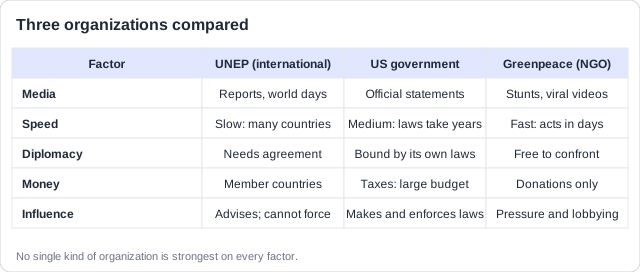
The first two factors are how an organization reaches people and how fast it can act.
Media and speed of response
- NGOs use the media to raise awareness and put pressure on firms and governments.
- A shocking image or video spreads fast and brings in donations and supporters.
- NGOs can respond in days: no votes or treaties are needed.
- International bodies are slow: many countries must negotiate and agree.
- Governments are in between: laws take years, but they can act fast in an emergency.
Real example: in 2010 Greenpeace posted a video that turned a Kit Kat chocolate bar into an orangutan's finger, to show that Nestlé bought palm oil from cleared rainforest. It spread online, and within about two months Nestlé promised to stop. By contrast, the world's new biodiversity targets, due in 2020, were agreed only in December 2022.
The next two factors are about power: who can make rules, and who can be made to follow them.
Diplomatic constraints and political influence
- International bodies face diplomatic constraints: they need agreement and cannot force a country.
- A country can refuse or leave a treaty, and compromises weaken the rules.
- Governments have the most political influence: they make and enforce laws in their own land.
- NGOs have no legal power, so they lobby, go to court and use public pressure.
- Free from diplomacy, NGOs can confront wrongdoers, but may be seen as biased.
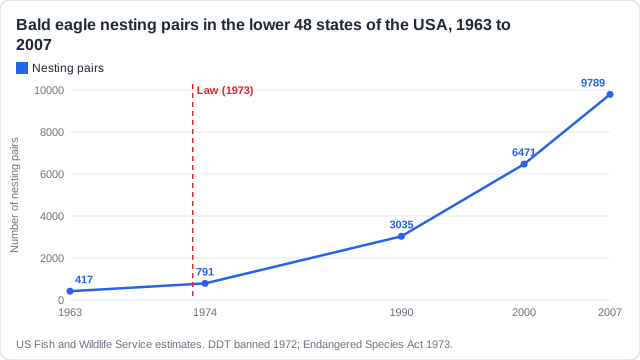
Real example: the US government banned the pesticide DDT in 1972 and passed the Endangered Species Act in 1973. Eagle numbers rose over twentyfold. Internationally, the International Whaling Commission banned commercial whaling from 1986, but in 2019 Japan simply left it.
Never wonder what to study next
Get a personalized daily plan based on your exam date, progress, and weak areas. We'll tell you exactly what to review each day.
The fifth factor is money: conservation needs rangers, land, research and time.
Financial resources
- Governments have taxes: big budgets, but nature competes with schools and hospitals.
- International bodies depend on contributions from member countries, which may be cut.
- NGOs depend on donations, which flow to charismatic animals more than to habitats or insects.
- Money pays for rangers, land, research and breeding; without it, plans stay on paper.
- Organizations often combine funds: governments, banks and NGOs together.
Real example: in 2023 Ecuador agreed a debt-for-nature swap. About US$1.6 billion of its debt was replaced by cheaper loans, freeing about US$450 million over some 18 years to protect the waters around the Galápagos Islands. A government, banks and conservation groups worked together.
'Consider this claim' means weigh it. Each kind of organization is strong on some factors and weak on others.
Weighing the claim
- For: every success above needed media, speed, money or influence, and failures lacked them.
- Against: success also needs local support, science and enforcement on the ground.
- Against: the biology of a species matters: slow breeders recover slowly whatever the effort.
- The strongest results come when the three kinds of organization work together.
Real example: the bald eagle's recovery needed all three. A book, Rachel Carson's Silent Spring, used the media to alarm the public; NGOs campaigned; the government banned DDT and protected nests by law. Money and science kept it going for 35 years.
Stop wasting time on topics you know
Our AI identifies your weak areas and focuses your study time where it matters. No more overstudying easy topics.
How this comes up: Paper 2, Section B: (a) [4] outline differences between organizations; (b) [7] explain how the five factors affect success; (c) [9] to what extent success depends on one factor, or on local versus international action.
WWF's Earth Hour, started in Sydney in 2007, now switches off lights in cities across the world each year.
To what extent does the success of conservation organizations depend more on their use of the media than on their financial resources?
Model answer plan
See the mark-by-mark plan — for / against / judgement, with marking guidance — in study mode.