Richness and evenness at Higher Level: The same two ideas as SL, with different real cases: Konza Prairie, the Great Barrier Reef and the rivers of Yellowstone.
Practise this as you read
- Distinguish richness from evenness in one sentence.
- Explain how each one makes an ecosystem more resilient.
Free preview
This is the free notes preview
You're reading the free notes. Aimnova Pro unlocks the full study experience — and you can try it with your first topic free to keep:
- FlashcardsLock in vocabulary and key terms with spaced repetition.
- Practice questionsAnswer exam-style questions and get instant AI marking.
- Mock exams & past-paper vaultSit full mocks and see exactly how examiners award marks.
- Personalised study planA daily plan built around your exam date and weak areas.
Two things make species diversity: Species diversity is a product of two things: richness and evenness. Both can be measured, so communities can be compared.
The points to remember
- Richness = the number of species in a community.
- Evenness = how similar the population sizes of each species are.
- Species diversity depends on both: many species, and none dominating.
- Many species is not enough: if one species dominates, diversity is still low.
- To define species diversity, name both: richness and evenness (relative abundance).
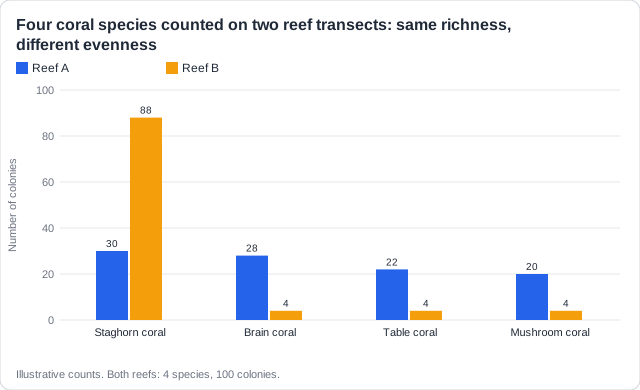
Both reefs have the same richness (4 coral species) and 100 colonies. On Reef A the numbers are even; on Reef B staghorn coral dominates, so B has the lower species diversity.
Rich but uneven is still low: Picture a pine plantation with a single oak tree. Richness is 2, but evenness is very low, and the lone oak is unlikely to reproduce there, so diversity stays low.
Real example: the tallgrass prairie of Konza Prairie in Kansas holds hundreds of plant species in similar numbers. A wheat field next to it is almost all wheat: low richness, and one species dominates.
Remember it as: Richness counts the species; evenness checks the shares.
Learn what examiners really want
See exactly what to write to score full marks. Our AI shows you model answers and the key phrases examiners look for.
Richness and evenness matter because they decide how well a community copes when something goes wrong.
Why richness matters
- Species depend on each other, so with many species the loss of one has less impact.
- More species make more branched food webs, so the system recovers faster from disease or disturbance.
- Many niches are filled, leaving fewer gaps for invasive species.
- A wide variety keeps the ecosystem productive, providing life support such as clean water and oxygen.
Real example: the Great Barrier Reef has over 400 kinds of hard coral. When a marine heatwave kills the most sensitive species, others survive, so the reef still gives fish food and shelter and can recover.
Why evenness matters
- When no single species dominates, the ecosystem is more stable and resilient.
- Species in similar numbers complement each other: they use resources in different ways.
- Competition between similar-sized populations keeps each species fit.
- Richness and evenness both raise the diversity index and biodiversity.
Real example: along Yellowstone's rivers, willow and aspen grow in similar numbers. If one is hit by heavy browsing or disease, the other still gives beavers, birds and insects food and shelter.
Not another level of biodiversity: Richness and evenness are part of species diversity. Asked for another level of biodiversity, give genetic or habitat diversity, not richness or evenness.
How this comes up: Define species diversity [1]; distinguish richness from evenness [1]; explain why both matter for biodiversity [3].
Divers survey two coral reefs with the same number of coral species. On one reef, staghorn coral makes up 88% of the colonies.
Explain why the reef with the more even coral populations is likely to be more resilient.
Model answer plan
See the mark-by-mark plan — for / against / judgement, with marking guidance — in study mode.
Both words, every time: A definition of species diversity with only richness, or only evenness, loses the mark. Name both.