What shapes the community at Higher Level: An HL-only statement. Two successions can start the same way and end in different places: a bog instead of a forest, a savanna instead of a woodland. Here are the factors that decide where each one ends up.
Practise this as you read
- Outline how climate, landform, bedrock and soil, fire and weather, and consumers shape the community.
- Explain a real case where the final community is not the forest the climate allows.
Free preview
This is the free notes preview
You're reading the free notes. Aimnova Pro unlocks the full study experience — and you can try it with your first topic free to keep:
- FlashcardsLock in vocabulary and key terms with spaced repetition.
- Practice questionsAnswer exam-style questions and get instant AI marking.
- Mock exams & past-paper vaultSit full mocks and see exactly how examiners award marks.
- Personalised study planA daily plan built around your exam date and weak areas.
Same process, different endings: Every succession follows the same process, but it does not end in the same community everywhere. The biggest influence is climate.
The points to remember
- Climate (temperature and rainfall) sets the broad type of community a succession ends in.
- Hot and wet all year: rainforest. Cool and moist: temperate forest.
- Too dry for trees: grassland. Too cold, with a short summer: tundra.
- The end point set by climate is called the climatic climax.
- Within one climate, local factors decide the details: rock, soil, slope, fire, animals.
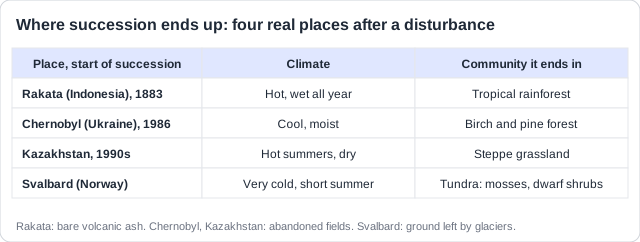
Real example: after the Soviet Union collapsed in 1991, millions of hectares of wheat fields in Kazakhstan were abandoned. The climate there is too dry for trees, so the fields went back to steppe grassland, not forest.
Never wonder what to study next
Get a personalized daily plan based on your exam date, progress, and weak areas. We'll tell you exactly what to review each day.
Within one climate, the shape of the land decides how deep the soil gets and how wet it stays.
Slope and drainage
- Geomorphology is the shape of the land: slopes, hollows, valley floors.
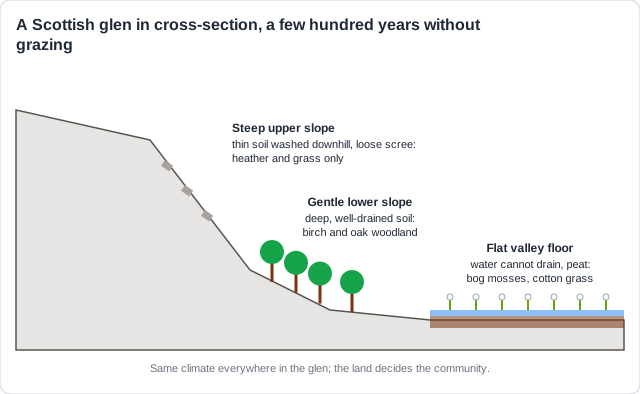
- Steep slopes: soil slides and washes downhill, so it stays thin: grass, heather, scree, not forest.
- Flat, badly drained ground: water cannot escape, the soil is waterlogged and short of oxygen.
- Waterlogged ground builds peat and ends as bog or fen, not woodland.
- Gentle, well-drained slopes build deep soil and reach woodland.
Real example: the Flow Country of northern Scotland is flat, rainy and underlain by rock that water cannot drain through. Instead of forest it holds about 4,000 km² of blanket bog, the largest in Europe. It became a World Heritage Site in 2024.
Soil forms from the rock beneath it, so the rock can decide which plants can live there at all.
Bedrock and soil
- The bedrock (parent rock) breaks down into the soil, so it sets the soil's minerals and acidity.
- Ultra-basic rock such as serpentine gives soils rich in toxic metals (nickel, chromium) and magnesium, and poor in nutrients.
- Only a few specially adapted plants can grow there, so the community stays sparse and unusual.
- Limestone gives lime-rich soils (flower-rich grassland, ash woods); granite and sandstone give acid soils (heath, pine).
Real example: on the Keen of Hamar, on the Shetland island of Unst, the rock is serpentine. After thousands of years it is still mostly bare stony ground with scattered small plants, including Edmondston's chickweed, found nowhere else in the world.
Name the soil property: Say what the rock does to the soil (toxic metals, few nutrients, acid, lime-rich) and then what that does to the community.
Stop wasting time on topics you know
Our AI identifies your weak areas and focuses your study time where it matters. No more overstudying easy topics.
Fire and weather: Related events (storms, floods, droughts) knock a succession back, and where they come often they decide which species make up the final community.
Fire, storms and floods
- Where fire comes often, the climax is made of fire-adapted species.
- Some trees resprout from buds under thick bark; some seeds only open after fire.
- Frequent grass fires kill tree seedlings, keeping savanna and grassland open.
- Storms, floods and droughts knock the community back and restart parts of the succession.
- So the 'final' community is often a patchwork of stages, not one uniform forest.
Real example: in Australia's 'Black Summer' fires of 2019-20, more than 20 million hectares burned. Within weeks, many blackened eucalypts were sprouting green shoots from buds hidden under their thick bark. Their forest has formed around fire.
Animals can decide the final community too: grazers by what they eat, predators by controlling the grazers. This is a top-down influence.
Top-down influences
- The community can also be shaped from the top down, by animals.
- Primary consumers (grazers, browsers) eat seedlings, so they decide which plants can grow up.
- Higher trophic levels (predators) control the grazers, and so, indirectly, the plants.
- Elephants push over and eat trees, keeping savanna open.
- Wolves in Yellowstone cut elk browsing, so willow and aspen could regrow along rivers.
Real example: in 1953 the disease myxomatosis reached Britain and killed almost all its rabbits within two years. Freed from grazing, the short turf of many chalk hills grew tall, and hawthorn scrub and woodland spread over grassland that rabbits had kept open.
Remember it as: Climate sets the menu; rock, slope, fire and animals choose the dish.
See how examiners mark answers
Answer exam-style questions with model answers. Learn exactly what earns marks and what doesn't.
How this comes up: No paper has tested this statement yet. The likely shapes are a Paper 2 Section B (a) [4] (four factors, named examples) or a Paper 1 case study asking why an area did not become forest.
In the Scottish Highlands, some land left ungrazed for centuries has become woodland, but other land nearby, in the same climate, is still bog, heather or bare rock.
Outline four factors, other than climate, that can influence the type of community that develops in a succession.
Model answer plan
See the mark-by-mark plan — for / against / judgement, with marking guidance — in study mode.
Factor, effect, example: Each point needs the factor, what it does to the community and, where you can, a named place.