Resilience and disturbance at Higher Level: The same statement as SL, with different examples: El Yunque after Hurricane Maria, Jamaica's reefs tipping to seaweed, the Gros Michel banana, Amazon regrowth, the Great Barrier Reef and Guanacaste. Expect to explain why a climax is stable and how people lower resilience.
Practise this as you read
- Link diversity and storages to recovery.
- Weigh how human actions reset, hold or stop succession.
Free preview
This is the free notes preview
You're reading the free notes. Aimnova Pro unlocks the full study experience — and you can try it with your first topic free to keep:
- FlashcardsLock in vocabulary and key terms with spaced repetition.
- Practice questionsAnswer exam-style questions and get instant AI marking.
- Mock exams & past-paper vaultSit full mocks and see exactly how examiners award marks.
- Personalised study planA daily plan built around your exam date and weak areas.
Bouncing back: Every ecosystem faces a disturbance sooner or later. Its resilience decides whether it recovers. You met resilience in topic 1.2; here it is tied to succession.
The points to remember
- Resilience: the ability to resist a disturbance or recover and return to a stable state.
- It is about coping with and recovering from a disturbance, not stopping it happening.
- Mature ecosystems sit in a dynamic equilibrium: small ups and downs, balanced overall.
- Negative feedback pulls a disturbed ecosystem back to its equilibrium.
- Disturbances can be natural (fire, storm, drought, disease) or human (felling, grazing).
Negative feedback
- Works against the change: negative feedback
- Keeps the ecosystem stable
- Helps it recover
Positive feedback
- Makes the change bigger: positive feedback
- Pushes it away from balance
- Too much lowers resilience
Real example: in 2017 Hurricane Maria stripped most of the leaves from El Yunque rainforest in Puerto Rico. Within a few years the canopy had closed again: the forest recovered to its dynamic equilibrium.
Never wonder what to study next
Get a personalized daily plan based on your exam date, progress, and weak areas. We'll tell you exactly what to review each day.
Whether an ecosystem tolerates a disturbance depends on the size of the disturbance and on how resilient the ecosystem is.
The points to remember
- A disturbance within its resilience: the ecosystem recovers to the same state.
- A disturbance too big or too frequent: it passes a tipping point into a new state.
- Positive feedback then pushes it further away, and the old state may not return.
- So how much an ecosystem can tolerate depends on its diversity and resilience.
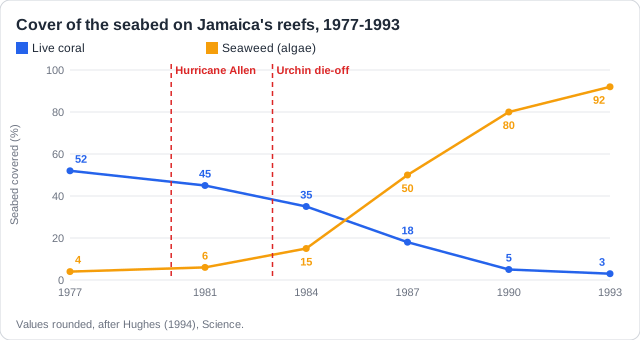
Real example: Jamaica's reefs had lost most of their plant-eating fish to overfishing. When Hurricane Allen (1980) and a disease that killed the grazing sea urchins (1983) followed, nothing kept the seaweed down, and the reef tipped from coral to seaweed.
Resilient is not untouchable: A resilient ecosystem still gets damaged. What marks it out is that it recovers.
Diversity is the main reason some ecosystems cope better. Many species and genes give redundancy, back-up routes for energy and more ways to survive.
The points to remember
- More species mean more complex food webs: energy has several pathways.
- Redundancy: if one species is lost, another with the same role takes over.
- Genetic diversity lets some individuals survive a disease, drought or fire.
- Evenness: when no single species dominates, one loss does less harm.
- Niches are filled, so invasive species find it harder to move in.
Low diversity
- One species or one clone
- One disease can kill all
- Simple food chain
High diversity
- Many species and genes
- Some survive, others take over
- Branched food web
Real example: almost every banana exported in the 1950s was one variety, Gros Michel, grown as copies of the same plant. With no genetic diversity, Panama disease, a soil fungus, wiped out plantations across Central America and the variety had to be replaced.
Remember it as: Many species, many back-ups.
Stop wasting time on topics you know
Our AI identifies your weak areas and focuses your study time where it matters. No more overstudying easy topics.
Succession builds diversity, storages and soil, so it builds resilience too. A climax community is usually more stable than the stages before it.
The points to remember
- More species, habitats, niches and genetic diversity at the climax.
- Higher gross productivity and more biomass stored: a buffer to regrow from.
- More complex food webs and energy pathways.
- More established nutrient cycling and deeper, more fertile soil.
- More favourable abiotic conditions: shade, moisture, shelter.
- More established negative feedback, so the climax stays in equilibrium.
- Early stages are less resilient: few species, small storages, thin soil.

Real example: in the Amazon, young forest on old pasture can burn through in a dry year, while nearby old-growth forest, with its deep shade, moist air and many species, usually resists the same fire.
Compare the stages: When asked why a climax is more stable, compare it with the earlier stage: 'more species than the intermediate stage', not just 'it has many species'.
Human interference can undo what succession builds. People often arrest a succession, or reset it, and that lowers diversity and resilience.
The points to remember
- Humans can reset a succession: deforestation sends it back to an early stage.
- Or arrest it: farming and grazing hold land at a field or grassland stage.
- Urbanisation stops it altogether under concrete.
- Monocultures cut species and genetic diversity, so one pest or disease can wipe them out.
- Pollution, overfishing and fire suppression remove key species or storages.
- Each lowers diversity and storages, so the ecosystem tolerates less disturbance.
Reset
- Clear-felling a forest
- Starts again from early stages
Hold
- Fields, pasture, grazing
- Kept at a simple early stage
Stop
- Towns and roads
- No succession under concrete
Real example: the Great Barrier Reef bleached in 2016, 2017, 2020, 2022 and 2024. Where farm runoff and overfishing had already cut its diversity, reefs recovered more slowly between the heatwaves.
See how examiners mark answers
Answer exam-style questions with model answers. Learn exactly what earns marks and what doesn't.
Because succession rebuilds diversity and storages, people can use it to rebuild resilience.
The points to remember
- Restore degraded land by letting succession run, or helping it with the right next-stage species.
- Knowing the stages lets managers predict recovery time after a disturbance.
- Rewilding: step back and let succession and natural grazing do the work.
- Invasive species often take hold in early stages, so they are managed early.
- Some ecosystems need fire or grazing; managers keep them, rather than stopping them.
Real example: in Guanacaste, Costa Rica, from the 1980s, cattle pasture was bought, fires were stopped, and the land left to regrow. Seeds carried in by wind and animals turned it back into tropical dry forest over a few decades.
Link back to diversity: In an answer, say what the action does to diversity or storages, and so to resilience.
How this comes up: Paper 2, Section B (a): outline how diversity affects an ecosystem's ability to tolerate a disturbance [4].
Coral reefs, rainforests and grasslands all face storms, droughts and disease.
Outline how the diversity of an ecosystem affects its ability to tolerate disturbances.
Model answer plan
See the mark-by-mark plan — for / against / judgement, with marking guidance — in study mode.