GP and NP during succession at Higher Level: An HL-only statement. A young thicket grows fast; an ancient forest hardly grows at all, although it makes far more. The difference is respiration, and it follows a pattern through every succession.
Practise this as you read
- Describe how GP, respiration and NP change from pioneer to climax.
- Explain why NP is high early on and approaches zero at the climax.
Free preview
This is the free notes preview
You're reading the free notes. Aimnova Pro unlocks the full study experience — and you can try it with your first topic free to keep:
- FlashcardsLock in vocabulary and key terms with spaced repetition.
- Practice questionsAnswer exam-style questions and get instant AI marking.
- Mock exams & past-paper vaultSit full mocks and see exactly how examiners award marks.
- Personalised study planA daily plan built around your exam date and weak areas.
What a community gains and keeps: Gross productivity is what the community makes; net productivity is what it keeps.
The points to remember
- Gross productivity (GP): all the biomass or energy the community gains, by photosynthesis and feeding.
- Respiration (R): what plants, animals and decomposers use up to stay alive.
- Net productivity (NP) = GP - R: what is left over, so the community's biomass can grow.
- In a succession, count the whole community: producers, consumers and decomposers all respire.
Real example: the world's plants capture about 120 billion tonnes of carbon a year by photosynthesis. They respire about half of it, so about 60 billion tonnes a year is left as net primary productivity, new plant growth that feeds everything else.
Remember it as: GP is the pay, R the bills, NP what is saved.
Study smarter, not longer
Most students waste 40% of study time on topics they already know. Our AI tracks your progress and optimizes every minute.
At the start of a succession the ground is nearly bare. Little is made, but almost all of it is kept.
Early stages: GP low, NP high
- GP is low: conditions are harsh (little soil, few nutrients) and there are few producers.
- R is low too: little biomass and few consumers to respire.
- So NP is high compared with GP: a large share of what is made is kept.
- The community is growing: biomass is accumulating year on year.
Real example: at Hubbard Brook, in New Hampshire, USA, a forest cut down in the 1960s grew back as a thicket of pin cherry and birch. With few animals and a small plant biomass to respire, its biomass rose fast for the first decades.
High NP, not high GP: Early stages have LOW GP but HIGH NP compared with GP. Mixing the two up loses the mark.
In the middle stages the community makes more and more, but it also spends more.
Middle stages: GP rises, R catches up
- GP rises: more plants, taller layers, deeper, more fertile soil, faster nutrient cycling.
- Consumers join the food web, so secondary productivity rises.
- R rises faster than GP: more animals and decomposers eat and respire.
- So NP falls as a share of GP, and biomass gain slows.
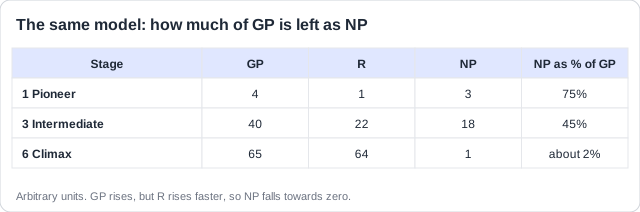
Real example: as the Hubbard Brook thicket grew into young forest, deer, insects and a growing army of decomposers in the deepening leaf litter moved in. Each of them respires, so more and more of the forest's growth was used up.
Practice with exam-style questions
Answer exam-style questions and get AI feedback that shows you exactly what examiners want to see in a full-marks response.
The climax balance: In a climax community GP may be high, but respiration balances it, so NP approaches zero.
Climax: GP high, NP near zero
- GP is high, near its maximum: the plants are at carrying capacity.
- Food chains are complete, so secondary productivity is at its maximum.
- R about equals GP: the huge biomass of plants, animals and decomposers uses almost all of it.
- So NP approaches zero: no net biomass gain for the community as a whole.
- The community is in a steady state: what it gains, it loses.
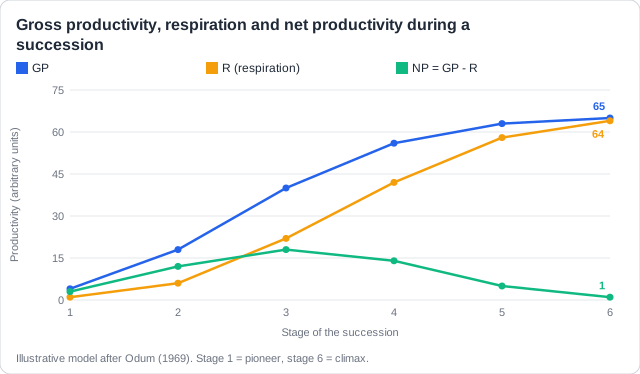
Real example: tropical rainforest has the highest GP of any land biome, yet an old rainforest gains little biomass each year, because its plants, animals and decomposers respire almost all of it. Some studies (Luyssaert and others, 2008) find old forests still gain a little carbon: NP approaches zero, rather than reaching it.
How this comes up: Paper 2 Section B has asked for [7]: explain how succession leads to changes in productivity. Walk through the stages, giving GP, respiration and NP at each.
On the Sefton Coast, near Liverpool, bare sand at the shore is colonised by grasses, and dunes further inland, hundreds of years old, carry pine and oak woodland.
Explain how gross and net productivity change during the succession from bare sand to woodland.
Model answer plan
See the mark-by-mark plan — for / against / judgement, with marking guidance — in study mode.
Say why at each stage: 'GP is low' needs its reason (poor soil, few producers); 'NP near zero' needs its reason (respiration balances GP).