Changes during succession at Higher Level: The same statement as SL, with different examples: Krakatau since 1883, Latin America's regrowing forests, the lupins of Mount St Helens, Yellowstone after 1988 and Australia's Black Summer fires. Expect a species table or a stage diagram to explain.
Practise this as you read
- Explain each change with a reason, not just its direction.
- Quote a table: numbers, richness and evenness.
Free preview
This is the free notes preview
You're reading the free notes. Aimnova Pro unlocks the full study experience — and you can try it with your first topic free to keep:
- FlashcardsLock in vocabulary and key terms with spaced repetition.
- Practice questionsAnswer exam-style questions and get instant AI marking.
- Mock exams & past-paper vaultSit full mocks and see exactly how examiners award marks.
- Personalised study planA daily plan built around your exam date and weak areas.
A community that builds itself up: During a succession, five things change over time: energy flow, productivity, species diversity, soil depth and nutrient cycling. From the first pioneers to the climax community, most of them rise.
The points to remember
- Species diversity rises: more species, more niches, more even numbers.
- Soil gets deeper, with more humus, water and nutrients.
- Nutrient cycling speeds up as decomposers multiply.
- Gross productivity and biomass rise towards the climax.
- Energy flow: food chains get longer and food webs more branched.
- Habitat variety grows: layers of plants, shade, leaf litter, dead wood.
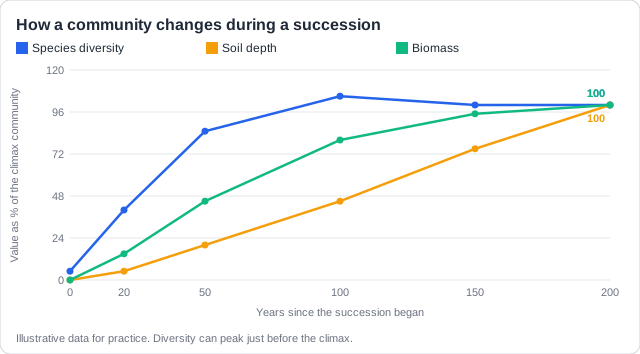
Real example: the 1883 eruption of Krakatau, Indonesia, left its islands bare and lifeless. Within about 50 years they were covered again in tropical forest, with hundreds of plant species, deeper soil and a full food web of insects, birds, bats and lizards.
Memorize terms 3x faster
Smart flashcards show you cards right before you forget them. Perfect for definitions and key concepts.
At first only a few hardy pioneer species can survive. Each stage makes the place suit more species, because it creates new niches.
The points to remember
- More habitats and niches: plants of different heights, shade, litter and dead wood.
- New species arrive (carried by wind, water or animals) once conditions suit them.
- Productivity rises, so there is more food and energy for more species.
- Nutrient cycling develops, so the soil supports more kinds of plants.
- Numbers become more even: richness and evenness both rise.
- Near the climax, diversity may level off or dip as a few long-lived species dominate.
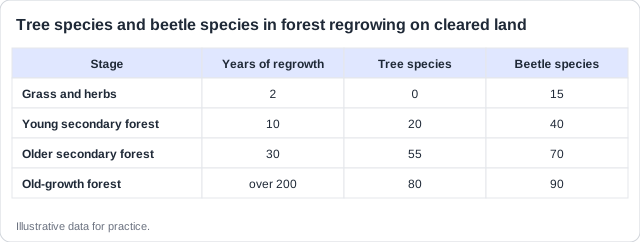
Real example: forests regrowing on abandoned cattle pasture across Latin America regain about 80% of the tree species richness of old-growth forest within about 20 years, though the exact mix of species takes far longer to return.
Using a species table: Quote numbers: the stage with the most species, and whether their numbers are even. Then give a reason, such as more niches or higher productivity.
Pioneers start on bare rock, sand or ash with no real soil. Every stage adds to it, so the soil gets deeper and richer in humus and nutrients.
The points to remember
- Pioneers (lichens, mosses, bacteria, fungi) help weather rock into small particles.
- Dead organisms add humus, so the soil gets deeper stage by stage.
- Humus holds more water and nutrients, so the soil gets more fertile.
- Decomposers multiply and recycle nutrients faster.
- Roots hold soil against erosion and break up more rock.
- Earthworms and burrowers mix and aerate the soil; animal droppings add organic matter.
- Plant cover shades the soil, so less water evaporates.
Remember it as: Break, add, hold, recycle: rock breaks, humus adds, roots hold, decomposers recycle.
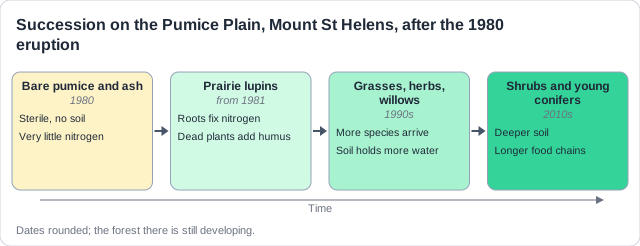
Real example: on the Pumice Plain of Mount St Helens, prairie lupins were among the first plants. Their roots fix nitrogen, and when they die they add humus, so grasses, willows and conifers could follow.
Say how, not just that: 'The soil improves' is not enough. Name the organism and what it does: roots stop erosion, earthworms aerate the soil, decomposers recycle nutrients.
Know your predicted grade
Take timed mock exams and get detailed feedback on every answer. See exactly where you're losing marks.
Productivity is how fast new biomass is made. gross productivity (GP) is the total; net productivity (NP) is what is left after respiration.
The points to remember
- Pioneer stage: poor soil and few plants, so GP is low; little respiration, so NP is a big share of GP.
- Middle stages: more plants, so GP rises; consumers arrive, so secondary productivity rises and NP slows.
- Climax: GP is highest, but respiration uses almost all of it, so NP is near zero: biomass stops growing.
- GP rises because soil fertility and nutrient cycling improve.
- Energy flow: more trophic levels, longer food chains, more branched food webs.
- More energy and biomass at each level; decomposers become more important.
Remember it as: Young communities grow fast; old ones break even.
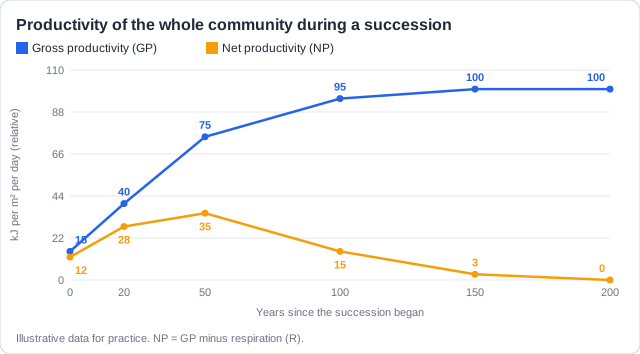
Real example: after the 1988 fires in Yellowstone National Park, USA, dense young lodgepole pines added biomass fast every year. In the oldest unburnt stands, new growth is nearly matched by respiration and decay, so their NP is close to zero.
Not everything goes up. As plants grow taller they change the conditions beneath them, so some abiotic factors fall.
The points to remember
- Light at ground level falls as the tree canopy closes.
- Temperature range gets smaller: shade keeps days cooler.
- Humidity rises as trees transpire water.
- Soil moisture can fall: trees take up more water than grasses.
- Soil nutrients can fall in a secondary succession, as growing trees lock them up.
- Biotic changes: shrubs then trees replace grasses; forest animals and more predators arrive.
Just after the fire
- Bright, bare ground
- Ash: a pulse of minerals
- Few soil organisms
Regrown forest
- Shade, more humidity
- Minerals locked up in trees
- Deep leaf litter, many decomposers
Real example: the 2019-20 Black Summer bushfires in eastern Australia left ash that released a pulse of minerals. As eucalypts resprouted and shrubs regrew, those minerals were taken back up into the plants, while leaf litter and soil life slowly built up again.
Name the change: Not just 'the vegetation changes': say it changes from grasses to shrubs to trees. And a meadow is dry land, so a change in water cloudiness does not apply there.
Get feedback like a real examiner
Submit your answers and get instant feedback — what you did well, what's missing, and exactly what to write to score full marks.
How this comes up: Paper 2, Section A: a table of species at three stages, then explain the change in diversity [2].
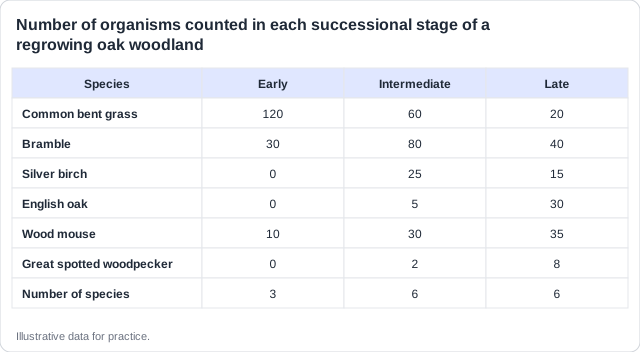
An area of oak woodland in England was cleared and left to regrow. Table 1 shows the organisms counted at three stages.
Explain why the diversity changes in the different successional stages.
Model answer plan
See the mark-by-mark plan — for / against / judgement, with marking guidance — in study mode.