Plagioclimax at Higher Level: An HL-only statement. Many of the landscapes people love, from purple moors to flower meadows, are not natural at all: people hold them in place. Here is how, and what happens when they stop.
Practise this as you read
- Define a plagioclimax and explain how grazing, burning, mowing or removing predators holds one.
- Evaluate whether a plagioclimax should be kept.
Free preview
This is the free notes preview
You're reading the free notes. Aimnova Pro unlocks the full study experience — and you can try it with your first topic free to keep:
- FlashcardsLock in vocabulary and key terms with spaced repetition.
- Practice questionsAnswer exam-style questions and get instant AI marking.
- Mock exams & past-paper vaultSit full mocks and see exactly how examiners award marks.
- Personalised study planA daily plan built around your exam date and weak areas.
People hold succession back: Human activity can divert and change the progression of succession. The community it holds is a plagioclimax.
The points to remember
- People can stop a succession (arrested) or send it a different way (deflected).
- The community they hold is a plagioclimax: stable, but not the natural climax.
- It stays only while the activity goes on: grazing, burning, mowing, cutting.
- Stop the activity and secondary succession restarts, towards the natural climax.
- People can also speed up or reverse a succession: planting trees, or clearing a forest.
Real example: every mown lawn is a plagioclimax. In the parks of London, grass is cut every week or two in summer. Where a corner is left uncut, brambles and tree seedlings appear within a few years: succession has started again.
Arrested or deflected?: Arrested: succession is stopped at one stage (mowing keeps grass as grass). Deflected: it is sent to a community it would never reach naturally (heather moorland instead of woodland).
Memorize terms 3x faster
Smart flashcards show you cards right before you forget them. Perfect for definitions and key concepts.
Britain holds about three quarters of the world's heather moorland. Almost all of it is a plagioclimax: without people, most would be woodland.
How moorland is held
- The uplands were once woodland; farmers cleared it from the Bronze Age for grazing.
- Sheep graze the land and eat tree seedlings, so no woodland can grow back.
- Gamekeepers burn heather in small patches every 10-15 years, for young shoots for red grouse.
- The fire also kills tree and shrub seedlings, so the heather stays.
- Stop grazing and burning, and birch, rowan and pine move in: succession restarts.
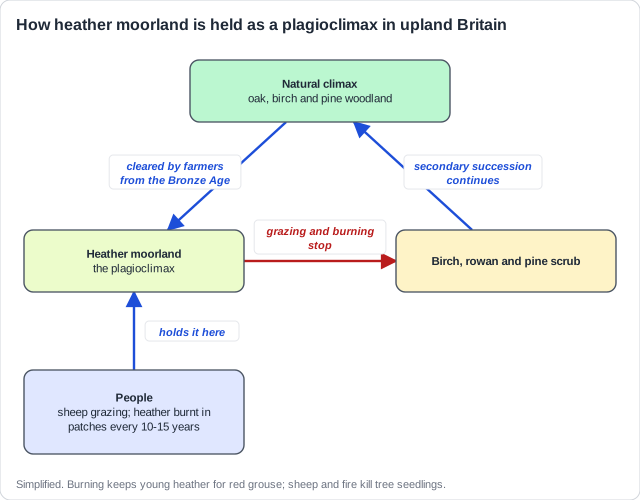
Real example: on the grouse moors of the North York Moors and the Scottish Highlands, keepers muirburn old heather in strips, giving the moor its patchwork look. Where sheep and fire have been kept off, birch woodland grows back within a few decades.
A flower-rich hay meadow is held by the farmer's calendar: cutting and grazing at the right times.
How a hay meadow is held
- A hay meadow is cut once a year, in July, after the flowers have set seed.
- Cutting removes shrub and tree seedlings, so scrub never gets going.
- Animals graze the regrowth in autumn, keeping the grass short.
- No chemical fertiliser: low nutrients stop a few tall grasses crowding out the flowers.
- Stop cutting and scrub moves in; add fertiliser and a few grasses win.
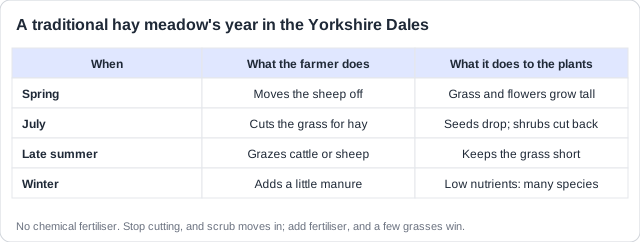
Real example: the hay meadows of the Yorkshire Dales, in northern England, are cut each July and hold dozens of flowering plants in one field, such as wood cranesbill and yellow rattle. Across Britain about 97% of these meadows were lost between the 1930s and the 1980s, mostly to fertiliser and silage.
Know your predicted grade
Take timed mock exams and get detailed feedback on every answer. See exactly where you're losing marks.
People can divert a succession without touching a plant, by removing the top carnivores.
Removing predators
- Removing top carnivores also diverts succession, through the food chain.
- Without predators, herbivores increase and browse tree seedlings.
- Trees cannot regrow, so the land stays grass or heather, not woodland.
- Domestic livestock (sheep, cattle, goats) do the same job as too many wild grazers.
- Cut the grazers, by culling or fences, and the trees come back.
Real example: wolves were hunted out of Scotland by about 1700. With no predator left, red deer now number several hundred thousand, and they browse almost every tree seedling. Only a few per cent of the old Caledonian pinewood survives. In Glen Feshie, heavy culling of deer since the early 2000s has let young pine and birch grow up again.
Remember it as: No wolves, too many deer, no young trees.
A plagioclimax is not always a loss. Whether to keep it depends on what we value.
Keep it or let it go?
- Many plagioclimaxes are rich in species: flower meadows, heaths, chalk grassland.
- They can hold more species than the dense climax forest that would replace them.
- So conservation often keeps them on purpose: conservation grazing, cutting, controlled burns.
- But they replace woodland: less carbon stored, less habitat for forest species.
- Burning on peat dries and damages it, releasing carbon and raising flood risk.
Reasons to keep it
- Rare species: orchids, ground-nesting birds
- Farming and cultural landscapes
- Often richer than the dense climax
Reasons to let it go
- Woodland stores more carbon
- Burning damages peat
- Habitat for forest species
Real example: since 2021 England has restricted burning on deep peat in protected upland sites, to protect the carbon the peat stores. On heathland nature reserves, by contrast, cattle and ponies are brought in on purpose to graze and hold the plagioclimax.
Get feedback like a real examiner
Submit your answers and get instant feedback — what you did well, what's missing, and exactly what to write to score full marks.
How this comes up: A Paper 1 case study gives a fact file and a diagram of how a place changes, then asks you to explain how people made or keep a plagioclimax [3]. In May 2026 it was pasture in a French valley, kept by grazing and a summer hay cut.
The table of a traditional hay meadow's year (section 3) shows how a farmer in the Yorkshire Dales manages a meadow. Without people, the natural climax there would be woodland.
With reference to the table, explain how human activity keeps the meadow as a plagioclimax.
Model answer plan
See the mark-by-mark plan — for / against / judgement, with marking guidance — in study mode.
Say what would happen without people: Name the natural climax (woodland) and say the activity stops the succession reaching it.