The climax debated at Higher Level: An HL-only statement. Was Europe once one great forest, or a patchwork kept open by wild cattle and horses? Does a succession even have one end? Ecologists still disagree, and you need both sides.
Practise this as you read
- Discuss why the climax idea has been challenged, including the Vera wood-pasture hypothesis.
- Explain alternative stable states with a real example.
Free preview
This is the free notes preview
You're reading the free notes. Aimnova Pro unlocks the full study experience — and you can try it with your first topic free to keep:
- FlashcardsLock in vocabulary and key terms with spaced repetition.
- Practice questionsAnswer exam-style questions and get instant AI marking.
- Mock exams & past-paper vaultSit full mocks and see exactly how examiners award marks.
- Personalised study planA daily plan built around your exam date and weak areas.
Is there one end point?: The idea of a single, stable climax community has been challenged.
The points to remember
- The classic idea (Clements, 1916): each climate has one climax, reached in the end everywhere.
- Challenge 1 (Tansley, 1935): soil, drainage, fire and grazing give many possible climaxes in one climate.
- Challenge 2: disturbance (storms, fire, disease) keeps coming, so the 'end' is rarely reached.
- Challenge 3: the climate itself changes, so the target keeps moving.
- So many ecologists now see a climax as a dynamic community, not a fixed end point.
Real example: the El Yunque rainforest in Puerto Rico was flattened in places by Hurricane Hugo in 1989, had largely regrown, and was stripped again by Hurricane Maria in 2017. With a big hurricane every few decades, the forest is always recovering: it never settles into one fixed climax.
Learn what examiners really want
See exactly what to write to score full marks. Our AI shows you model answers and the key phrases examiners look for.
There is real uncertainty over what ecosystems would develop naturally if there were no human influences at all.
Why 'natural' is hard to know
- People have changed ecosystems for thousands of years: fire, hunting, farming.
- Many large grazers that shaped the land are extinct (the aurochs, wild horses).
- So there is no untouched place to show what 'natural' would be.
- Evidence from the past (pollen, fossil beetles) is incomplete and read in different ways.
- Each generation takes the land it grew up with as 'natural': a shifting baseline.
Real example: the aurochs died out in Britain thousands of years ago, and the very last one died in a Polish forest in 1627. Nobody has seen a European lowland with its full set of wild grazers, so nobody can be sure what it looked like.
Remember it as: No untouched land, no sure answer.
The best-known debate is over lowland Europe before farming: closed forest, or open wood-pasture?
The Vera wood-pasture hypothesis
- Frans Vera (2000): primary consumers shaped lowland Europe's natural vegetation.
- Wild grazers (aurochs, wild horses, deer) kept a mosaic: grassland, thorny scrub and groves of trees.
- Oak and hazel need light: they cannot regrow under a closed canopy.
- Thorny scrub shields oak seedlings from grazers; groves grow, age, die and open up again.
- The old view: a closed-canopy forest (the 'wildwood'), with grazers too few to open it.
Closed-forest view
- Dense forest from coast to hills
- Grazers too few to open it
- Grassland only after farming began
Vera's wood-pasture
- Shifting mosaic: grass, scrub, groves
- Grazers keep it open
- Oak and hazel regrow in the open
Real example: Vera, a Dutch ecologist, set out the idea in 2000. He pointed out that oak seedlings in today's closed forests rarely survive in the shade, yet oak was one of the commonest trees in the ancient pollen record.
Never wonder what to study next
Get a personalized daily plan based on your exam date, progress, and weak areas. We'll tell you exactly what to review each day.
Both sides point to evidence, and rewilding projects now test the idea on the ground.
The evidence and the tests
- For closed forest: pollen from that time is mostly tree pollen; grass pollen is scarce.
- For closed forest: most fossil beetles found are woodland species.
- For wood-pasture: oak and hazel pollen is abundant, and both need open light to regrow.
- Testing it: rewilding sites let grazers roam and watch what the vegetation becomes.
- The answer may differ by place: open on dry, fertile land; closed forest elsewhere.
Real example: at the Knepp estate in West Sussex, England, farming stopped in 2001. Longhorn cattle, Exmoor ponies, Tamworth pigs and deer now roam freely. Instead of closed forest, a shifting mosaic of grassland, thorny scrub and trees has formed, with young oaks growing up inside the thorn bushes, much as Vera predicted.
Give both sides: In an evaluation, give evidence for each view (pollen and beetles; oak and hazel needing light), then judge: the answer may differ from place to place.
Chance can decide which community forms, and then that community can hold itself in place.
Alternative stable states
- One place can have more than one stable community: these are alternative stable states.
- Which one forms can depend on random events: a hurricane, a disease, a fire, which seeds arrive first.
- Once formed, each state holds itself in place through negative feedback.
- So there may be no single 'natural' climax for a place.
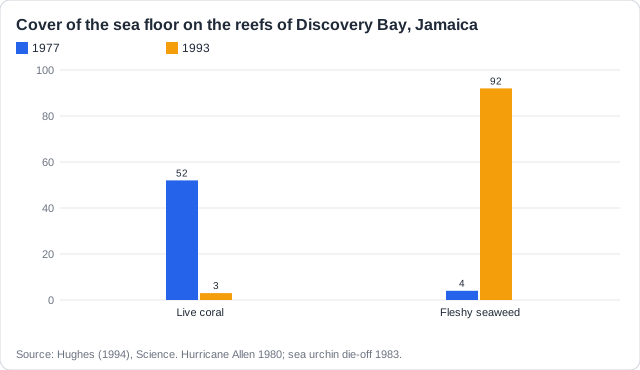
Real example: in Jamaica, Hurricane Allen broke up the corals in 1980, and in 1983 a disease killed almost all the sea urchins that grazed seaweed. Seaweed smothered the reefs, and young corals could no longer settle: the reef flipped to a stable seaweed state that has lasted for decades.
Stop wasting time on topics you know
Our AI identifies your weak areas and focuses your study time where it matters. No more overstudying easy topics.
How this comes up: No paper has tested this statement yet. The likely shapes are a Paper 2 Section B (b) [7] evaluation or a (c) [9] 'to what extent', where both sides and a conclusion are needed.
Ecology textbooks once taught that every succession ends in one climax community set by the climate, such as oak forest across lowland England.
Evaluate the idea that every succession ends in a single climax community.
Model answer plan
See the mark-by-mark plan — for / against / judgement, with marking guidance — in study mode.
Name a real case for each point: Knepp, the Flow Country, El Yunque, Jamaica: a named case turns a claim into evidence.