r- and K-strategists at Higher Level: An HL-only statement. Why are the first plants on bare ground weeds with thousands of seeds, while the last are oaks that take decades to fruit? The answer is how each species has its young.
Practise this as you read
- Distinguish r- and K-strategists by their offspring.
- Outline why r-strategists suit pioneer communities and K-strategists suit climax communities.
Free preview
This is the free notes preview
You're reading the free notes. Aimnova Pro unlocks the full study experience — and you can try it with your first topic free to keep:
- FlashcardsLock in vocabulary and key terms with spaced repetition.
- Practice questionsAnswer exam-style questions and get instant AI marking.
- Mock exams & past-paper vaultSit full mocks and see exactly how examiners award marks.
- Personalised study planA daily plan built around your exam date and weak areas.
Two ways to have young: Species can invest in many cheap offspring or in a few well-cared-for ones. The first is an r-strategist, the second a K-strategist.
The points to remember
- An r-strategist has very many offspring, gives them little or no care, and most die young.
- It breeds early, grows fast and is usually small and short-lived.
- A K-strategist has few offspring and cares for them, so each one is likely to survive.
- It breeds late, grows slowly and is usually large and long-lived.
- Most species sit between the two ends: it is a scale, not two boxes.
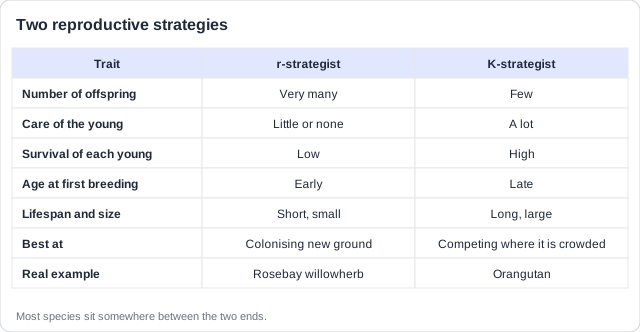
Real example: one plant of rosebay willowherb can release about 80,000 tiny seeds on the wind. A female orangutan in Borneo has her first baby at about 15 and then one baby every 7 to 8 years, carrying and feeding it for years.
Never wonder what to study next
Get a personalized daily plan based on your exam date, progress, and weak areas. We'll tell you exactly what to review each day.
A pioneer community grows on bare, open ground that nobody else is using yet. r-strategists are built for exactly this.
Why pioneers are r-strategists
- Many offspring (seeds, eggs): the population grows fast.
- They spread widely (seeds on the wind) and colonise new ground quickly.
- They mature quickly and breed early, so they establish before others arrive.
- They cope with harsh, low-nutrient ground and have less specialised needs.
- They use short-lived resources: bare, sunny ground that later plants will shade out.
Link the trait to the pioneer stage: 'r-strategists have a short life' gets no credit on its own. Say why the trait helps on bare ground: many seeds spread widely, so they colonise quickly.
Real example: after the bombing of London in 1940-41, rosebay willowherb covered the bomb sites within a year or two. Its wind-blown seeds reached every patch of rubble, and it grew fast on the bare, poor ground. Londoners called it 'bombweed'.
Remember it as: r for rapid: many seeds, fast spread, first to arrive.
A climax community is crowded: every patch of light and soil is taken. Here a few strong, well-fed offspring do better than thousands of weak ones.
Why climax species are K-strategists
- Few offspring, with much care or a big food store (a large seed), so survival is high.
- They are strong competitors for light, space and food in a crowded community.
- They live long and hold their place for decades or centuries.
- Conditions in a climax are stable, so a slow, careful strategy pays off.
- K-strategists make the community more stable: their populations change little.
Real example: Borneo's lowland rainforest is a climax community. Orangutans there raise one baby at a time and teach it for about 7 years where to find fruit. Few babies are born, but most survive.
K is for capacity: K is the symbol for carrying capacity. K-strategists live in populations held close to it, where competition is strong.
Stop wasting time on topics you know
Our AI identifies your weak areas and focuses your study time where it matters. No more overstudying easy topics.
As a succession goes on, the balance shifts: r-strategists give way to K-strategists.
From r to K
- Early in a succession, r-strategists arrive first: annual weeds and grasses.
- Each stage changes the conditions: more soil, more shade, more competition.
- Slow-growing K-strategists can now establish, and outcompete the r-strategists.
- By the climax the community is dominated by K-strategists: long-lived trees.
- r-strategists survive only where the ground is disturbed again: a fire, a flood, a gap.
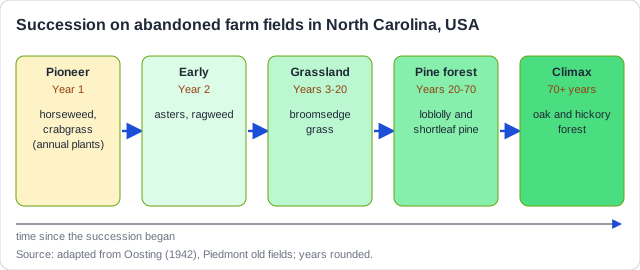
Real example: on abandoned cotton fields in North Carolina, USA, horseweed covers the ground in the first year. Pines move in after about 20 years. Oak and hickory seedlings, which grow in shade, slowly take over under the pines.
Paper 1 often gives a fact file about a species and asks you to pick out the feature that shows it is an r-strategist. Look for numbers about breeding.
Features that show an r-strategist
- Many eggs or seeds at one time (thousands).
- Breeds often: several times a year.
- Young grow fast and mature early (within a year).
- Little or no care for the young.
- Many invasive species are r-strategists: that is how they spread so fast.
Real example: the harlequin ladybird reached Britain in 2004. A female can lay over 1,000 eggs in her life, and two generations can grow in one year. It spread across most of England within about five years.
Quote the fact file: Copy the number: 'lays over 1,000 eggs' scores; 'it is invasive' or 'it eats aphids' shows nothing about how it reproduces.
See how examiners mark answers
Answer exam-style questions with model answers. Learn exactly what earns marks and what doesn't.
How this comes up: Two shapes: a Paper 1 fact file ('identify a feature showing the species is r-selected' [1]) and a Paper 2 succession strip ('outline two reasons why the pioneer species are likely to be r-strategists' [2]).
Abandoned farm fields in North Carolina are colonised first by horseweed and crabgrass, and after about 70 years become oak and hickory forest (see the strip in section 4).
Outline two reasons why the species in the first stage are more likely to be r-strategists than K-strategists.
Model answer plan
See the mark-by-mark plan — for / against / judgement, with marking guidance — in study mode.
One reason per line: Write each reason on its own line: the trait, then why it helps a pioneer.