Entropy in ecosystems at Higher Level: An HL-only statement that takes the second law (2.2.8) one step further: what happens to biomass itself as it passes through an ecosystem, and how living things stay organised in a world where disorder always grows.
Practise this as you read
- Outline how entropy increases as biomass passes along a food chain.
- Explain how organisms keep a low entropy without breaking the second law.
Free preview
This is the free notes preview
You're reading the free notes. Aimnova Pro unlocks the full study experience — and you can try it with your first topic free to keep:
- FlashcardsLock in vocabulary and key terms with spaced repetition.
- Practice questionsAnswer exam-style questions and get instant AI marking.
- Mock exams & past-paper vaultSit full mocks and see exactly how examiners award marks.
- Personalised study planA daily plan built around your exam date and weak areas.
From order to disorder: Entropy rises as biomass passes through an ecosystem. The ordered molecules of living things are broken down, step by step, into simple molecules and heat.
The points to remember
- Entropy is the amount of disorder in a system.
- Biomass is highly organised: large, complex molecules built into cells and tissues, so low entropy.
- At every trophic level, respiration breaks food molecules into simple carbon dioxide and water.
- It also releases heat, which spreads out into the surroundings.
- Simple molecules and spread-out heat are disordered: high entropy.
- So as biomass passes through an ecosystem, the entropy of the system increases (the second law, 2.2.8).
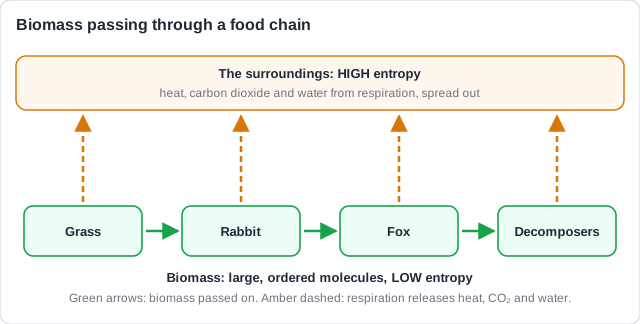
Remember it as: Big, ordered molecules in; small molecules and heat out.
Example: a rabbit eats grass rich in large starch and protein molecules. Most of it is respired to carbon dioxide, water and heat; only a little is rebuilt into the rabbit's own ordered body.
Study smarter, not longer
Most students waste 40% of study time on topics they already know. Our AI tracks your progress and optimizes every minute.
If entropy always increases, how do living things stay so organised? The answer: the second law is about the total entropy, not the entropy of each part.
How living things stay organised
- Living things keep a high degree of organisation and low entropy inside them.
- To build and repair that order they need a constant input of energy: sunlight or food.
- They pay for it through cellular respiration, which releases heat, carbon dioxide and water.
- This raises the entropy of the surroundings by more than the organism lowers its own.
- So there is a net increase in entropy: life does not break the second law.
Inside the organism
- Ordered cells and tissues
- Low entropy, kept by energy input
In the surroundings
- Heat, carbon dioxide and water
- Entropy rises by more
Real example: a person at rest gives off about 100 joules of heat every second, about as much as an old-style light bulb. That heat, from respiration, is the price the body pays to stay organised.
Say 'net increase': Do not write that organisms break or escape the second law. Write that they keep a low entropy inside through a net increase in entropy, largely from cellular respiration.
Decomposers are the last step: they break down what every other level left behind.
Death and decay
- When an organism dies, its energy input stops, so it can no longer keep itself organised.
- Decomposers respire its biomass, turning it into carbon dioxide, water and heat.
- The dead matter falls apart: its entropy increases until almost nothing ordered is left.
- The whole ecosystem stays organised only while sunlight, a low-entropy input, keeps arriving.
Remember it as: Stay organised inside by spreading disorder outside.
Real example: in a garden compost heap, bacteria and fungi respire the waste so fast that the middle heats up to 60-70 °C. In the Białowieża Forest in Poland, fallen trees are left to rot, and over decades fungi and beetles turn them into carbon dioxide, water, heat and soil.
Link it to open systems: An ecosystem is an open system (1.2.5): low-entropy sunlight comes in, and heat leaves. Without the sunlight, entropy would win and the ecosystem would fall apart.
Practice with real exam questions
Answer exam-style questions and get AI feedback that shows you exactly what examiners want to see in a full-marks response.
How this comes up: Paper 2, Section B (a): outline how entropy increases as biomass passes through an ecosystem [4]. Section A: explain a change, such as decay or weight loss, in terms of entropy [2-3].
In a coastal meadow in Wales, grass is eaten by field voles, which are eaten by barn owls, and dead material is broken down by fungi.
Outline how the second law of thermodynamics explains the increase in entropy as biomass passes through this ecosystem.
Model answer plan
See the mark-by-mark plan — for / against / judgement, with marking guidance — in study mode.