Biogeochemical cycles at Higher Level: The same ideas as SL, with different examples: the Space Station's water, salmon feeding forests, the Gulf of Mexico and the Amazon's rain. At HL the nitrogen cycle gets its own pages (2.3.17 onwards).
Practise this as you read
- Link each human impact to the cycle it breaks.
- Judge how far the idea of a cycle explains sustainability.
Free preview
This is the free notes preview
You're reading the free notes. Aimnova Pro unlocks the full study experience — and you can try it with your first topic free to keep:
- FlashcardsLock in vocabulary and key terms with spaced repetition.
- Practice questionsAnswer exam-style questions and get instant AI marking.
- Mock exams & past-paper vaultSit full mocks and see exactly how examiners award marks.
- Personalised study planA daily plan built around your exam date and weak areas.
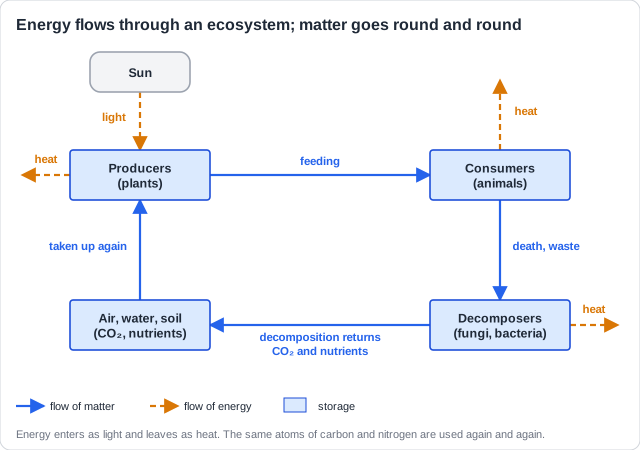
Energy passes through; matter goes round: Every ecosystem needs energy flowing through it and matter used again and again. A biogeochemical cycle is how an element keeps coming back for new life.
The points to remember
- Energy flows one way: in as sunlight, out as heat lost in respiration.
- Matter cycles: the same atoms of carbon and nitrogen are used again and again.
- Earth gains almost no new matter, so elements must be recycled to stay available.
- Living things need elements such as carbon, nitrogen and phosphorus to build their bodies.
- Energy is lost at every feeding level, so food chains rarely have more than 4 or 5 levels.
Remember it as: Energy passes through; matter goes round.
Real example: the International Space Station gets its energy from solar panels, but new water must be flown up from Earth. Since 2023 it has recycled about 98% of its water, including the crew's sweat and urine, so the same water goes round again and again.
Say which one cycles: Energy never cycles: it is lost as heat. Only matter goes round. (Open and closed systems: see 1.2.5.)
See how examiners mark answers
Answer exam-style questions with model answers. Learn exactly what earns marks and what doesn't.
Each element has its own cycle, with stores and flows linking them.
The points to remember
- A cycle moves an element between living (biotic) and non-living (abiotic) parts.
- Producers take elements in from air, water and soil: carbon dioxide, nitrates, phosphates.
- Elements pass along food chains when one organism eats another.
- Decomposers break down dead matter and waste and return the elements to soil, water and air.
- Without this recycling, elements would stay locked in dead matter and run out for new life.
| Cycle | Main stores | Key flows |
|---|---|---|
| Carbon | Air, living things, soil, oceans, fossil fuels | Photosynthesis, respiration, decomposition |
| Nitrogen | Air (nitrogen gas), soil, living things | Nitrogen fixation, nitrification, denitrification |
| Water | Oceans, ice, groundwater, air | Evaporation, condensation, precipitation |
| Phosphorus | Rocks, soil, living things | Weathering, uptake by plants, decomposition |
Remember it as: Taken in, passed on, broken down, taken in again.
Real example: Pacific salmon grow up in the ocean and return to rivers in British Columbia, Canada, to spawn and die. Bears drag the bodies into the forest, where they rot. Up to about a quarter of the nitrogen in trees beside these rivers came from the sea in salmon.
The next pages: Stores, sinks and sources are on 2.3.2. Whether a flow is a transfer or a transformation is on 2.3.4 (and 1.2.4).
Natural cycles are roughly in balance: as much of an element enters each store as leaves it. People change the size of the flows, and the balance breaks.
The points to remember
- People speed up some flows: burning fossil fuels, clearing forests, spreading fertiliser.
- Stores then fill or empty faster than natural flows can balance them.
- More carbon in the air leads to global warming and ocean acidification.
- Extra nitrogen and phosphorus in water lead to eutrophication: algae blooms and dead zones.
- Clearing plants and soil breaks the loop, so land loses its nutrients and fertility.
- A system whose cycles are broken cannot keep itself going: it is not sustainable.
Remember it as: Speed up a flow, fill a store, break the balance.
Real example: fertiliser from farms across the Mississippi basin washes into the Gulf of Mexico. Every summer it feeds huge algae blooms, and their decay uses up the oxygen, leaving a dead zone of about 15 000 km² where fish cannot live.
Link it to sustainability: Saying 'humans burn fossil fuels' is not enough. Say what it does to the cycle (a store fills too fast) and why that makes the ecosystem less sustainable.
Study smarter, not longer
Most students waste 40% of study time on topics they already know. Our AI tracks your progress and optimizes every minute.
A cycle is also a way of thinking: a model you can use to judge whether any system, natural or human, can last.
The points to remember
- In a cycle, what flows out of a store comes back as an input: nothing is wasted.
- So stores stay steady over long periods: the root of sustainability.
- It fits natural systems: carbon, nitrogen and water cycles, ocean currents, air circulation, rocks.
- It fits human systems too: recycling and the circular economy copy nature's loops.
- It shows where a loop is broken: a one-way flow from a store to waste cannot last.
- Limit: some loops take millions of years (fossil fuels, rocks), so for people they are one-way.
- Limit: energy does not cycle, and a simple model hides detail.
Why the idea is useful
- Shows that outputs return as inputs, so stores stay steady
- Works for many systems, natural and human
- Points to the broken loop that needs fixing
Its limits
- Some loops take millions of years
- Energy flows, it does not cycle
- A simple model hides detail and is hard to measure
Real example: the Amazon makes much of its own rain. Trees return water to the air by transpiration, and winds carry it inland as 'flying rivers'; up to half the rain may be recycled this way. Clearing the forest breaks the loop, and the region dries out.
Weigh it up: In a 'justify' or 'to what extent' answer, give the strengths with named systems, then the limits, then a clear judgement.
How this comes up: Paper 2, Section B (c): justify how useful the idea of a cycle is for understanding sustainability [9].
Farmland, oceans and space stations all depend on matter being used again and again.
With reference to named systems, justify the view that a system is sustainable only if its cycles of matter stay unbroken.
Model answer plan
See the mark-by-mark plan — for / against / judgement, with marking guidance — in study mode.