Secondary productivity at Higher Level: An HL-only statement: the consumers' side of 2.2.13. How much of what an animal eats becomes animal, how to measure it with food and faeces, and how to follow a wild population's growth over a year.
Practise this as you read
- Calculate GSP and NSP, formula first, with units.
- Outline a laboratory method for GSP, step by step.
Free preview
This is the free notes preview
You're reading the free notes. Aimnova Pro unlocks the full study experience — and you can try it with your first topic free to keep:
- FlashcardsLock in vocabulary and key terms with spaced repetition.
- Practice questionsAnswer exam-style questions and get instant AI marking.
- Mock exams & past-paper vaultSit full mocks and see exactly how examiners award marks.
- Personalised study planA daily plan built around your exam date and weak areas.
What consumers keep: Consumers ingest food, but they keep only the part they absorb and assimilate. The rest leaves as faeces.
The points to remember
- Secondary productivity is the gain in biomass by consumers.
- They build it from carbon compounds absorbed and assimilated from the food they ingest (eat).
- Food that passes straight through the gut leaves as faeces: never absorbed, so not counted.
- Secondary productivity = food eaten - faecal loss.
- Units are the same as primary productivity: e.g. kg m⁻² yr⁻¹ or kJ m⁻² yr⁻¹.
Remember it as: Eaten minus faeces: that is what the consumer gained.
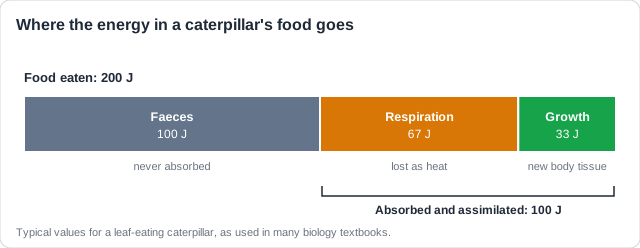
Example: a leaf-eating caterpillar passes about half of the energy in its leaves straight out as faeces. Plant food is hard to digest, so herbivores lose far more in faeces than meat-eaters do.
See how examiners mark answers
Access past paper questions with model answers. Learn exactly what earns marks and what doesn't.
2.2.13 showed gross and net productivity for any organism. For consumers, HL uses these two formulas.
GSP, R and NSP
- GSP (gross secondary productivity) = food eaten - faecal loss.
- Consumers then use much of it in respiration (R), lost as heat.
- NSP (net secondary productivity) = GSP - R: the new body tissue.
- Consumers move about and keep warm, so their R is large and NSP is small.
- Write each formula first, then the numbers, then the units.
The formulas: GSP = food eaten - faecal loss
NSP = GSP - R
Worked with the caterpillar in the figure above:
Worked example: GSP = food eaten - faecal loss = 200 - 100 = 100 J.
NSP = GSP - R = 100 - 67 = 33 J.
For a whole population, the same sums are done per m² per year, e.g. in kJ m⁻² yr⁻¹.
So only a sixth of the energy the caterpillar ate became new caterpillar.
Do not weigh the animals for GSP: Weighing the animals shows their growth, which is net productivity. GSP comes from the food and the faeces only.
Gross secondary productivity is measured in the laboratory by weighing what goes in and what comes out. Masses are dry masses (2.2.16), because the water in food and faeces varies.
Measuring GSP in the laboratory
- Find the dry mass of food given to the animals at the start.
- After a set number of days, collect and dry the food left; food eaten = given - left.
- Collect and dry all the faeces made over the same days.
- GSP = food eaten - faeces.
- Divide by the number of days (and animals) for a rate per day.
Food in
Dry mass of food given.
Food left
Dry mass left after the set days.
Faeces
Dry mass of faeces over the same days.
GSP
(Given - left) - faeces, divided by the days.
Example: to find the GSP of zebras in a zoo, keepers can weigh the hay each zebra eats and collect and weigh its dung: GSP = food eaten - faecal loss.
Study smarter, not longer
Most students waste 40% of study time on topics they already know. Our AI tracks your progress and optimizes every minute.
Net secondary productivity is the growth of the consumers. For a wild population, measure how much the whole population's biomass changes over a year, per m².
Measuring NSP of a wild population
- Estimate the population size with mark-release-recapture and the Lincoln index (2.1.17).
- Weigh a sample of animals; dry a few to convert wet mass to dry mass.
- Mean dry mass × population size = total biomass.
- Repeat a year later; the change in total biomass is the NSP of the population.
- Measure the area it lives in and divide: kg m⁻² yr⁻¹.
Another route: In the laboratory, NSP = GSP - R: find GSP from food and faeces, then R from the carbon dioxide the animals give off.
Example: for ground beetles in a woodland, pitfall traps and the Lincoln index give the numbers each summer; a dried sample gives the mean dry mass; the change over the year, divided by the wood's area, gives kg m⁻² yr⁻¹.
How this comes up: State how GSP could be found [1]; outline a laboratory method for GSP [4]; the procedures to estimate the net productivity of a wild population [7].
A school keeps a tank of pond snails that feed on lettuce.
Outline the procedures in a laboratory-based method to find the gross secondary productivity of the pond snails in terms of biomass per day.
Model answer plan
See the mark-by-mark plan — for / against / judgement, with marking guidance — in study mode.