Primary productivity at Higher Level: An HL-only statement. It takes 2.2.13's gross and net productivity to the producers: how fast they build biomass, what controls the rate, and how ecologists measure it in a lake and in a meadow.
Practise this as you read
- Calculate NPP = GPP - R, formula first, with units.
- Evaluate a method for measuring primary productivity.
Free preview
This is the free notes preview
You're reading the free notes. Aimnova Pro unlocks the full study experience — and you can try it with your first topic free to keep:
- FlashcardsLock in vocabulary and key terms with spaced repetition.
- Practice questionsAnswer exam-style questions and get instant AI marking.
- Mock exams & past-paper vaultSit full mocks and see exactly how examiners award marks.
- Personalised study planA daily plan built around your exam date and weak areas.
How fast producers grow: Primary productivity measures how fast an ecosystem's producers turn energy and simple chemicals into new living material.
The points to remember
- Primary productivity is the rate at which producers make new biomass.
- They use an external energy source: light, or chemical energy (2.2.22).
- They build it from inorganic carbon (carbon dioxide) and other elements such as nitrogen and phosphorus.
- Units: kg of carbon per m² per year (kg C m⁻² yr⁻¹); also g dry mass or kJ per m² per year.
- It is a rate, per area and per time; biomass is a store at one moment.
Remember it as: Productivity is a speed, not a size.
Real example: giant kelp off California can grow about half a metre in a day, one of the highest rates of primary productivity on Earth.
A rate needs a time: '2 kg per m²' is a biomass. '2 kg per m² per year' is a productivity. Always give both the area and the time.
Feeling unprepared for exams?
Get a clear study plan, practice with real questions, and know exactly where you stand before exam day. No more guessing.
2.2.13 showed that any organism has a gross and a net productivity. For producers, HL uses these names and this formula.
GPP, R and NPP
- GPP (gross primary productivity): the total rate producers make biomass.
- Producers use part of it at once in their own respiration (R), lost as heat.
- NPP (net primary productivity): what is left as new plant biomass.
- Write the formula first: NPP = GPP - R.
- Keep the units the same for all three, and give them in the answer.
The formula: NPP = GPP - R
Warm, busy producers respire a lot, so a high GPP does not always mean a high NPP.
Worked example: Field studies of Amazon rainforest give, in round numbers, GPP = 3.3 kg C m⁻² yr⁻¹ and R = 2.2 kg C m⁻² yr⁻¹.
NPP = GPP - R = 3.3 - 2.2 = 1.1 kg C m⁻² yr⁻¹.
So the trees use two thirds of what they make just to stay alive.
The same sum works in dry mass: a rainforest plot with GPP = 9,400 g dry mass m⁻² yr⁻¹ and R = 6,100 has NPP = 9,400 - 6,100 = 3,300 g dry mass m⁻² yr⁻¹, the biomass left for herbivores and decomposers.
Respiration is a loss: NPP = GPP - R, never GPP + R. And always write the units: mass or energy, per m², per year.
Photosynthesis needs light, warmth, water, carbon dioxide and nutrients. Whichever is in shortest supply sets the rate, so these abiotic factors control productivity.
Abiotic factors that change NPP
- Light: sunlight, day length, cloud; in water, depth and turbidity (cloudiness).
- Temperature: photosynthesis is fastest when it is warm, slow in the cold.
- Water on land, and nutrients (nitrate, phosphate) everywhere.
- In the sea: currents and upwellings bring nutrients up; salinity, pH and CO₂ matter too.
- Pressure / buoyancy: plankton must stay afloat in the sunlit layer.
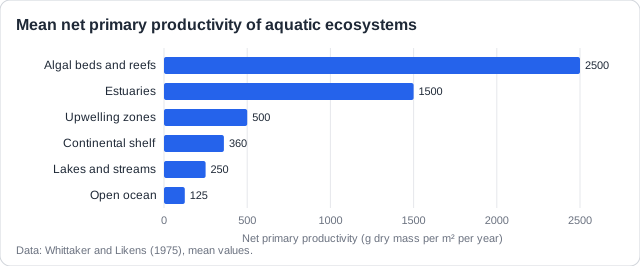
Real example: off Peru, cold upwellings feed so much phytoplankton that the anchoveta fishery there is one of the largest in the world. Estuaries are productive too: rivers bring nutrients and the water is shallow enough for light.
State a factor, then link it: In a 'state' question the factor alone is enough: 'temperature', 'nutrient availability'. In an 'explain' question, link it to the rate of photosynthesis.
Memorize terms 3x faster
Smart flashcards show you cards right before you forget them. Perfect for definitions and key concepts.
In the laboratory, a photosynthesising sample (such as pondweed) can be kept in water and the oxygen it gives off measured. In a lake, the same idea is used with bottles of lake water.
The light and dark bottle method
- Fill three bottles with lake water; measure dissolved oxygen in one at the start.
- Hang a clear (light) and a foil-covered (dark) bottle in the lake for a set time, e.g. 24 hours.
- Light bottle: photosynthesis minus respiration, so its oxygen gain = NPP.
- Dark bottle: respiration only, so its oxygen loss = R.
- GPP = NPP + R: the light bottle's gain plus the dark bottle's loss.
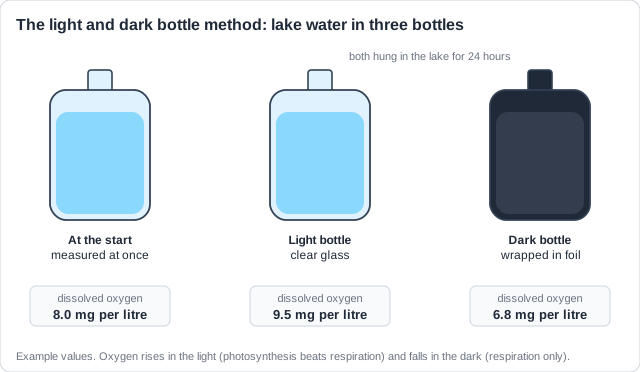
Worked example: NPP = light bottle end - start = 9.5 - 8.0 = 1.5 mg O₂ per litre per day.
R = start - dark bottle end = 8.0 - 6.8 = 1.2 mg O₂ per litre per day.
GPP = NPP + R = 1.5 + 1.2 = 2.7 mg O₂ per litre per day.
Example: students on a field course at Windermere, England's largest lake, can hang the bottles at 1 m depth from a jetty and compare them with bottles hung deeper down.
On land, the guide's method is to measure the change in biomass of the plants over time, for example in a grassland.
The harvest method
- Mark out three plots; cover one with opaque plastic so it cannot photosynthesise.
- Cut, dry (2.2.16) and weigh a sample at the start to get the dry biomass per m².
- Repeat at the end of a set time, e.g. four weeks.
- Open plot: its gain in dry biomass = NPP. Covered plot: its loss = R.
- GPP = NPP + R, per m² per unit time.
Start
Cut, dry and weigh samples from the plots.
Wait
Leave the plots for a set time, one covered.
End
Cut, dry and weigh again.
Calculate
Gain = NPP; loss under cover = R; GPP = NPP + R.
Real example: in the Park Grass Experiment at Rothamsted, England, the hay from each plot has been cut and weighed every year since 1856, the longest record of grassland productivity in the world.
Know your predicted grade
Take timed mock exams and get detailed feedback on every answer. See exactly where you're losing marks.
An 'evaluate' question wants the strengths and the limits of the method itself.
Strengths and limits
- Bottles, strengths: simple and cheap; ethical, as the water can be returned.
- Bottles, limits: zooplankton in the water also respire; only the submerged part is measured.
- Plots, strengths: easy to isolate the producers; works in any grassland.
- Plots, limits: plants are killed; roots are hard to collect; impossible for trees.
- Both: results depend on temperature and on how precise the instruments are.
Remember it as: Bottles: easy and kind, but mixed-up water. Plots: clear producers, but killing and no trees.
Example: in a tropical rainforest the harvest method fails, because the trees are too big to cut and weigh; scientists there measure tree growth and carbon dioxide exchange instead.
What does not count: 'The samples were too small' or 'the scales were inaccurate' are mistakes in doing it, not limits of the method. Name a real ecosystem, and write about productivity, not biodiversity.
How this comes up: Paper 2, Section A: state abiotic factors that influence NPP [2]. Section B (b): evaluate one method for measuring primary productivity in a named ecosystem [7].
Windermere is a large lake in the Lake District, England. Ecologists want to know how productive its phytoplankton are.
Evaluate one method for measuring primary productivity in a named ecosystem.
Model answer plan
See the mark-by-mark plan — for / against / judgement, with marking guidance — in study mode.