Photo- and chemoautotrophs at Higher Level: An HL-only statement. Most food webs start with light, but some start with chemicals. You will meet deep-sea vents, a cave sealed for millions of years, and the bacteria that feed them.
Practise this as you read
- Distinguish the two energy sources, naming each process.
- Explain why chemoautotrophs are the main producers where there is no light.
Free preview
This is the free notes preview
You're reading the free notes. Aimnova Pro unlocks the full study experience — and you can try it with your first topic free to keep:
- FlashcardsLock in vocabulary and key terms with spaced repetition.
- Practice questionsAnswer exam-style questions and get instant AI marking.
- Mock exams & past-paper vaultSit full mocks and see exactly how examiners award marks.
- Personalised study planA daily plan built around your exam date and weak areas.
Same job, different power supply: Every producer is an autotroph (2.2.21). What differs is where it gets the energy to do it: light, or a chemical reaction.
The points to remember
- All producers are autotrophs: they make carbon compounds from carbon dioxide.
- They differ in their external energy source.
- Photoautotrophs use light energy in photosynthesis: plants, algae, phytoplankton.
- Chemoautotrophs use energy from exothermic inorganic chemical reactions in chemosynthesis.
- Chemoautotrophs are bacteria (and similar microbes); they need no sunlight.
Remember it as: Photo = light. Chemo = chemicals.
Photoautotrophs
- Energy: light
- Process: photosynthesis
- Examples: plants, algae, phytoplankton
- Where: anywhere with light
Chemoautotrophs
- Energy: chemical reactions
- Process: chemosynthesis
- Examples: sulfur and nitrifying bacteria
- Where: often dark places
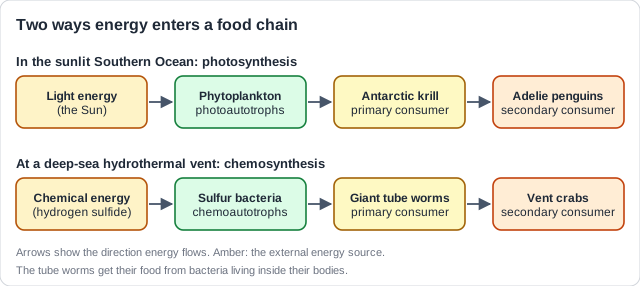
Real example: in the Southern Ocean, phytoplankton photosynthesise in the sunlit surface water and feed Antarctic krill, which feed Adelie penguins.
Practice with real exam questions
Answer exam-style questions and get AI feedback that shows you exactly what examiners want to see in a full-marks response.
Chemosynthesis runs on exothermic reactions between inorganic chemicals. The bacteria oxidise such a chemical and trap the energy released.
How chemosynthesis works
- The bacteria oxidise an inorganic chemical, such as hydrogen sulfide, ammonia, iron or methane.
- The reaction is exothermic: it releases energy.
- That energy is used to turn carbon dioxide into sugars: new biomass.
- So the chemical, not the Sun, is the energy source at the base of the food chain.
In words: carbon dioxide + hydrogen sulfide + oxygen → sugar + sulfur + water
Photosynthesis (2.2.4) uses the same carbon dioxide to make sugar; only the energy source is different.
Say 'chemical energy', not 'heat': Vent bacteria do not use the heat of the vent. They use the energy released by chemical reactions, such as oxidising hydrogen sulfide.
Real example: at deep-sea vents, bacteria oxidise the hydrogen sulfide in the vent water. In soil, nitrifying bacteria oxidise ammonia in the same way.
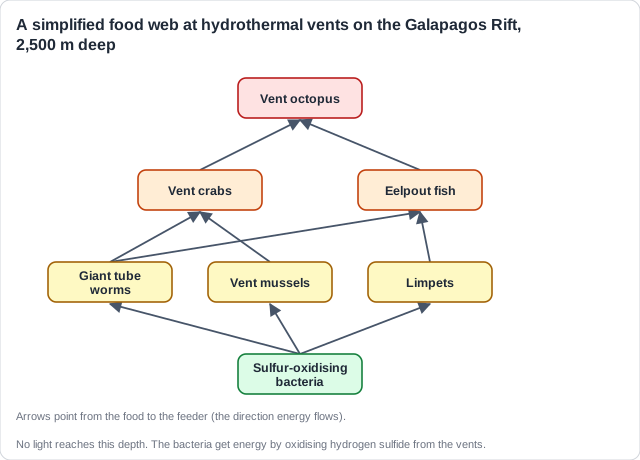
In 1977 the submarine Alvin found animals crowded around a hydrothermal vent on the Galapagos Rift, 2,500 m down, where no sunlight ever reaches. Their food web runs on chemosynthesis.
The points to remember
- No light reaches the deep sea floor, so photosynthesis is impossible there.
- Vent water is rich in hydrogen sulfide; bacteria oxidise it for energy.
- These chemoautotrophs are the producers: the principal source of energy for the food web.
- Tube worms, mussels and limpets feed on the bacteria; crabs, fish and octopus feed on them.
- Stop the vent and the whole food web starves.
Remember it as: No light, no plants: the bacteria are the base.
Real example: giant tube worms have no mouth or gut. Chemosynthetic bacteria live inside their bodies and feed them, a symbiosis.
Feeling unprepared for exams?
Get a clear study plan, practice with real questions, and know exactly where you stand before exam day. No more guessing.
Vents are not the only place. Chemoautotrophs are found wherever the right chemicals are, but they matter most where light is missing.
The points to remember
- Chemoautotrophs live in many ecosystems: sea floor, caves, hot springs, soil.
- Where there is little or no light, they are the main producers.
- Where there is light, photoautotrophs supply almost all the energy.
- In soil, nitrifying bacteria are chemoautotrophs too, but plants still feed the food web.
| Ecosystem | Light? | Main energy source for the food web |
|---|---|---|
| Deep-sea vent or cold seep | None | Chemoautotrophs |
| Sealed cave | None | Chemoautotrophs |
| Sunlit ocean surface | Plenty | Photoautotrophs (phytoplankton) |
| Meadow soil | Above ground | Photoautotrophs (plants) |
Real example: Movile Cave in Romania was sealed off for about 5.5 million years. Bacteria oxidise hydrogen sulfide and methane there, and they feed spiders, centipedes and a water scorpion found nowhere else. On the floor of the Gulf of Mexico, cold seeps support mussels in the same way.
Link the ecosystem to the light: Say why chemoautotrophs dominate: no light, so no photosynthesis, so chemical energy is the only supply.
How this comes up: Paper 2, Section A: a food web from a place with no light. Distinguish between the energy sources of its producers and those of a sunlit ecosystem [2].
Figure 1 shows a simplified food web at hydrothermal vents on the Galapagos Rift, 2,500 m below the surface.
Distinguish between the way the producers in Figure 1 obtain energy and the way phytoplankton in the sunlit surface ocean obtain energy.
Model answer plan
See the mark-by-mark plan — for / against / judgement, with marking guidance — in study mode.