Autotrophs and heterotrophs at Higher Level: The same ideas as SL, with different examples: phytoplankton, krill and blue whales in the Southern Ocean, and dodder, a plant that feeds on other plants. At HL, expect to trace carbon from carbon dioxide into a consumer.
Practise this as you read
- Classify any organism by where its carbon compounds come from.
- Trace carbon from CO2 through an autotroph to heterotrophs.
Free preview
This is the free notes preview
You're reading the free notes. Aimnova Pro unlocks the full study experience — and you can try it with your first topic free to keep:
- FlashcardsLock in vocabulary and key terms with spaced repetition.
- Practice questionsAnswer exam-style questions and get instant AI marking.
- Mock exams & past-paper vaultSit full mocks and see exactly how examiners award marks.
- Personalised study planA daily plan built around your exam date and weak areas.
Self-feeders: An autotroph builds its own food. It takes simple inorganic substances and turns them into the carbon compounds that make up its body.
The points to remember
- An autotroph makes its own carbon compounds: sugars, starch, cellulose, proteins and fats.
- It builds them from inorganic carbon: carbon dioxide from the air or dissolved in water.
- It also takes in other elements as simple ions from soil or water, such as nitrate and phosphate.
- It needs an external energy source: for plants and algae this is light, used in photosynthesis.
- Autotrophs are the producers: plants, algae, phytoplankton and some bacteria.
Remember it as: Auto = self: it makes its own.
Real example: tiny phytoplankton carry out about half of all the photosynthesis on Earth, making carbon compounds from carbon dioxide dissolved in seawater.
Stop wasting time on topics you know
Our AI identifies your weak areas and focuses your study time where it matters. No more overstudying easy topics.
A heterotroph cannot build carbon compounds from carbon dioxide. It has to take them, ready-made, from other organisms, by eating them or by absorbing them.
The points to remember
- A heterotroph cannot make carbon compounds from inorganic carbon.
- It obtains carbon compounds from other organisms, living or dead.
- Consumers eat them: herbivores eat producers, carnivores eat other animals.
- Decomposers, such as fungi and many bacteria, absorb them from dead matter.
- It digests what it takes in and builds its own compounds from the pieces.
- All animals and fungi, and most bacteria, are heterotrophs.
Remember it as: Hetero = other: it takes from others.
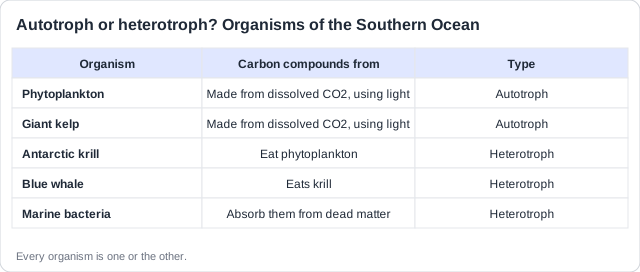
Real example: in the Southern Ocean, Antarctic krill eat phytoplankton, and a blue whale eats several tonnes of krill a day in the feeding season.
All living organisms can be sorted into these two groups. One question decides it: where do its carbon compounds come from?
The points to remember
- Every living organism is either an autotroph or a heterotroph.
- The test: are its carbon compounds made from CO2, or taken from another organism?
- Fungi are not plants: they absorb carbon compounds, so they are heterotrophs.
- A plant that catches insects, such as the Venus flytrap, is still an autotroph: insects give it nitrogen, not carbon.
- A plant with almost no green pigment that feeds on another plant, such as dodder, is a heterotroph.
Two common mix-ups: 'Fungi are plants' is wrong: fungi are heterotrophs.
Autotroph does not mean 'green' or 'plant' alone: say it makes carbon compounds from inorganic carbon.
Real example: dodder wraps around other plants and pushes feeding tubes into their stems to take their sugars: a plant that is a heterotroph.
See how examiners mark answers
Access past paper questions with model answers. Learn exactly what earns marks and what doesn't.
How this comes up: Paper 2, Section A: trace carbon from an inorganic source to a consumer [3].
In the Southern Ocean, phytoplankton are eaten by krill, and krill are eaten by blue whales.
Explain how carbon from carbon dioxide dissolved in seawater becomes part of a blue whale.
Model answer plan
See the mark-by-mark plan — for / against / judgement, with marking guidance — in study mode.