Human impacts on energy and matter at Higher Level: The same ideas as SL, with different examples: Australia's Black Summer fires, Borneo's oil palm, Singapore and Brazil's Cerrado. At HL, expect to weigh a possible gain against the losses, and to link each activity to productivity.
Practise this as you read
- Balance the one gain (more CO2) against the losses.
- Link each activity to energy in, matter stored and food webs.
Free preview
This is the free notes preview
You're reading the free notes. Aimnova Pro unlocks the full study experience — and you can try it with your first topic free to keep:
- FlashcardsLock in vocabulary and key terms with spaced repetition.
- Practice questionsAnswer exam-style questions and get instant AI marking.
- Mock exams & past-paper vaultSit full mocks and see exactly how examiners award marks.
- Personalised study planA daily plan built around your exam date and weak areas.
People change what flows through nature: Burning fossil fuels, deforestation, urbanization and agriculture all change how energy flows through ecosystems and how matter is transferred and stored in them.
The points to remember
- Energy enters an ecosystem through photosynthesis and flows along food chains.
- Matter (carbon, nutrients) is stored in biomass and soil, and recycled by decomposers.
- Human activities cut the capacity for photosynthesis, so less energy enters.
- They cause loss of ecosystem biomass, the store of carbon and nutrients.
- They disrupt food webs by removing producers, prey or predators.
- They move matter out (harvests, logging, runoff) or in (fertilisers, pollutants, CO2).
Remember it as: Less green, less energy in; less biomass, less matter kept.
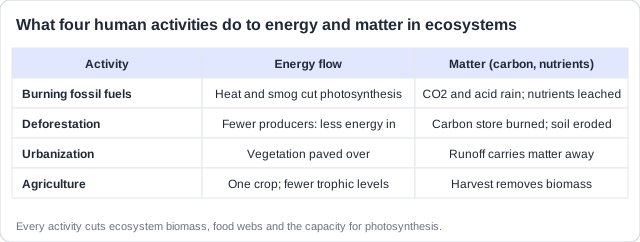
Real example: humans now use or remove about a quarter of all the net primary productivity on land, through farming, forestry and building.
Know your predicted grade
Take timed mock exams and get detailed feedback on every answer. See exactly where you're losing marks.
Burning coal, oil and gas releases CO2 and other gases. Plants need CO2, so this sounds helpful, but the other pollutants and global warming reduce primary productivity overall.
The points to remember
- More CO2 can raise photosynthesis a little: the one possible gain.
- But CO2 causes global warming: droughts, fires, floods and heat that damages plant enzymes.
- Warming also changes rainfall and can dry land out: desertification.
- Sulfur dioxide and nitrogen oxides cause acid rain: soil pH falls, nutrients are leached out, toxic metals are released.
- Nitrogen oxides and hydrocarbons form photochemical smog and ground-level (tropospheric) ozone, which damage leaves and their pores.
- Nitrogen oxides also thin the ozone layer: more UV damages plants.
- Less primary productivity means less secondary productivity; warming and acid seas also harm marine food webs.
Remember it as: A little more CO2 to eat, a lot more heat, drought and acid.
May raise productivity
- More CO2 for photosynthesis
- Warmer, longer growing seasons in cold places
Reduces productivity
- Drought, fire, floods, extreme heat
- Acid rain and leached soils
- Smog, ground-level ozone, more UV
Real example: after record heat and drought, Australia's 2019-2020 'Black Summer' fires burned more than 18 million hectares, destroying producers across whole landscapes.
Do not stop at 'more CO2 helps plants': Give the possible gain, then explain why the other effects of burning fossil fuels reduce productivity overall.
Deforestation removes the producers that capture energy and hold the ecosystem's matter.
The points to remember
- Fewer producers: less photosynthesis, so less energy enters the ecosystem.
- The biomass that stored carbon and nutrients is removed; burning or rotting releases CO2.
- Food webs break: the animals that fed and sheltered on the trees lose their food and habitat.
- Bare soil is eroded and nutrients are leached by rain, so less matter is recycled.
- Less transpiration disrupts the water cycle, so the area can become drier.
Remember it as: Deforestation cuts both: energy in AND matter stored.
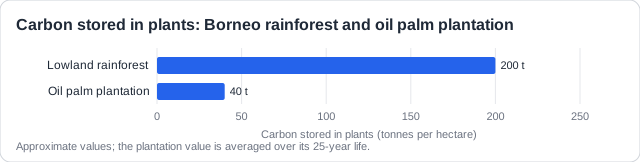
Real example: Borneo lost about 30% of its forest between 1973 and 2010, much of it replaced by oil palm plantations.
Get feedback like a real examiner
Submit your answers and get instant feedback — what you did well, what's missing, and exactly what to write to score full marks.
Urbanization replaces living ecosystems with buildings, roads and car parks.
The points to remember
- Vegetation is paved over: fewer producers, less photosynthesis, biomass lost.
- Habitats are fragmented by roads and buildings, so food webs are broken up.
- Rain runs off hard surfaces into drains, carrying soil, nutrients and pollutants away.
- Cities import food and energy from far away and export waste and pollution.
- They raise energy demand, so more fossil fuels are burned.
Remember it as: Concrete does not photosynthesise.
Real example: Singapore has cleared about 95% of its original rainforest since 1819; the rest survives in a few small reserves between the city's buildings.
Farms are ecosystems too, but managed ones: people choose one crop, remove the harvest and add what the soil lacks. That changes both energy flow and matter transfers.
The points to remember
- A varied ecosystem becomes one crop (monoculture): a simpler food web, fewer trophic levels, lower resilience.
- The harvest removes biomass and its nutrients, so they are not recycled by decomposers.
- So farms need fertilisers and irrigation, which can raise crop productivity for a time.
- Fertilisers, machines and pumps run on fossil fuel energy.
- Pesticides kill non-target species and disrupt food webs; ploughed soil erodes and loses carbon.
- Global trade moves food, and its nutrients, far from where it grew; eating local food keeps them nearer.
Remember it as: Plant one crop, take it away, feed the soil from a bag.
Real example: about half of Brazil's Cerrado has been cleared, mainly for soy and cattle.
Productivity or biomass?: Lower productivity means new biomass is made more slowly (a rate). Lower biomass means less living material is there at one time (an amount). Farming and clearing can change both.
Learn what examiners really want
See exactly what to write to score full marks. Our AI shows you model answers and the key phrases examiners look for.
Human activities also change food webs directly, by taking species out or adding new ones.
The points to remember
- Hunting, trapping and fishing remove species from the food chain: their predators lose food, their prey boom.
- Logging and trampling by visitors remove producers, the first trophic level.
- Introduced species add new predators, prey or competitors.
- Protecting a predator raises predation on its prey; dams built or removed change which species can live there.
- Always name the feeding link that changes, not just 'habitat loss'.
Remember it as: Name the activity, then the feeding link it changes.
Real example: the brown tree snake, carried to Guam by accident after 1945, ate the island's forest birds; 10 of its 12 native forest bird species have gone from the wild.
Two answers that score nothing: 'It destroys habitat' alone does not count: say which feeding link changes.
One-word answers such as 'deforestation', 'agriculture' or 'pollution' do not count either.
How this comes up: Paper 2, Section B (a): outline the impacts of one activity on flows of energy and transfers of matter [4].
Large areas of rainforest in Borneo have been cleared for oil palm plantations.
Outline four ways in which deforestation can affect flows of energy and transfers of matter in an ecosystem.
Model answer plan
See the mark-by-mark plan — for / against / judgement, with marking guidance — in study mode.