Knowledge of species and human impacts at Higher Level: This statement is Higher Level only. It brings together classification, niches and life cycles to judge how much harm people do to a species.
Practise this as you read
- Link each kind of knowledge to a human impact.
- Follow the climate chain: temperature, plants, animals.
Free preview
This is the free notes preview
You're reading the free notes. Aimnova Pro unlocks the full study experience — and you can try it with your first topic free to keep:
- FlashcardsLock in vocabulary and key terms with spaced repetition.
- Practice questionsAnswer exam-style questions and get instant AI marking.
- Mock exams & past-paper vaultSit full mocks and see exactly how examiners award marks.
- Personalised study planA daily plan built around your exam date and weak areas.
Three kinds of knowledge: To judge how badly humans affect a species, we need to know what it is (classification), what it needs (its niche) and how it breeds and grows (its life cycle).
Classification: knowing what is there
- We can only measure the impact on a species we can identify and name.
- Classification lets scientists count species, track declines and assess them for the IUCN Red List.
- Splitting one species into two can show that each is rarer than we thought.
- Cladograms show evolutionarily distinct species, whose loss would remove a whole branch.
Remember it as: Name it, count it, protect it.
Real example: Africa's elephants were long treated as one species. DNA showed two: the savanna elephant and the forest elephant. Assessed separately for the IUCN Red List in 2021, the forest elephant is Critically Endangered and the savanna elephant Endangered.
Link to cladistics: The tuatara of New Zealand is protected partly because cladistics shows it is the only survivor of its branch.
Practice with real exam questions
Answer exam-style questions and get AI feedback that shows you exactly what examiners want to see in a full-marks response.
The narrower a species' niche, the more easily a human change can remove what it needs.
Niche requirements: who is most at risk
- Niche requirements are the conditions and resources a species needs to survive and breed.
- Specialists have narrow niches, so losing one resource can wipe them out.
- Generalists use many resources, so they cope better with human change.
- Knowing the niche shows which human impact matters: protecting the ecosystem keeps the niche.
Remember it as: Narrow niche, high risk.
Specialist: koala
- Eats mostly eucalyptus leaves.
- Clearing eucalyptus woods removes its food and home.
Generalist: red fox
- Eats almost anything.
- Now thrives even in cities.
Real example: monarch butterfly caterpillars can eat only milkweed. As weedkillers removed milkweed from US farmland, monarch numbers fell.
A species' life cycle shows how fast it can recover, and when and where it can be harmed.
Life cycles: slow breeders and broken timing
- K-strategists breed slowly, so they recover slowly from hunting, fishing or habitat loss.
- r-strategists can bounce back fast, and some become pests or invasive species.
- Species that need several habitats in their life cycle are hit when any one is lost.
- Many life cycles are synchronized with the seasons and with other species.
- Climate change shifts the timing of plant life cycles, which disrupts the animals that depend on them.
Remember it as: Slow breeders, broken links, wrong timing.
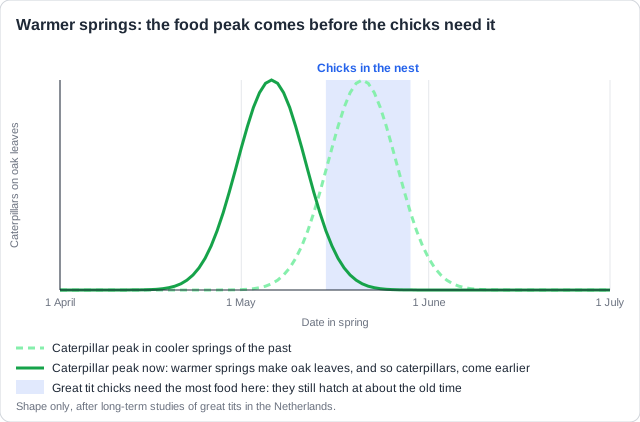
Real example: in the Netherlands, warmer springs now bring oak leaves and winter moth caterpillars earlier. Great tits still lay at about the old time, so many chicks hatch after the food peak and fewer survive.
Real example: sea turtles: The temperature of the sand decides whether a turtle egg hatches male or female: warmer sand gives more females. On the warm beaches of the northern Great Barrier Reef, over 99% of young green turtles are now female.
Feeling unprepared for exams?
Get a clear study plan, practice with real questions, and know exactly where you stand before exam day. No more guessing.
How this comes up: Paper 2, Section B (b) [7] or (a) [4], or a Paper 1 part that asks you to use a life cycle to explain an impact shown in a graph.
A national park has money to protect only a few of its species, and must decide which are most harmed by people.
Explain how knowledge of species' classifications, niche requirements and life cycles helps us to understand the extent of human impacts upon them.
Model answer plan
See the mark-by-mark plan — for / against / judgement, with marking guidance — in study mode.