Life cycles at Higher Level: This statement is Higher Level only. It compares how species breed and how long they live, and why r- and K-strategists suit different places.
Practise this as you read
- Compare r and K on the same feature.
- Link each strategy to its environment and stage of succession.
Free preview
This is the free notes preview
You're reading the free notes. Aimnova Pro unlocks the full study experience — and you can try it with your first topic free to keep:
- FlashcardsLock in vocabulary and key terms with spaced repetition.
- Practice questionsAnswer exam-style questions and get instant AI marking.
- Mock exams & past-paper vaultSit full mocks and see exactly how examiners award marks.
- Personalised study planA daily plan built around your exam date and weak areas.
Different ways to live and breed: Every species has a life cycle, but life cycles differ in how species reproduce and how long they live.
The points to remember
- Reproductive behaviour varies: how many offspring, how often, and how much care the parents give.
- Some species breed once and then die; others breed many times over a long life.
- Lifespan varies hugely: from a day or so to hundreds of years.
- Each life cycle adapts the species to its own environment.
Remember it as: How many, how often, how much care, how long.
Breed once, then die
- Pacific salmon: swim upriver, spawn, die.
- Mayfly: the adult lives a day or so.
Breed many times
- African elephant: a calf every 4 to 5 years.
- Wandering albatross: an egg every 2 years.
Real example: an adult mayfly lives only a day or so, just long enough to mate and lay eggs. The Greenland shark may live for several hundred years and may not breed until it is well over 100.
Practice with real exam questions
Answer exam-style questions and get AI feedback that shows you exactly what examiners want to see in a full-marks response.
Two broad life-cycle strategies sit at opposite ends: r-strategists and K-strategists.
r- and K-strategists
- r-strategists produce many small offspring with little care, so each has a low chance of survival.
- They mature early, live short lives and colonize new habitats rapidly.
- They make opportunistic use of short-lived resources, such as a newly burned field.
- K-strategists produce few offspring with a lot of care, so each has a high chance of survival.
- They mature late, live long lives and thrive in stable communities, near carrying capacity.
Remember it as: r = rapid and many. K = kept alive, few.
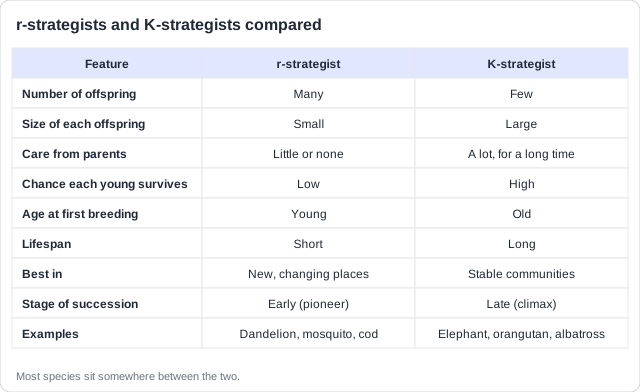
Real examples: a large female Atlantic cod can release millions of eggs a year and never sees her young (r). An African elephant has one calf after a pregnancy of about 22 months and cares for it for years (K).
Each strategy suits a different environment and a different stage of succession.
Where each strategy wins
- New or changing places, such as bare ground or a burned field, favour r-strategists.
- Stable communities, where competition is strong, favour K-strategists.
- Early in succession the pioneers are mostly r-strategists; the climax community is mostly K-strategists.
- r-strategist populations boom and crash; K-strategist populations stay near carrying capacity.
- Most species lie between the two, on a continuum.
Remember it as: New and changing: r wins. Stable and crowded: K wins.
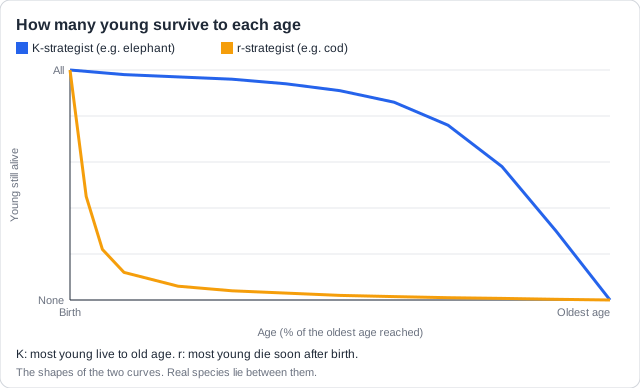
Real example: a green sea turtle lays about 100 eggs in a nest and gives no care, like an r-strategist, but it lives for decades and first breeds at 25 or older, like a K-strategist. It sits between the two.
Match the feature to the question: For pioneers, give the features that help them colonize: many offspring, spreading widely, growing fast. 'Short lifespan' on its own is not enough.
Feeling unprepared for exams?
Get a clear study plan, practice with real questions, and know exactly where you stand before exam day. No more guessing.
How this comes up: Paper 1: identify a feature of an r-strategist from a fact file [1]. Paper 2: outline differences [4] or why pioneers are r-strategists [2].
Surtsey, a volcanic island that rose from the sea off Iceland in 1963, was first colonized by a few fast-spreading species; others arrived much later.
Outline two differences between the life cycles of r-strategists and K-strategists, using named examples.
Model answer plan
See the mark-by-mark plan — for / against / judgement, with marking guidance — in study mode.