Energy and matter at Higher Level: The same ideas as SL, told through Alaska's salmon: fish that carry the ocean's nutrients into a forest. At HL, expect to link these supplies to productivity and to how efficiently energy passes along food chains.
Practise this as you read
- Separate each point into energy and matter.
- Name where each one enters and leaves your example.
Free preview
This is the free notes preview
You're reading the free notes. Aimnova Pro unlocks the full study experience — and you can try it with your first topic free to keep:
- FlashcardsLock in vocabulary and key terms with spaced repetition.
- Practice questionsAnswer exam-style questions and get instant AI marking.
- Mock exams & past-paper vaultSit full mocks and see exactly how examiners award marks.
- Personalised study planA daily plan built around your exam date and weak areas.
Two supplies keep it going: Every ecosystem runs on two supplies: energy and matter. Both come in from outside and both can leave.
The points to remember
- Energy, mostly sunlight, powers every living process.
- Matter (water, carbon dioxide, nutrients such as nitrogen and phosphorus) builds living bodies.
- Take away either one and organisms die: the ecosystem collapses.
- Ecosystems are open systems: energy and matter both enter and leave them.
Remember it as: Energy runs it; matter builds it.
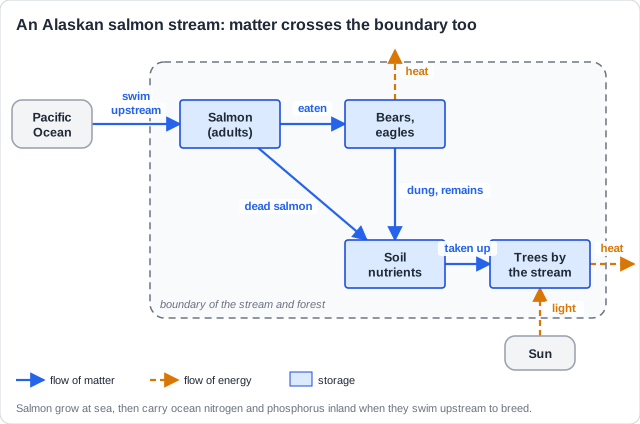
Real example: Pacific salmon grow at sea, then swim up Alaskan rivers to breed and die. Bears drag them into the forest. Up to about a quarter of the nitrogen in the trees along some of these streams comes from the sea, carried in by the fish.
Say both: When you describe what keeps an ecosystem going, name the energy supply and the matter supply.
Never wonder what to study next
Get a personalized daily plan based on your exam date, progress, and weak areas. We'll tell you exactly what to review each day.
Energy and matter both move through an ecosystem, but they take different routes. Energy passes through once; matter goes round and round.
The difference in the route
- Energy arrives all the time as sunlight.
- It flows one way: light, then chemical energy in food, then heat.
- Heat leaves the ecosystem and cannot be used again, so energy is not recycled.
- Matter is recycled: decomposers return nutrients to the soil, water and air.
- These loops are biogeochemical cycles, such as the carbon, nitrogen and water cycles.
- Earth gets a steady input of energy but almost no new matter: for matter it is nearly closed.
Remember it as: Energy is a one-way street; matter goes round a roundabout.
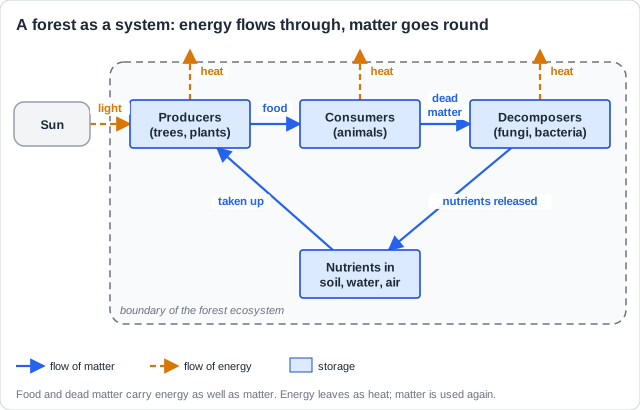
Real example: in Alaska, salmon carcasses rot on the forest floor and their nitrogen feeds the trees. When the leaves fall and decay, that nitrogen goes back into the soil to be used again.
Energy is never recycled: Never write that energy cycles or is recycled. Energy flows through and leaves as heat; only matter is recycled.
A question may ask you to compare energy and matter. They differ in their route, but they also have a lot in common.
What they have in common
- Both move between storages: heat leaves a body; biomass passes up a food chain.
- Both are transformed: light becomes chemical energy; carbon dioxide becomes sugar.
- Neither is created or destroyed: both are conserved (the first law, 2.2.2).
- Both are inputs an ecosystem cannot do without, and both can leave as outputs.
- Both follow the second law: every change leaves things more spread out and disordered (2.2.8).
Energy
- A steady input from the Sun
- One way: light, chemical, heat
- Leaves as heat, lost for good
Matter
- Almost no new input to Earth
- Goes round in cycles
- Small losses: animals leaving, nutrients washed out
Compare how they move, not what they are: 'Matter can be touched but energy cannot' does not count: it describes what they are, not how they move.
Real example: a salmon swimming inland is an input of both: chemical energy stored in its body, and matter such as nitrogen.
Stop wasting time on topics you know
Our AI identifies your weak areas and focuses your study time where it matters. No more overstudying easy topics.
How this comes up: Paper 2, Section B (a): outline, with a named example, why an ecosystem is an open system [4].
Every summer, salmon swim from the Pacific Ocean up the rivers of Alaska to breed.
With reference to a named ecosystem, outline why ecosystems are described as open systems.
Model answer plan
See the mark-by-mark plan — for / against / judgement, with marking guidance — in study mode.