Fundamental and realized niche at Higher Level: This statement is Higher Level only. It takes the idea of a niche (2.1.8) further: where a species could live, and where it actually lives.
Practise this as you read
- Use a named species, such as Connell's barnacles.
- Explain a change in both directions: growing and shrinking.
Free preview
This is the free notes preview
You're reading the free notes. Aimnova Pro unlocks the full study experience — and you can try it with your first topic free to keep:
- FlashcardsLock in vocabulary and key terms with spaced repetition.
- Practice questionsAnswer exam-style questions and get instant AI marking.
- Mock exams & past-paper vaultSit full mocks and see exactly how examiners award marks.
- Personalised study planA daily plan built around your exam date and weak areas.
Could live, does live: The fundamental niche is where a species could live if there were no limiting factors. The realized niche is where it actually lives.
The points to remember
- A niche is a species' role: how it obtains and uses resources and how it interacts with other species.
- Fundamental niche: the full range of conditions and resources in which a species could survive and reproduce, with no limiting factors.
- Realized niche: the actual mode of existence, where and how the species really lives.
- The realized niche results from the species' adaptations and competition with other species.
- So the realized niche is usually smaller than the fundamental niche.
Remember it as: Fundamental = could. Realized = does.
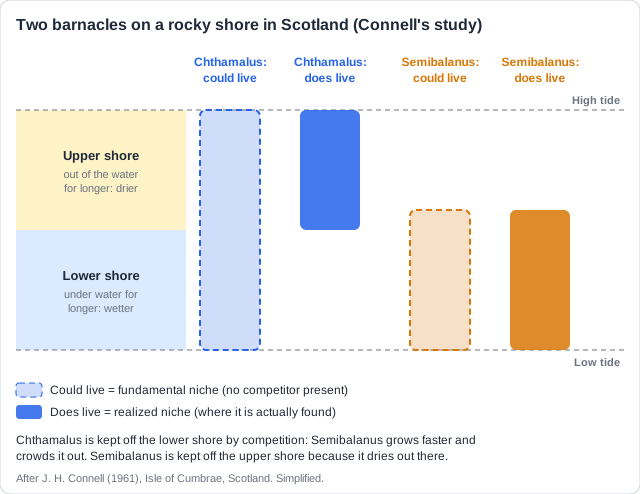
Real example: on the Isle of Cumbrae in Scotland, Joseph Connell studied two barnacles. When he removed Semibalanus from the lower shore, Chthamalus survived there. So its fundamental niche is the whole shore, but its realized niche is only the upper shore.
Do not swap them: Fundamental is the possible niche with no competitors or predators. Realized is the smaller, actual one.
Practice with real exam questions
Answer exam-style questions and get AI feedback that shows you exactly what examiners want to see in a full-marks response.
A realized niche is not fixed. It changes when the species around it change.
How a realized niche changes
- Competitors, predators and a lack of food limit where and how a species actually lives.
- When a new species arrives, a realized niche can grow or shrink.
- It grows with more prey or food, fewer competitors, or more places to hunt or shelter.
- It shrinks when food runs short, a stronger competitor arrives, or prey can hide more easily.
- Follow the chain: invasive plant, then native plants, then herbivores, then the predator.
Remember it as: More food or fewer rivals: the niche grows. Less food or more rivals: it shrinks.
Niche grows
- More herbivores to eat.
- New prey species arrive.
- Hunts at more times or in new ways.
- Thicker plants give cover for ambush.
Niche shrinks
- Native plants lost, so fewer herbivores.
- Less shelter for prey to breed in.
- Prey hide in dense plants.
- Other predators move in and compete.
Real example: when brown anoles invaded islands in Florida, the native green anoles moved higher up the trees. Within about 15 years, the green anoles had evolved larger, stickier toe pads for climbing: their realized niche had moved up.
Several species can share one place because their realized niches differ.
Different realized niches reduce competition
- Two species with exactly the same niche cannot live together for long: one outcompetes the other (competitive exclusion).
- Species that share a place can avoid competing by using different parts of it.
- They can differ in habitat, nest site, food, or the time they feed.
- Compare: say what this species does and what the others do.
- Then say how the difference cuts competition: they no longer need the same food or space.
Remember it as: Name the difference, compare it with the others, link it to competition.
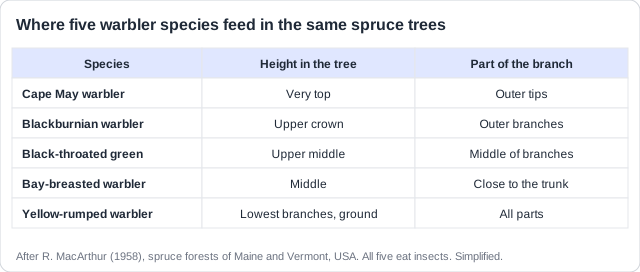
Real example: in the spruce forests of the north-east USA, Robert MacArthur found five warbler species eating insects in the same trees. Each fed mostly in a different part of the tree, so they competed less.
A reason alone is not enough: Writing 'nest sites' is not enough for the mark. Write 'it nests on cliffs, whereas the others nest in trees, so they do not compete for nest space'.
Feeling unprepared for exams?
Get a clear study plan, practice with real questions, and know exactly where you stand before exam day. No more guessing.
How this comes up: Paper 2, Section B (b) [7]: explain how a niche could change. Paper 1: outline how realized niches reduce competition [2], using a fact file and a table.
Lantana, a shrub from Central and South America, has spread across large areas of India's forests, including reserves where tigers hunt deer.
Explain how the niche of a terrestrial predator could change due to the introduction of an invasive producer species.
Model answer plan
See the mark-by-mark plan — for / against / judgement, with marking guidance — in study mode.