Difficulties in classification at Higher Level: This statement is Higher Level only. It asks why the traditional ranks, from kingdom to species, do not always fit the way species have evolved.
Practise this as you read
- Compare the traditional classes with a tree of relationships.
- Give each difficulty a real example.
Free preview
This is the free notes preview
You're reading the free notes. Aimnova Pro unlocks the full study experience — and you can try it with your first topic free to keep:
- FlashcardsLock in vocabulary and key terms with spaced repetition.
- Practice questionsAnswer exam-style questions and get instant AI marking.
- Mock exams & past-paper vaultSit full mocks and see exactly how examiners award marks.
- Personalised study planA daily plan built around your exam date and weak areas.
Boxes inside boxes: The traditional hierarchy sorts every organism into taxa at seven fixed ranks. Evolution, though, does not come in neat levels.
The points to remember
- The traditional hierarchy has seven ranks: kingdom, phylum, class, order, family, genus, species.
- Each rank sits inside the one above it, like boxes inside boxes.
- It was built in the 1700s from visible features, long before evolution was understood.
- Evolution makes a branching tree, not boxes at fixed levels.
- So the ranks do not always match the way species have diverged (split apart) over time.
Remember it as: Kingdom, phylum, class, order, family, genus, species: King Philip Came Over For Good Soup.
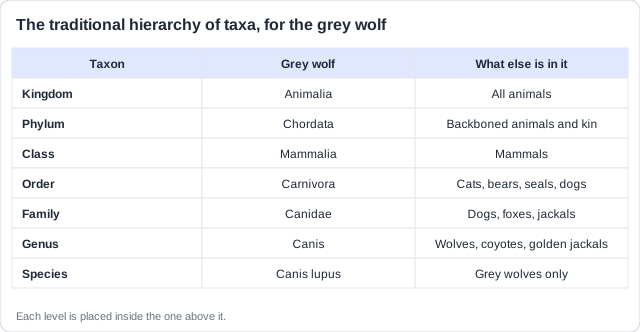
Real example: the grey wolf is in the order Carnivora with cats, bears and seals, the family Canidae with dogs and foxes, and the genus Canis with coyotes.
Stop wasting time on topics you know
Our AI identifies your weak areas and focuses your study time where it matters. No more overstudying easy topics.
Put the traditional classes beside a tree of evolutionary relationships, and some of them do not fit.
Groups that do not match evolution
- Some traditional groups are not clades: they leave out some descendants of their ancestor.
- Class Reptilia leaves out birds, although birds evolved from reptiles.
- Crocodiles are closer to birds than to lizards, yet they share a class with lizards.
- The same is true of fish: lungfish are closer to frogs and humans than to salmon.
- The ranks are not equal: one 'class' or 'family' may be much older or more varied than another.
Remember it as: Birds are reptiles that fly: the class boxes miss them.
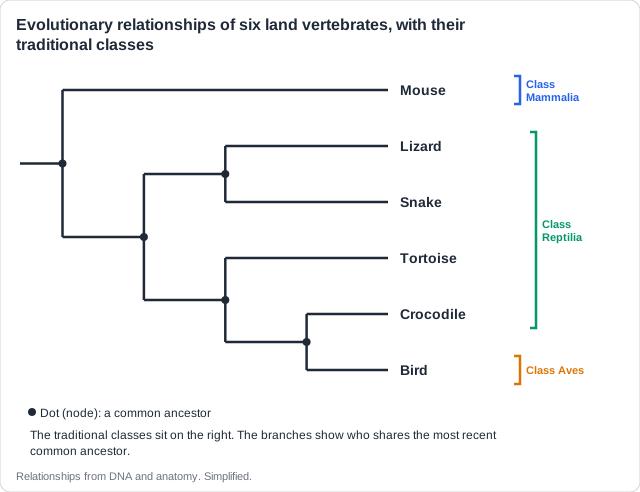
Real example: birds and dinosaurs: Fossils and DNA show that birds evolved from small, feathered dinosaurs. In a tree of relationships, birds sit inside the reptiles; in the traditional hierarchy, they are a separate class of equal rank.
Other difficulties come from how organisms evolve and from new evidence.
Other difficulties
- Convergent evolution: unrelated species look alike because they live the same way.
- Some organisms mix features of different groups, such as the platypus.
- In bacteria, which swap genes, and organisms that do not breed sexually, even a 'species' is hard to define.
- New evidence, especially DNA, keeps moving organisms from one taxon to another.
Remember it as: Look-alikes, mix-ups, gene-swappers, new DNA.
New World vultures
- Condors of the Americas.
- Bald head, soaring wings, eat carrion.
- A family of their own.
Old World vultures
- Griffon vultures of Africa and Europe.
- Bald head, soaring wings, eat carrion.
- Related to hawks and eagles.
Real example of convergence: both groups of vultures were once put in one family because they look alike. DNA shows they evolved the same way of life separately.
More real examples: The platypus makes milk like a mammal but lays eggs. Mushrooms were classed as plants until evidence showed fungi are closer to animals.
See how examiners mark answers
Access past paper questions with model answers. Learn exactly what earns marks and what doesn't.
How this comes up: Paper 2, Section B (a) [4], or a Section A question on a tree drawn beside the traditional classes.
A biology textbook still lists birds and reptiles as two separate classes of equal rank.
Outline two difficulties in classifying organisms into the traditional hierarchy of taxa.
Model answer plan
See the mark-by-mark plan — for / against / judgement, with marking guidance — in study mode.