Cladistics at Higher Level: This statement is Higher Level only. Classification groups organisms; cladistics groups them by who they evolved from, so the groups show real evolutionary relationships.
Practise this as you read
- Read a cladogram: find where two branches join.
- Give each advantage with a real example.
Free preview
This is the free notes preview
You're reading the free notes. Aimnova Pro unlocks the full study experience — and you can try it with your first topic free to keep:
- FlashcardsLock in vocabulary and key terms with spaced repetition.
- Practice questionsAnswer exam-style questions and get instant AI marking.
- Mock exams & past-paper vaultSit full mocks and see exactly how examiners award marks.
- Personalised study planA daily plan built around your exam date and weak areas.
One ancestor and all its descendants: A clade shows evolutionary relationships: every member evolved from the same common ancestor.
The points to remember
- A clade is a common ancestor and all of its descendants, living and extinct.
- A cladogram is a branching diagram that shows clades.
- Each node (branch point) is a common ancestor.
- Species that branch from a more recent node are more closely related.
- Clades are found from shared characteristics and, above all, from DNA comparisons.
Remember it as: One ancestor plus all its descendants: that is a clade.
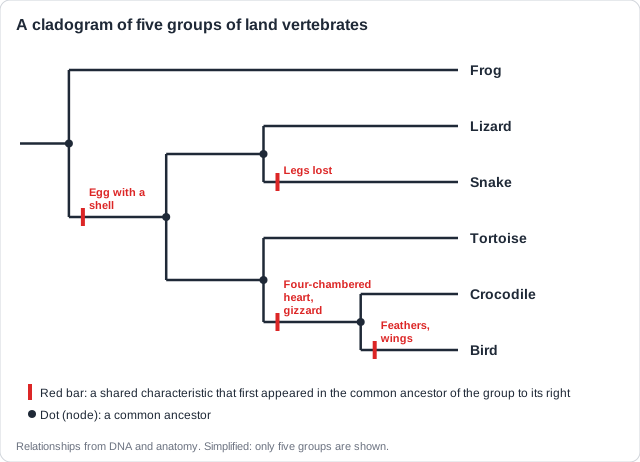
Real example: crocodiles look like lizards, but they share a more recent common ancestor with birds. Both have a four-chambered heart and a gizzard, and their DNA agrees. So crocodiles and birds form a clade.
A cladogram is not a ladder: Read how recently two groups share an ancestor, not which is 'more advanced'. Every living species has been evolving for the same length of time.
Feeling unprepared for exams?
Get a clear study plan, practice with real questions, and know exactly where you stand before exam day. No more guessing.
Older systems grouped organisms by how they look. Clades group them by who they evolved from, and this has several advantages.
Advantages of classifying in clades
- It shows evolutionary relationships: which species share the most recent common ancestor.
- It rests on evidence that can be tested, above all DNA, so groups can be checked and updated.
- It helps predict characteristics: close relatives often share features, such as useful chemicals.
- It reveals hidden relationships that looks alone would miss.
- It shows which species are evolutionarily distinct, so conservation can protect unique branches.
Remember it as: Relationships, testable evidence, predictions, hidden links, conservation priorities.
Grouping by looks
- Similar-looking species go together.
- Hard to test.
- Fooled by similar ways of life.
Grouping by clades
- Grouped by common ancestor.
- Tested with DNA.
- Shows how closely species are related.
Real example: DNA shows that the closest living relatives of whales are hippos. Nobody could see this from their bodies alone: a hidden relationship.
Conservation: the tuatara: The tuatara is the only survivor of a branch of reptiles that split from lizards and snakes about 250 million years ago. Losing it would lose a whole branch of the tree, so it is a high priority for protection.
Real example of prediction: the cancer drug taxol was first found in the bark of the rare Pacific yew. Its close relative, the common European yew, has a similar chemical in its needles, so the drug can now be made without cutting down rare trees.
How this comes up: Paper 2, Section B (a) [4], or a Section A question on a cladogram: read it, then give an advantage.
A natural history museum is rearranging its reptile and bird galleries so that they follow clades instead of the traditional classes.
Outline two advantages of using a method of classification that shows evolutionary relationships in a clade.
Model answer plan
See the mark-by-mark plan — for / against / judgement, with marking guidance — in study mode.