Reversing biodiversity loss at Higher Level: The same ideas as SL, with different cases: Tasmania's kelp, monarch butterflies and the Amazon. At HL, link each step from species loss to a tipping point.
Practise this as you read
- Chain species loss to resilience to a tipping point.
- Say whether an action slows the loss or reverses it.
Free preview
This is the free notes preview
You're reading the free notes. Aimnova Pro unlocks the full study experience — and you can try it with your first topic free to keep:
- FlashcardsLock in vocabulary and key terms with spaced repetition.
- Practice questionsAnswer exam-style questions and get instant AI marking.
- Mock exams & past-paper vaultSit full mocks and see exactly how examiners award marks.
- Personalised study planA daily plan built around your exam date and weak areas.
Turn it round before it tips: Biosphere integrity is already past its safe limit. To avoid ecosystems passing a tipping point, the loss must be reversed, not just slowed.
The points to remember
- Losing species and habitat lowers an ecosystem's resilience.
- A less resilient ecosystem can be pushed past a tipping point into a new state.
- The change can be sudden, and hard or impossible to reverse.
- So slowing the loss is not enough: the loss of biosphere integrity must be reversed.
Remember it as: Slow the loss, then turn it round, before the system flips.
Real example: along the east coast of Tasmania, Australia, more than 95% of the giant kelp forest has been lost since the 1940s, as warmer water and booming sea urchins turned forest into bare rock that stays bare.
Link loss to tipping points: In an answer, go step by step: species lost, then resilience down, then a tipping point is closer.
Practice with real exam questions
Answer exam-style questions and get AI feedback that shows you exactly what examiners want to see in a full-marks response.
Why protect a whole ecosystem rather than one species? Because every species needs its niche.
The points to remember
- A species' niche is everything it needs: food, shelter, breeding sites and the right conditions.
- These needs are met only in an intact ecosystem.
- Protecting the ecosystem protects the niches of all the species in it, not just one.
- It also keeps the interactions species rely on: their prey, pollinators and partners.
- Saving a species without its habitat rarely works: it cannot survive in the wild.
Remember it as: Save the home and you save the species.
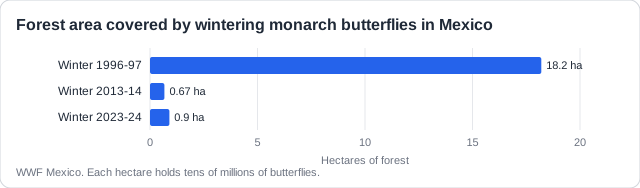
Real example: monarch butterflies need two places: milkweed in the USA and Canada to breed, and a few fir forests in Mexico to survive the winter. Protecting only one of them cannot save the migration.
Protecting the integrity of ecosystems slows the damage. Restoring what has been lost turns it round.
How the loss can be slowed and reversed
- Protected areas keep whole ecosystems intact, which slows the loss.
- Wildlife corridors link habitats, so species can move, find mates and breed.
- Reduce the pressures: less clearing, overfishing, pollution and fewer invasive species.
- Restoration, such as replanting forest or bringing back missing species, reverses the loss.
- Goal: protect 30% of land and sea by 2030 (a world agreement made in 2022).
Slows the loss
- Protected areas
- Corridors
- Fewer pressures
Reverses the loss
- Replanting habitat
- Removing invasive species
- Bringing back missing species
Real example: Brazil cut the yearly clearing of the Amazon by about 80% between 2004 and 2012, by creating protected areas and Indigenous territories and enforcing the law, which kept the forest further from its tipping point.
Protecting is not yet reversing: A protected area stops more damage; only restoration, with fewer pressures, brings the lost species and habitat back. Say which one you mean.
Feeling unprepared for exams?
Get a clear study plan, practice with real questions, and know exactly where you stand before exam day. No more guessing.
How this comes up: Paper 2, Section B (b): explain [7]. One point per paragraph, with named examples.
Scientists warn that several ecosystems are close to tipping points.
Explain why the loss of biosphere integrity needs to be reversed to avoid critical tipping points.
Model answer plan
See the mark-by-mark plan — for / against / judgement, with marking guidance — in study mode.