aımnova
DashboardMy LearningPaper MasteryStudy Plan

Aimnova site navigation

Stay in the loop

Get the latest study resources and updates

New features, study tips and exam insights — straight to your inbox.

IB Diploma

  • IB Past Papers
  • IB Study Notes
  • IB Question Bank
  • IB Mock Exams
  • IB Revision

IB Subjects

  • IB Math AA
  • IB Math AI
  • IB Economics
  • IB Business Management
  • IB Physics
  • IB Biology
  • View all IB subjects→

IB Past Papers

  • IB Math AA HL Past Papers
  • IB Math AA SL Past Papers
  • IB Math AI HL Past Papers
  • IB Math AI SL Past Papers
  • IB Economics HL Past Papers
  • IB Economics SL Past Papers
  • IB ESS Past Papers
  • View all past papers→

Study Resources

  • Study Notes
  • Question Bank
  • Mock Exams
  • Flashcards
  • Revision Guide
  • Exam Skills
  • Command Terms
  • Grade Calculator
  • Exam Timetable 2026

Aimnova

  • Features
  • Pricing
  • For Teachers
  • For Schools
  • For Parents
  • About Us
  • Blog
  • Contact
aımnova

IB study, practice and feedback built around the real exam.

TermsPrivacyCookies·© 2026 Aimnova. All rights reserved.1b845d5

Aimnova is not affiliated with or endorsed by the International Baccalaureate Organization (IB).

NotesEnglish A: Lang & LitTopic 2.3Text type: the transcript
Back to English A: Lang & Lit Topics
2.3.44 min read

Text type: the transcript

IB English A: Language and Literature · Unit 2

Exam preparation

Practice the questions examiners actually ask

Our question bank mirrors real IB exam papers. Practice under timed conditions and track your progress across topics.

Start Practicing

Contents

  1. 1What it is
  2. 2Try it yourself
The gist: A transcript writes down real speech exactly — with its ‘um’s, pauses and interruptions — so how people talk reveals character and who holds the power.

Read what people actually say, not the tidy version.

“I just — no, sorry, let me — the thing is, um, I never agreed to that.”

All those stumbles and restarts aren't mistakes to fix — they're evidence. Someone hesitant, or cut off, or dominating the talk tells you a lot. A transcript captures the mess of real speech; analyse it.

What to look for

1

Fillers and hesitations

‘um’, ‘er’, ‘like’, false starts — signs of nerves, thinking or uncertainty.

2

Interruptions and overlaps

Who cuts in and who gets cut off shows who holds the power.

3

Turn length

One person dominating, another giving one-word replies, reveals the balance.

4

Non-verbal notes

‘(pause)’, ‘(laughs)’, ‘(quietly)’ — how something is said, not just what.

The key move: Ask ‘how does the WAY they speak reveal character and power?’ In a transcript, hesitations, interruptions and turn length are the evidence.

Free preview

This is the free notes preview

You're reading the free notes. Aimnova Pro unlocks the full study experience — and you can try it with your first topic free to keep:

  • FlashcardsLock in vocabulary and key terms with spaced repetition.
  • Practice questionsAnswer exam-style questions and get instant AI marking.
  • Mock exams & past-paper vaultSit full mocks and see exactly how examiners award marks.
  • Personalised study planA daily plan built around your exam date and weak areas.
Start Studying Free Full access to Aimnova Pro · cancel anytime
Why it matters in the exam: A transcript can appear in Paper 1. A strong answer analyses features of real speech — pauses, fillers, interruptions, who dominates — and what they reveal, not just the topic.
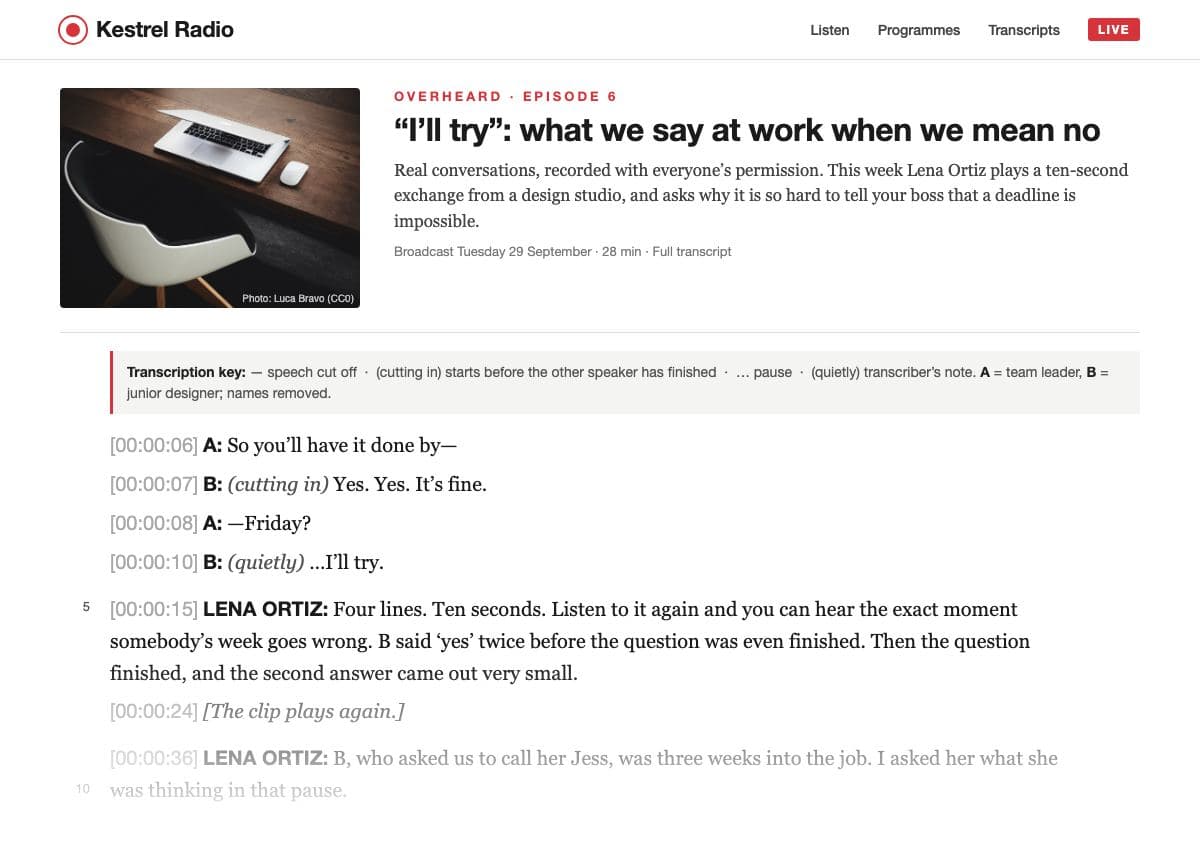
The top of an episode page on the ‘Kestrel Radio’ website: a photo tile of an empty desk with a closed laptop and a white chair in the dark; the tag ‘Overheard · Episode 6’; the title ‘“I'll try”: what we say at work when we mean no’; a blurb saying the programme plays a ten-second exchange recorded, with permission, in a design studio; a shaded transcription key (— speech cut off; (cutting in) starts before the other speaker has finished; … pause; (quietly) transcriber's note; A = team leader, B = junior designer, names removed); then the timestamped transcript: ‘A: So you'll have it done by—’ / ‘B: (cutting in) Yes. Yes. It's fine.’ / ‘A: —Friday?’ / ‘B: (quietly) …I'll try.’, followed by the presenter's comment, fading out at the foot of the clipping.
Radio programme transcript, opening (an original text written for Aimnova; photograph by Luca Bravo, CC0 via Wikimedia Commons, cropped with text added)
IB-style questionAnalyse[6 marks]

Analyse how the opening of this transcript reveals the power between the two speakers.

Model answer plan

See the mark-by-mark plan — for / against / judgement, with marking guidance — in study mode.

Claim your free topic
Watch out: Don't ‘tidy up’ the speech in your head and analyse only the topic. The ‘um’s, pauses and interruptions are the evidence.

IB Exam Questions on Text type: the transcript

Practice with IB-style questions filtered to Topic 2.3.4. Get instant AI feedback on every answer.

Practice Topic 2.3.4 QuestionsBrowse All English A: Lang & Lit Topics

How Text type: the transcript Appears in IB Exams

Examiners use specific command terms when asking about this topic. Here's what to expect:

  • Define

    Give the precise meaning of key terms related to Text type: the transcript.

    AO1
  • Describe

    Give a detailed account of processes or features in Text type: the transcript.

    AO2
  • Explain

    Give reasons WHY — cause and effect within Text type: the transcript.

    AO3
  • Evaluate

    Weigh strengths AND limitations of approaches in Text type: the transcript.

    AO3
  • Discuss

    Present arguments FOR and AGAINST with a balanced conclusion.

    AO3

See the full IB Command Terms guide

Related English A: Lang & Lit Topics

Continue learning with these related topics from the same unit:

2.1.1Text type: the advertisement2.1.2Text type: the poster2.1.3Text type: the brochure or leaflet2.1.4Text type: the campaign material
View all English A: Lang & Lit topics
Improve your exam techniqueCommand terms, paper structure, and mark-scheme tips for English A: Lang & Lit
Previous2.3.3Text type: the social media postNextText type: the infographic2.4.1

4 exam-style questions ready for you

Students who practice on Aimnova improve their scores by 15% on average. Get instant feedback that shows exactly how to improve your answers.

Practice Now — FreeView All English A: Lang & Lit Topics