Spectra at Higher Level: The same statement as SL. At HL the pigments are arranged in photosystems (3.3.9), which explains why accessory pigments widen the action spectrum.
Practise this as you read
- Distinguish absorption and action spectra.
- Deduce from an action spectrum which colours an organism uses.
Free preview
This is the free notes preview
You're reading the free notes. Aimnova Pro unlocks the full study experience — and you can try it with your first topic free to keep:
- FlashcardsLock in vocabulary and key terms with spaced repetition.
- Practice questionsAnswer exam-style questions and get instant AI marking.
- Mock exams & past-paper vaultSit full mocks and see exactly how examiners award marks.
- Personalised study planA daily plan built around your exam date and weak areas.
If chlorophyll absorbs blue and red light, then those should be the colours that drive photosynthesis fastest. Scientists check this by comparing two graphs.
The two graphs
- The absorption spectrum: which colours the pigment absorbs
- The action spectrum: which colours make photosynthesis go fastest
Absorption spectrum vs action spectrum
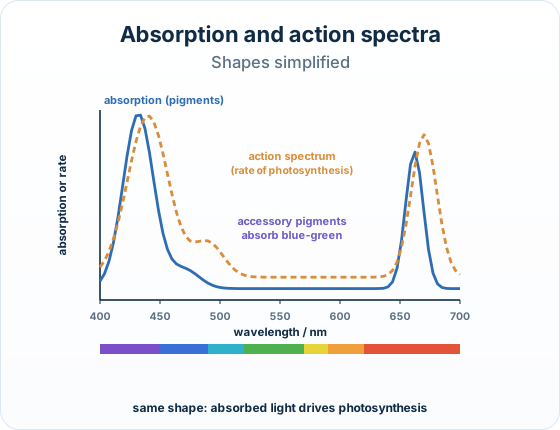
- The absorption spectrum plots how much light a pigment absorbs at each wavelength.
- The action spectrum plots the rate of photosynthesis at each wavelength.
Why the two graphs match: The two graphs have almost the same shape: both peak in the blue and red and dip in the green. They match because absorbed light is the energy source: the wavelengths the pigment absorbs are the wavelengths that power photosynthesis.
| Feature | Absorption spectrum | Action spectrum |
|---|---|---|
| What is plotted on the y-axis | Amount of light absorbed by the pigment | Rate of photosynthesis |
| What is plotted on the x-axis | Wavelength (colour) of light | Wavelength (colour) of light |
| What it measures | Which wavelengths a pigment soaks up | Which wavelengths actually drive photosynthesis |
| Typical shape | High in blue and red, low in green | High in blue and red, low in green |
| Why they match closely | Absorbed light is the energy source — so wavelengths that are absorbed are the wavelengths that power photosynthesis | Photosynthesis is fast at exactly the wavelengths the pigments absorb |
Accessory pigments fill the gaps: Chlorophyll absorbs blue and red well but misses some wavelengths in between.
How accessory pigments help
- Plants also contain accessory pigments, such as carotenoids (orange and yellow).
- These absorb some of the blue-green light that chlorophyll cannot, and pass the energy on to chlorophyll.
- The result: the plant captures a wider range of wavelengths than chlorophyll could on its own, so it loses less of the available light energy.
| Pigment | Colour it appears | Light it absorbs |
|---|---|---|
| Chlorophyll | Green | Mainly blue and red; reflects green |
| Carotenoids (accessory) | Orange / yellow | Mainly blue-green light that chlorophyll misses |
| Why it matters | Different colours = different pigments | Together they capture a wider range of wavelengths |
Chlorophyll
- The main photosynthetic pigment
- Absorbs blue and red strongly
- Reflects green → leaves look green
- Misses some wavelengths on its own
Accessory pigments (carotenoids)
- Extra pigments alongside chlorophyll
- Absorb blue-green light chlorophyll misses
- Pass the energy on to chlorophyll
- Widen the range of light captured
An easy way to remember: Absorbtion spectrum = what a pigment absorbs. Action spectrum = the action (rate) of photosynthesis.
They line up because a plant can only use light that is first absorbed — no absorption, no action.
Never wonder what to study next
Get a personalized daily plan based on your exam date, progress, and weak areas. We'll tell you exactly what to review each day.
The big idea: An action spectrum shows the rate of photosynthesis at each wavelength, measured as oxygen released or carbon dioxide taken up. It has almost the same shape as the absorption spectrum, because only absorbed light can drive photosynthesis.
The points to remember
- Absorption spectrum: light absorbed against wavelength.
- Action spectrum: rate of photosynthesis against wavelength.
- Measure the rate as oxygen produced or carbon dioxide used per unit time.
- Similar: both peak in the blue and red, low in the green.
- Different: the action spectrum is a little broader, because accessory pigments pass on energy from blue-green light.
Remember it as: Absorb first, then act.
Real example: Engelmann's experiment. In 1882, Theodor Engelmann lit a strand of alga with a spectrum of colours. Oxygen-seeking bacteria gathered mostly in the red and blue light, where photosynthesis released most oxygen: an early action spectrum.
Trap: An action spectrum is not a measure of light absorbed: its vertical axis is a rate.
How it is asked: Expect data questions on spectra: which colour drives photosynthesis, which organism suits deeper water, and Distinguish questions on the two kinds of spectrum.
Distinguish between an absorption spectrum and an action spectrum.
Model answer plan
See the answer broken into clear points, with guidance on how each point earns marks.