Absorbing light at Higher Level: The same statement as SL. At HL the excited electrons are followed further: photosystems emit them from a reaction centre (3.3.9).
Practise this as you read
- Explain why only some wavelengths are absorbed.
- Read an absorption spectrum.
Free preview
This is the free notes preview
You're reading the free notes. Aimnova Pro unlocks the full study experience — and you can try it with your first topic free to keep:
- FlashcardsLock in vocabulary and key terms with spaced repetition.
- Practice questionsAnswer exam-style questions and get instant AI marking.
- Mock exams & past-paper vaultSit full mocks and see exactly how examiners award marks.
- Personalised study planA daily plan built around your exam date and weak areas.
The big idea: Photosynthesis is powered by light, but a leaf does not use all of the light that lands on it.
What chlorophyll does
- The green pigment chlorophyll absorbs some colours of light strongly and reflects others.
- Chlorophyll absorbs blue and red light well.
- It reflects green light back to your eye, which is exactly why leaves look green.
The absorption spectrum of chlorophyll: light absorbed is high in the blue (~450 nm) and red (~660 nm) regions and low in the green (~550 nm). The green light is mostly reflected — which is why leaves look green.
Interactive diagram
Explore the labelled diagram, charts and maps for this topic in full study mode.
- Pigment
- A coloured molecule that absorbs some wavelengths (colours) of light and reflects others. The colour you see is the light the pigment does NOT absorb.
- Chlorophyll
- The main green pigment of plants. It absorbs blue and red light strongly and reflects green light, so it appears green.
- Wavelength
- What gives light its colour. Visible light runs from short-wavelength blue/violet (~400 nm) through green (~550 nm) to long-wavelength red (~700 nm).
- Absorption spectrum
- A graph showing how much light a pigment absorbs at each wavelength. For chlorophyll it has two peaks — one in the blue, one in the red — and a dip in the green.
The colour you see is the light it does NOT use: A leaf looks green because green is the colour chlorophyll reflects, not the colour it absorbs.
The useful light — the light that actually powers photosynthesis — is the blue and red that chlorophyll soaks up and you never see.
Feeling unprepared for exams?
Get a clear study plan, practice with real questions, and know exactly where you stand before exam day. No more guessing.
The big idea: A pigment absorbs only the wavelengths whose energy can excite one of its electrons. Chlorophyll absorbs blue and red; green is hardly absorbed, so it is reflected. The excited electrons' energy becomes chemical energy.
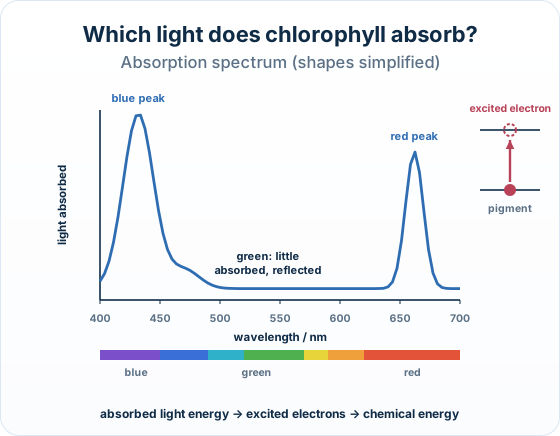
The points to remember
- Visible light: about 400 nm (violet-blue) to 700 nm (red).
- An absorption spectrum plots light absorbed against wavelength (label the colours too).
- Absorbed light excites electrons to a higher energy level.
- Only wavelengths with the right amount of energy are absorbed; the rest are reflected or transmitted.
- The energy of the excited electrons is converted into chemical energy.
Remember it as: Absorbed light lifts electrons; reflected light is the colour you see.
Real example: red algae. Red algae living deep in the sea contain pigments that absorb blue-green light, the wavelengths that reach deepest, and reflect red light, so they look red.
Trap: Leaves look green because chlorophyll reflects green light, not because it absorbs it.
How this is tested: Photosynthesis spectra are a data-question favourite. These are the usual tasks.
The common formats
- Read a spectrum (data question): given an absorption or action spectrum, identify the colour the pigment absorbs least (green) or the wavelength where photosynthesis is fastest.
- Distinguish: the difference between an absorption spectrum and an action spectrum, and why the two curves match.
- Chromatography of a leaf extract: separating the pigments shows there is more than one (different colours / different Rf values), which is why a leaf can absorb a range of wavelengths.
Exam-style question — read the absorption spectrum
An absorption spectrum of chlorophyll shows high absorption at about 450 nm (blue) and about 660 nm (red), and very low absorption at about 550 nm (green). Using the data, explain why a leaf containing this chlorophyll appears green. [3]
Step by step
- Read the low point. At about 550 nm (green light) the absorption is very low, so chlorophyll absorbs little green light.
- Say what happens to that light. Light that is not absorbed is reflected (or transmitted), so the green light is reflected off the leaf.
- Link reflection to colour. The colour we see is the reflected light, so the reflected green light reaches our eyes and the leaf looks green.
Final answer
Chlorophyll absorbs very little green light (the dip at ~550 nm), so green light is reflected rather than absorbed; the reflected green light is what reaches our eyes, so the leaf looks green.
Why this works: It uses the data (the low point at ~550 nm), not just memorised facts, and it connects three ideas: low absorption of green → green is reflected → reflected green is the colour we see.
A frequent slip is saying the leaf 'absorbs green' — it is the opposite: the leaf reflects the green it does not absorb.
| Feature | Absorption spectrum | Action spectrum |
|---|---|---|
| What is plotted on the y-axis | Amount of light absorbed by the pigment | Rate of photosynthesis |
| What is plotted on the x-axis | Wavelength (colour) of light | Wavelength (colour) of light |
| What it measures | Which wavelengths a pigment soaks up | Which wavelengths actually drive photosynthesis |
| Typical shape | High in blue and red, low in green | High in blue and red, low in green |
| Why they match closely | Absorbed light is the energy source — so wavelengths that are absorbed are the wavelengths that power photosynthesis | Photosynthesis is fast at exactly the wavelengths the pigments absorb |
Another question in the papers' style:
Explain why chlorophyll absorbs red and blue light but not green light.
Model answer plan
See the answer broken into clear points, with guidance on how each point earns marks.