Enzymes and metabolism at Higher Level: The same statement as SL. At HL it leads on to how pathways are controlled: inhibitors and feedback inhibition, later in this topic.
Practise this as you read
- Define metabolism.
- Explain why many enzymes are needed and how they control metabolism.
Free preview
This is the free notes preview
You're reading the free notes. Aimnova Pro unlocks the full study experience — and you can try it with your first topic free to keep:
- FlashcardsLock in vocabulary and key terms with spaced repetition.
- Practice questionsAnswer exam-style questions and get instant AI marking.
- Mock exams & past-paper vaultSit full mocks and see exactly how examiners award marks.
- Personalised study planA daily plan built around your exam date and weak areas.
The big idea: Metabolism is the whole web of chemical reactions inside a living cell. Almost every one is catalysed by an enzyme, which is why metabolism is described as the cell's enzyme-catalysed reactions.
These reactions fall into two types
- Those that build larger molecules: anabolism
- Those that break molecules down: catabolism
- Metabolism
- All of the enzyme-catalysed chemical reactions that take place inside a living organism.
- Anabolism
- The reactions of metabolism that BUILD larger molecules from smaller ones. Anabolism uses (requires) energy.
- Catabolism
- The reactions of metabolism that BREAK larger molecules into smaller ones. Catabolism releases energy.
- Enzyme
- A biological catalyst — a protein that speeds up a metabolic reaction without being used up.
A name to remember it by: Anabolism = building up (think of an athlete building muscle).
Catabolism = breaking down (think of a catastrophe tearing things apart).
Both are part of metabolism, the cell's full set of enzyme-controlled reactions.
Study smarter, not longer
Most students waste 40% of study time on topics they already know. Our AI tracks your progress and optimizes every minute.
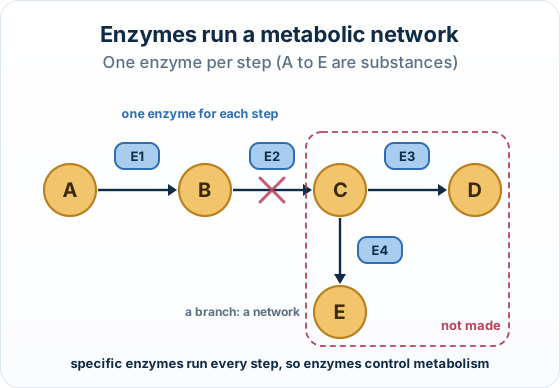
The big idea: Metabolism is a network of linked reactions. Each reaction needs its own enzyme, so a cell needs many different enzymes, and it controls metabolism by controlling them.
The points to remember
- Reactions are linked: the product of one reaction is the substrate of the next.
- Pathways branch and join, so they form a network that depends on every step.
- Enzymes are specific: each catalyses one reaction, so there is a different enzyme for each step.
- The cell controls metabolism by making, activating or inhibiting particular enzymes.
Remember it as: One step, one enzyme; control the enzyme, control the step.
Real example: phenylketonuria. People with phenylketonuria lack a working phenylalanine hydroxylase, the enzyme that changes the amino acid phenylalanine into tyrosine. Phenylalanine builds up in the blood, so they must eat a diet low in it: one missing enzyme disrupts a whole part of metabolism.
Trap: Do not say one enzyme can run a whole pathway. Because of specificity, each step needs its own enzyme.
How it is asked: Expect a definition of metabolism, or an explanation of why so many enzymes are needed and how they control metabolism.
Explain why living organisms need many different enzymes.
Model answer plan
See the answer broken into clear points, with guidance on how each point earns marks.