Active sites at Higher Level: The same statement as SL. At HL the same idea explains inhibitors: a molecule binding away from the active site can still change its shape.
Practise this as you read
- Outline how the active site is formed.
- Explain why the whole protein matters for catalysis.
Free preview
This is the free notes preview
You're reading the free notes. Aimnova Pro unlocks the full study experience — and you can try it with your first topic free to keep:
- FlashcardsLock in vocabulary and key terms with spaced repetition.
- Practice questionsAnswer exam-style questions and get instant AI marking.
- Mock exams & past-paper vaultSit full mocks and see exactly how examiners award marks.
- Personalised study planA daily plan built around your exam date and weak areas.
The big idea: Enzymes are globular proteins that act as biological catalysts: they speed up the chemical reactions of life without being used up.
How an enzyme works
Active site
Every enzyme has a special pocket on its surface called the active site.
Substrate binds
The molecule the enzyme acts on, the substrate, binds into the active site.
Complex forms
Together the two form an enzyme-substrate complex.
Reaction
The reaction takes place and the products are released.
Reused
The enzyme is left unchanged, ready to be used again.
Bind, react, release, reuse.
An enzyme at work: the substrate binds the active site, forming an enzyme-substrate complex (induced fit); the reaction occurs and the products are released, leaving the enzyme unchanged and able to be reused.
Interactive diagram
Explore the labelled diagram, charts and maps for this topic in full study mode.
- Enzyme
- A globular protein that acts as a biological catalyst, speeding up a specific reaction without being used up.
- Catalyst
- A substance that speeds up a reaction but is not changed or used up by it, so it can be reused.
- Substrate
- The reactant molecule (or molecules) that an enzyme acts on.
- Active site
- The specific region on the surface of an enzyme where the substrate binds; its shape is complementary to the substrate.
- Enzyme-substrate complex
- The temporary structure formed when a substrate is bound to an enzyme's active site, just before the reaction occurs.
- Product
- The new molecule (or molecules) formed by the reaction, which is then released from the active site.
The active site is the key part: Only a small part of a large enzyme — the active site — actually touches the substrate.
This is why an enzyme can be a big protein yet still be choosy about exactly which molecule it works on: everything depends on the shape of the active site.
Feeling unprepared for exams?
Get a clear study plan, practice with real questions, and know exactly where you stand before exam day. No more guessing.
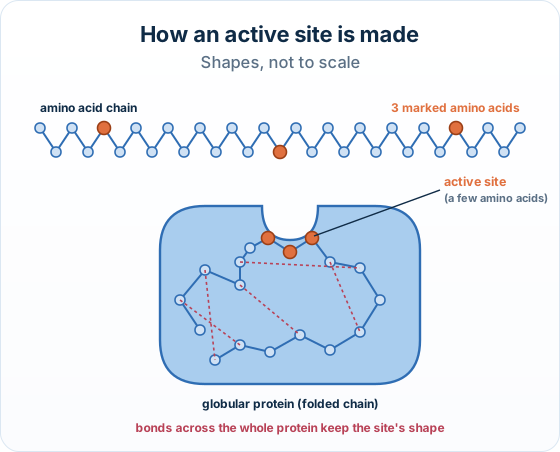
The big idea: An enzyme is a globular protein. Its active site is made of only a few amino acids, but the whole folded structure holds it in the right shape for catalysis.
The points to remember
- Enzymes are globular proteins: one or more polypeptide chains folded into a compact, rounded shape.
- The active site is formed by a few amino acids, often far apart in the chain.
- Interactions between amino acids across the whole 3D structure hold those few in place.
- So a change anywhere in the protein can change the active site and stop catalysis.
Remember it as: A few amino acids make the site; the whole protein holds it.
Real example: chymotrypsin. The active site of chymotrypsin, a protein-digesting enzyme, depends on three amino acids at positions 57, 102 and 195 of its chain. They are far apart in the chain but side by side once it folds.
Trap: The active site is part of the enzyme, not of the substrate. The substrate binds to the active site.
How it is asked: Expect the name of the active site or the enzyme-substrate complex, or an outline of how the folded protein makes the active site.
Outline how the structure of an enzyme gives it an active site suited to catalysis.
Model answer plan
See the answer broken into clear points, with guidance on how each point earns marks.