Each heartbeat is a repeating sequence called the cardiac cycle.
It is driven by muscle contracting and relaxing, and by valves that snap shut at the right moments so blood only ever flows one way.
- Cardiac cycle
- One complete heartbeat — the repeating sequence of contraction (systole) and relaxation (diastole) of the heart chambers.
- Systole
- The contraction phase, when a chamber squeezes to push blood out.
- Diastole
- The relaxation phase, when the chambers refill with blood.
- Double circulation
- A system in which blood passes through the heart twice for each full circuit of the body — once for the lungs (pulmonary circuit) and once for the body (systemic circuit).
The cardiac cycle — three stages
Atria contract (atrial systole)
The AV valves are open, so blood is pushed down from the atria into the ventricles.
Ventricles contract (ventricular systole)
The AV valves shut (this makes the first heart sound, 'lub') and the semilunar valves open, so blood is forced out into the pulmonary artery and the aorta.
Everything relaxes (diastole)
The semilunar valves shut (the second heart sound, 'dub') and the chambers refill, ready for the next beat.
Atria squeeze, ventricles squeeze ('lub'), all relax ('dub').
| Stage | What contracts / relaxes | Valves | Effect on blood |
|---|---|---|---|
| Atrial systole | atria contract | AV valves open | blood pushed from atria into ventricles |
| Ventricular systole | ventricles contract | AV valves shut, semilunar valves open | blood forced out into the pulmonary artery and aorta |
| Diastole | atria and ventricles relax | semilunar valves shut, AV valves open | chambers refill with blood returning to the heart |
Pressure, valves and heart sounds — the data link: Valves are pushed open and shut by pressure differences, and this is exactly what a cardiac-cycle pressure graph shows.
Reading the valves
- A valve opens when the pressure behind it becomes higher than the pressure in front of it
- It shuts when the pressure in front becomes higher (which would push blood backwards)
- The heart sounds are the valves closing
- 'Lub' is the AV valves shutting at the start of ventricular systole
- 'Dub' is the semilunar valves shutting at the start of diastole
Single and double circulation
- How a mammal's double circulation differs from a fish's single circulation is taught on 2.7.14.
Right side (deoxygenated)
- Receives blood from the body (via the vena cava)
- Right atrium → right ventricle
- Pumps out through the pulmonary artery
- Sends blood to the lungs to pick up oxygen
Left side (oxygenated)
- Receives blood from the lungs (via the pulmonary vein)
- Left atrium → left ventricle
- Pumps out through the aorta
- Sends blood to the whole body at high pressure
An easy way to remember: Atria are Above and Accept blood; ventricles are below and vent it out.
And the odd one out for blood colour: the pulmonary artery carries deoxygenated blood and the pulmonary vein carries oxygenated blood — the only vessels where 'artery = oxygenated' does not hold.
Free preview
This is the free notes preview
You're reading the free notes. Aimnova Pro unlocks the full study experience — and you can try it with your first topic free to keep:
- FlashcardsLock in vocabulary and key terms with spaced repetition.
- Practice questionsAnswer exam-style questions and get instant AI marking.
- Mock exams & past-paper vaultSit full mocks and see exactly how examiners award marks.
- Personalised study planA daily plan built around your exam date and weak areas.
The big idea: Each beat starts at the sinoatrial node. Valves open and shut purely because of pressure differences between the chambers and the aorta.
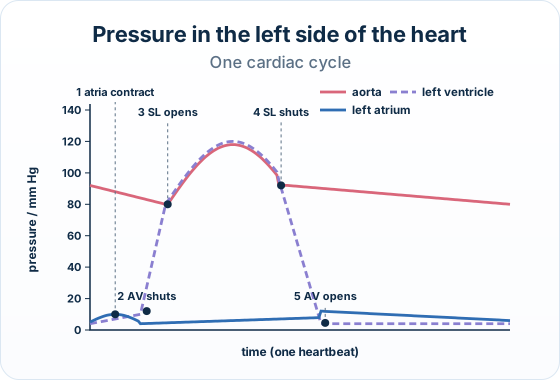
The points to remember
- Atrial systole: the SA node fires, the atria contract and top up the ventricles.
- Ventricular systole: ventricle pressure passes atrium pressure, so the AV valve shuts.
- Then it passes aortic pressure, so the semilunar valve opens and blood is ejected.
- Diastole: ventricle pressure falls below the aorta's (semilunar valve shuts) and then below the atrium's (AV valve opens), so the ventricle fills.
| Reading | What it is | Typical value |
|---|---|---|
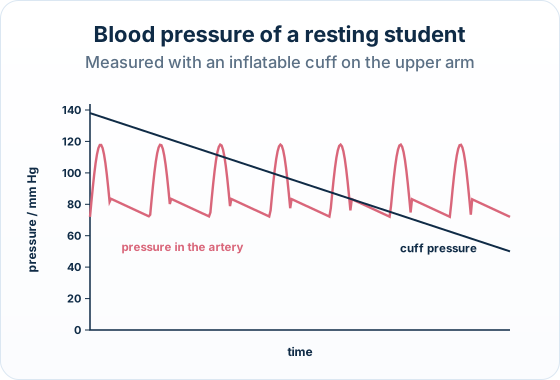
| Systolic | Peak pressure in the arteries, when the ventricles contract | about 120 mm Hg |
| Diastolic | Lowest pressure in the arteries, when the ventricles relax | about 80 mm Hg |
Two traps: Blood pressure is written systolic over diastolic, as in 120/80: the higher number is systolic.
During exercise systolic pressure rises a lot, but diastolic changes little: it is the pressure while the ventricles are relaxed.
Study smarter, not longer
Most students waste 40% of study time on topics they already know. Our AI tracks your progress and optimizes every minute.
How it is asked: Expect a pressure graph (cardiac cycle or a cuff reading) to read values from, and short suggestions about what the numbers mean.
During exercise a student's systolic pressure rose from 118 to 160 mm Hg, but diastolic pressure stayed near 75 mm Hg. Suggest a reason for the small change in diastolic pressure.
Model answer plan
See the answer broken into clear points, with guidance on how each point earns marks.