Condensation at Higher Level: The same statement as SL. At HL you meet this reaction again and again: every polymer you study is built by it, and longer answers expect the water and the new bond named every time.
Practise this as you read
- Name the reaction that joins monomers.
- Draw two monomers joining, with the water released.
- Give an example of each polymer: a polysaccharide, a polypeptide, a nucleic acid.
Free preview
This is the free notes preview
You're reading the free notes. Aimnova Pro unlocks the full study experience — and you can try it with your first topic free to keep:
- FlashcardsLock in vocabulary and key terms with spaced repetition.
- Practice questionsAnswer exam-style questions and get instant AI marking.
- Mock exams & past-paper vaultSit full mocks and see exactly how examiners award marks.
- Personalised study planA daily plan built around your exam date and weak areas.
Macromolecules are far too large to be made in one step.
Two reactions
- Condensation: the cell joins many small monomers together, one at a time, to build a macromolecule.
- Hydrolysis: the reverse reaction. To use a macromolecule for energy or recycle its parts, the cell breaks it back down into monomers.
- Condensation
- A reaction that joins two subunits together and releases one molecule of water (H₂O).
- Hydrolysis
- A reaction that uses one molecule of water (H₂O) to break a bond and split a molecule into two subunits.
- Anabolic reaction
- A reaction that builds larger molecules from smaller ones (condensation is anabolic).
- Catabolic reaction
- A reaction that breaks larger molecules into smaller ones (hydrolysis is catabolic).
Condensation — joining with water removed: In condensation, two monomers are joined and one water molecule (H₂O) is released.
Repeating this many times links monomers into a polymer (a macromolecule).
Examples: glucose + glucose → maltose + water; many glucose → starch; glycerol + fatty acids → a triglyceride; amino acid + amino acid → a dipeptide.
Condensation: two monomers join, a new bond forms, and one H₂O is removed.
Interactive diagram
Explore the labelled diagram, charts and maps for this topic in full study mode.
Hydrolysis — breaking with water added: Hydrolysis is the reverse. One water molecule (H₂O) is added across the bond, splitting the molecule into two subunits.
The word itself is a clue: hydro = water, lysis = splitting — 'splitting with water'.
Examples: starch + water → glucose; a disaccharide + water → two monosaccharides; a protein + water → amino acids.
Hydrolysis: a water molecule is added to split the bond, releasing the two subunits.
Interactive diagram
Explore the labelled diagram, charts and maps for this topic in full study mode.
Condensation
- Joins subunits together
- Releases one water molecule
- Builds larger molecules (polymers)
- Is an anabolic reaction
Hydrolysis
- Breaks a molecule apart
- Uses one water molecule
- Breaks down larger molecules into monomers
- Is a catabolic reaction
An easy way to remember: Condensation constructs (and water comes out). Hydrolysis uses hydro (water goes in) to split the molecule.
What all macromolecules share: Polysaccharides (like starch), triglycerides and proteins look very different, but they are built the same way: smaller subunits joined by condensation, releasing water each time.
That shared feature is a favourite exam point — the common thread is condensation of subunits with the loss of water.
Memorize terms 3x faster
Smart flashcards show you cards right before you forget them. Perfect for definitions and key concepts.
The big idea: Cells build all their big molecules the same way: monomers are joined one by one by condensation, and each bond releases water.
The points to remember
- A monomer is a small unit; a polymer is a long chain of monomers.
- Condensation joins two monomers with a new covalent bond.
- Each new bond releases one molecule of water.
- Polysaccharides (starch, glycogen, cellulose) are chains of monosaccharides such as glucose.
- Polypeptides are chains of amino acids, joined by peptide bonds.
- Nucleic acids (DNA, RNA) are chains of nucleotides.
Remember it as: Join and lose water: that is condensation.
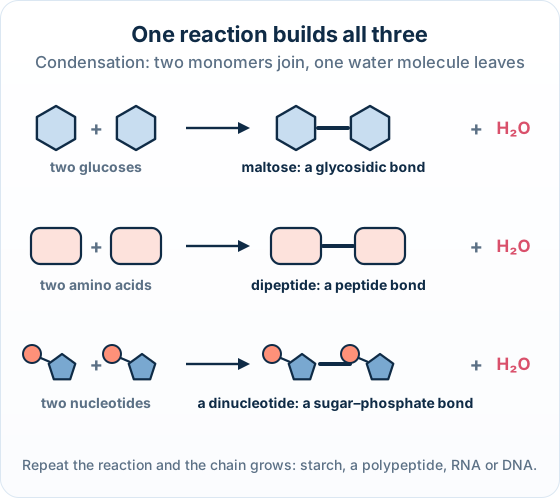
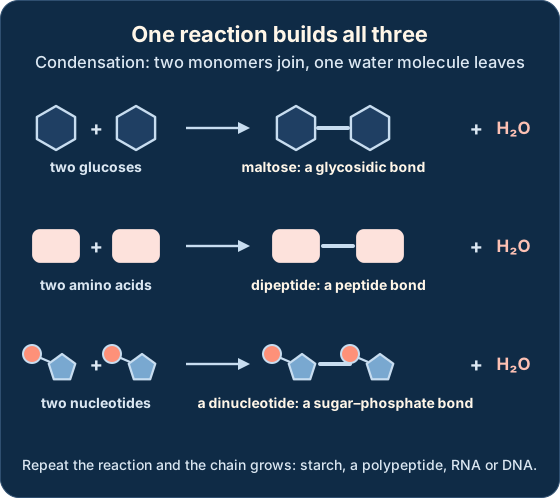
Real example: insulin: Insulin, the hormone that lowers blood sugar, is two chains of 21 and 30 amino acids: 49 peptide bonds, so 49 condensation reactions and 49 water molecules.
The big idea: A condensation drawing shows where the water comes from: an -OH from one monomer and an H from the other.
The points to remember
- Draw the two monomers side by side.
- Show an -OH on one and an H on the other: they leave together as H₂O.
- Join the two monomers with a new bond.
- Label the water released, the new bond and the product.
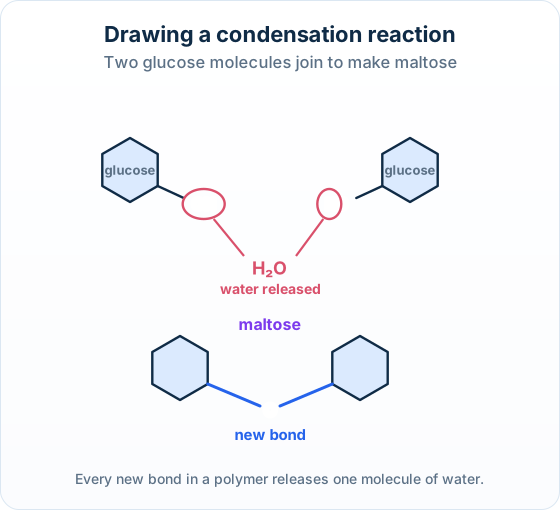
Do not draw water going in: In condensation water is released. Water going in to split a bond is hydrolysis, the reverse.
Know your predicted grade
Take timed mock exams and get detailed feedback on every answer. See exactly where you're losing marks.
How it is asked: A one-mark State on the reaction that joins monomers, a multiple-choice item on what different polymers share, and short Outline answers on how a polymer is built.
State the type of reaction that joins two amino acids to form a dipeptide.
Model answer plan
See the answer broken into clear points, with guidance on how each point earns marks.
And a three-mark Outline in the same style:
Germinating barley seeds make maltose. Outline how two glucose molecules are joined to form maltose.
Model answer plan
See the answer broken into clear points, with guidance on how each point earns marks.