Hydrolysis at Higher Level: The same statement as SL. At HL every digestion, every breakdown of a stored polymer and every enzyme that splits a substrate rests on this one reaction, so be exact about where the water goes.
Practise this as you read
- Name the reaction that splits a polymer.
- Explain the role of water: -H and -OH into the monomers.
- Give the products of hydrolysing starch, a protein and a triglyceride.
Free preview
This is the free notes preview
You're reading the free notes. Aimnova Pro unlocks the full study experience — and you can try it with your first topic free to keep:
- FlashcardsLock in vocabulary and key terms with spaced repetition.
- Practice questionsAnswer exam-style questions and get instant AI marking.
- Mock exams & past-paper vaultSit full mocks and see exactly how examiners award marks.
- Personalised study planA daily plan built around your exam date and weak areas.
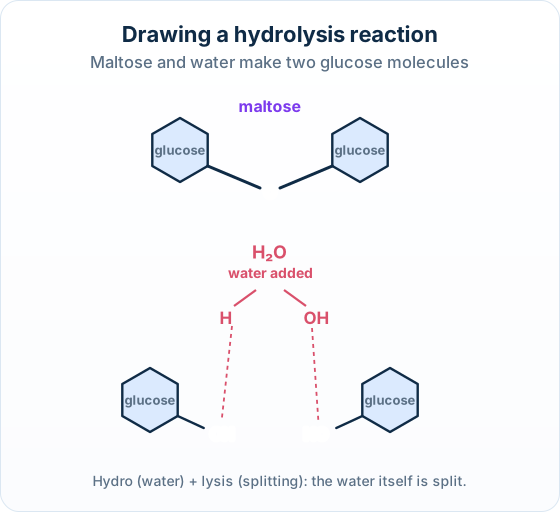
The big idea: Hydrolysis breaks a bond between two monomers by splitting a water molecule. Its -H and -OH end up in the two monomers.
The points to remember
- Hydrolysis splits a polymer into its monomers: the reverse of condensation.
- One water molecule is used for every bond broken.
- The water is split into -H and -OH.
- The -H joins one monomer and the -OH joins the other, so both become complete.
- That is the name: hydro = water, lysis = splitting.
Remember it as: Water in, bond broken, monomers out.
Real example: fat in olive oil: In your small intestine the enzyme lipase hydrolyses the fat from olive oil. Each triglyceride uses three water molecules and gives glycerol and three fatty acids.
Stop wasting time on topics you know
Our AI identifies your weak areas and focuses your study time where it matters. No more overstudying easy topics.
The big idea: Digestion uses hydrolysis to turn every big food molecule back into the monomers it was built from.
The points to remember
- Digestion is hydrolysis: big food molecules are split into monomers that can be absorbed.
- Starch and glycogen → glucose; proteins → amino acids; DNA and RNA → nucleotides.
- A disaccharide → two monosaccharides (lactose → glucose + galactose).
- A triglyceride → glycerol + three fatty acids, using three water molecules.
- Enzymes speed up hydrolysis; the water is what is split.
| Food molecule | Hydrolysed into | Water used |
|---|---|---|
| Starch | many glucose | one per bond |
| Protein | amino acids | one per peptide bond |
| Lactose | glucose + galactose | one |
| Triglyceride | glycerol + 3 fatty acids | three |
Remember it as: Built by condensation, broken by hydrolysis.
Condensation
- Joins monomers into a polymer
- Water is released
- A bond is made
Hydrolysis
- Splits a polymer into monomers
- Water is used and split
- A bond is broken
Water is used, not made: The products of hydrolysing a triglyceride are glycerol and fatty acids. Water is a reactant, so it is never one of the products.
How it is asked: A one-mark State on the reaction that digests a sugar, and multiple-choice items on the role of water and on the products of hydrolysis.
Sucrose, table sugar, is digested in the small intestine into glucose and fructose. State the type of reaction that produces monosaccharides from disaccharides.
Model answer plan
See the answer broken into clear points, with guidance on how each point earns marks.
And a multiple-choice item on the role of water:
What is the role of water in the digestion of a polymer?
Model answer plan
See the answer broken into clear points, with guidance on how each point earns marks.