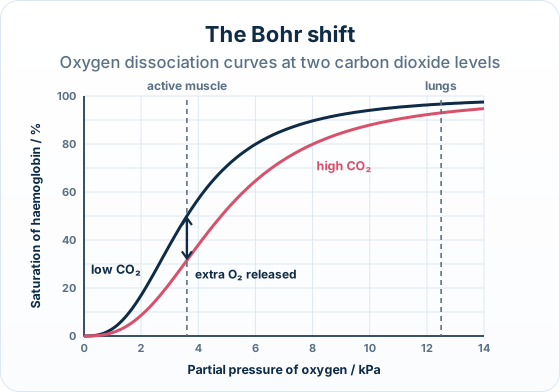
The big idea: More carbon dioxide makes haemoglobin release more oxygen. This is the Bohr shift, and it sends oxygen to the tissues that are respiring fastest.
The points to remember
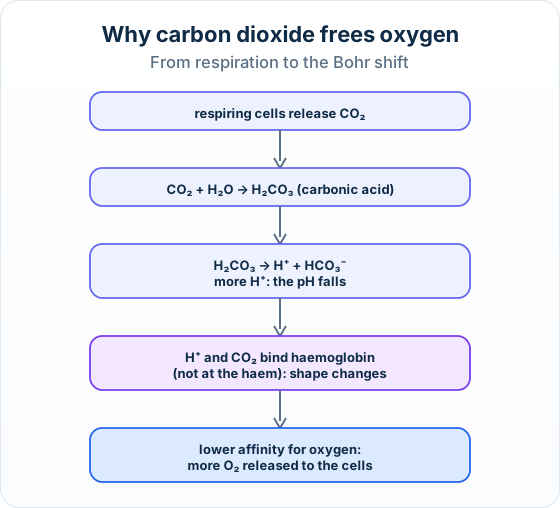
- Actively respiring tissues release carbon dioxide.
- Carbon dioxide + water → carbonic acid, which dissociates into hydrogen ions and hydrogen carbonate ions: the pH falls.
- Hydrogen ions and carbon dioxide bind to haemoglobin away from the haem (allosteric) and change its shape.
- Haemoglobin's affinity for oxygen falls, so it unloads more oxygen.
Remember it as: More carbon dioxide, lower pH, lower affinity, more oxygen out.
Trap: Carbon dioxide lowers the affinity; it does not raise it, and it does not push oxygen off by taking its place on the haem.
Free preview
This is the free notes preview
You're reading the free notes. Aimnova Pro unlocks the full study experience — and you can try it with your first topic free to keep:
- FlashcardsLock in vocabulary and key terms with spaced repetition.
- Practice questionsAnswer exam-style questions and get instant AI marking.
- Mock exams & past-paper vaultSit full mocks and see exactly how examiners award marks.
- Personalised study planA daily plan built around your exam date and weak areas.
Start Studying Free Full access to Aimnova Pro · cancel anytime
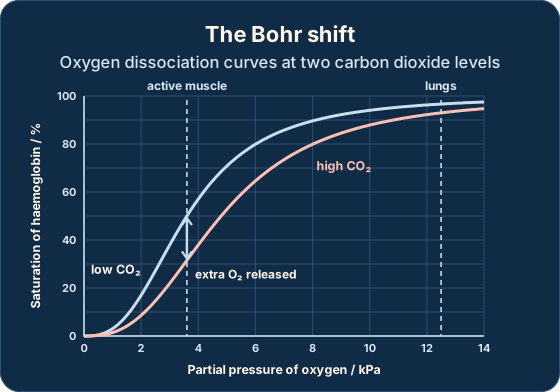
The big idea: On a dissociation graph the Bohr shift moves the curve to the right: at the same partial pressure of oxygen, haemoglobin is less saturated.
The points to remember
- Right shift = lower affinity = more oxygen given up.
- In an active muscle carbon dioxide is high, so oxygen is released exactly where it is needed.
- In the lungs carbon dioxide is low and oxygen is high, so haemoglobin still loads fully.
- To sketch it: label both axes, draw two S-shaped curves, the high-CO₂ one on the right.
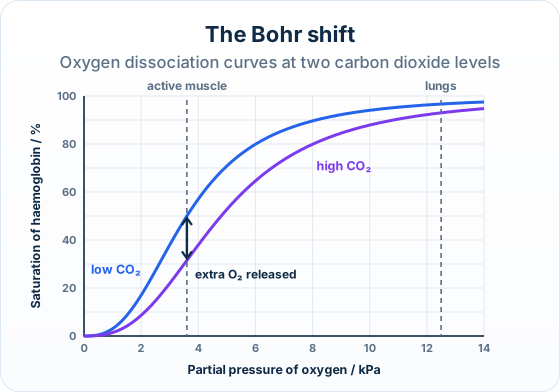
Trap: More carbon dioxide moves the curve right, not left; a curve to the left means a higher affinity, like foetal haemoglobin.
Real example: exercise. During hard exercise, muscles make more carbon dioxide and get warmer, so the blood passing through them gives up a larger share of its oxygen than at rest.
Never wonder what to study next
Get a personalized daily plan based on your exam date, progress, and weak areas. We'll tell you exactly what to review each day.
Try Free Study PlanYour first topic is free to keep • No credit card required
How it is asked: Expect a pair of curves to explain or to find the cause of, or a long Explain worth up to 8 marks.
IB-style questionExplain[8 marks]
Explain how the Bohr shift allows more oxygen to be supplied to actively respiring tissues.
Model answer plan
See the answer broken into clear points, with guidance on how each point earns marks.
The sketch that goes with it: