The big idea: Haemoglobin in red blood cells carries oxygen. It loads oxygen in the lungs and unloads it in respiring tissues, because the binding is reversible.
The points to remember
- Four subunits, each with a haem group whose iron binds one oxygen molecule: up to four O₂ per haemoglobin.
- Cooperative binding: when one oxygen binds, the molecule changes shape and the other subunits' affinity for oxygen rises.
- So the more oxygen is bound, the easier the next one binds; losing one makes the rest easier to lose.
- Allosteric binding of carbon dioxide: it binds at a site other than the haem and lowers the affinity, so oxygen is released.
Remember it as: Four haems, four oxygens; each one makes the next easier.
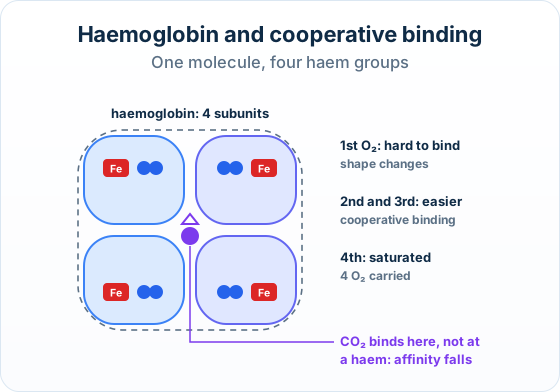
Trap: Carbon dioxide does not take oxygen's place on the haem: it binds at a different site and changes the shape.
Free preview
This is the free notes preview
You're reading the free notes. Aimnova Pro unlocks the full study experience — and you can try it with your first topic free to keep:
- FlashcardsLock in vocabulary and key terms with spaced repetition.
- Practice questionsAnswer exam-style questions and get instant AI marking.
- Mock exams & past-paper vaultSit full mocks and see exactly how examiners award marks.
- Personalised study planA daily plan built around your exam date and weak areas.
The big idea: Foetal haemoglobin has a higher affinity for oxygen than adult haemoglobin, so it can take oxygen from the mother's blood in the placenta.
The points to remember
- Foetal haemoglobin has different subunits, which give it a higher affinity for oxygen.
- Its dissociation curve is S-shaped and lies to the left of the adult curve.
- At the low partial pressure of oxygen in the placenta, the mother's haemoglobin unloads oxygen and the foetus's haemoglobin loads it.
- To sketch the foetal curve: the same S shape, drawn to the left of the adult one.
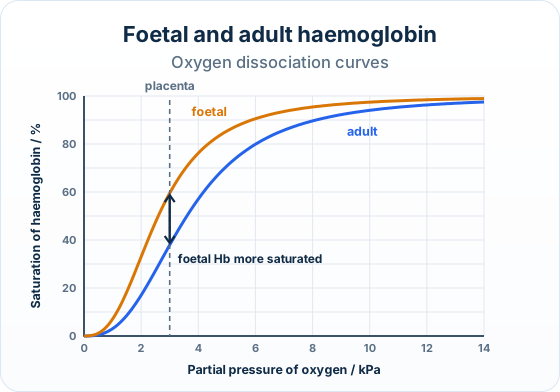
Two traps: Draw the foetal curve to the left, never to the right: to the right would mean a lower affinity.
Keep the S shape: a straight line or a curve that starts steeply scores nothing.
Real example: newborn babies. After birth a baby breathes for itself, and over its first months its foetal haemoglobin is replaced by adult haemoglobin.
Get feedback like a real examiner
Submit your answers and get instant feedback — what you did well, what's missing, and exactly what to write to score full marks.
How it is asked: Expect an adult dissociation curve to sketch the foetal one on, a one-mark adaptation of haemoglobin, or naming the molecule that carries oxygen.
On a graph showing the oxygen dissociation curve of adult haemoglobin, sketch an oxygen dissociation curve for foetal haemoglobin.
Model answer plan
See the answer broken into clear points, with guidance on how each point earns marks.
The same question goes on to ask about the molecule itself:
Describe an adaptation of haemoglobin for the transport of oxygen.
Model answer plan
See the answer broken into clear points, with guidance on how each point earns marks.