The big idea: Every part of a mitochondrion's structure helps it make ATP by aerobic respiration.
The points to remember
- A double membrane: the outer membrane separates the mitochondrion from the cytoplasm.
- The inner membrane is folded into cristae, a large surface area for the electron transport chain and ATP synthase.
- The intermembrane space is very small, so pumping protons into it builds a steep proton gradient quickly.
- The matrix holds the enzymes and substrates of the Krebs cycle, concentrated in one compartment.
Remember it as: Folds for surface, a thin gap for protons, a matrix for the Krebs cycle.
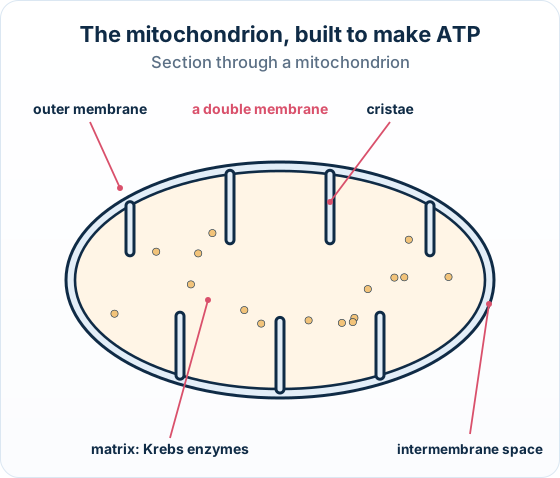
Real example: heart muscle: Heart muscle never rests, and its mitochondria are packed with closely spaced cristae: more surface for making ATP than in the mitochondria of a less active cell.
Free preview
This is the free notes preview
You're reading the free notes. Aimnova Pro unlocks the full study experience — and you can try it with your first topic free to keep:
- FlashcardsLock in vocabulary and key terms with spaced repetition.
- Practice questionsAnswer exam-style questions and get instant AI marking.
- Mock exams & past-paper vaultSit full mocks and see exactly how examiners award marks.
- Personalised study planA daily plan built around your exam date and weak areas.
Start Studying Free Full access to Aimnova Pro · cancel anytime
How it is asked: Expect a Paper 1A item on which organelle property is correct, or an Explain on how the structure suits ATP production. Each mark needs a feature and why it helps.
IB-style questionExplain[3 marks]
Explain how the structure of a mitochondrion is adapted for the production of ATP by aerobic respiration.
Model answer plan
See the answer broken into clear points, with guidance on how each point earns marks.