aımnova
DashboardMy LearningCrash CoursesStudy Plan

Aimnova site navigation

Stay in the loop

Get the latest study resources and updates

New features, study tips and exam insights — straight to your inbox.

IB Diploma

  • IB Past Papers
  • IB Study Notes
  • IB Question Bank
  • IB Mock Exams
  • IB Revision

IB Subjects

  • IB Math AA
  • IB Math AI
  • IB Economics
  • IB Business Management
  • IB Physics
  • IB Biology
  • View all IB subjects→

IB Past Papers

  • IB Math AA HL Past Papers
  • IB Math AA SL Past Papers
  • IB Math AI HL Past Papers
  • IB Math AI SL Past Papers
  • IB Economics HL Past Papers
  • IB Economics SL Past Papers
  • IB ESS Past Papers
  • View all past papers→

Study Resources

  • Study Notes
  • Question Bank
  • Mock Exams
  • Crash Courses
  • Flashcards
  • Revision Guide
  • Exam Skills
  • Command Terms
  • Grade Calculator
  • Exam Timetable 2026

Aimnova

  • Features
  • Pricing
  • For Teachers
  • For Schools
  • For Parents
  • About Us
  • Blog
  • Contact
aımnova

IB study, practice and feedback built around the real exam.

TermsPrivacyCookies·© 2026 Aimnova. All rights reserved.c90f7ab

Aimnova is not affiliated with or endorsed by the International Baccalaureate Organization (IB).

NotesBiology HLTopic 2.4Adaptations of the chloroplast for photosynthesis
Back to Biology HL Topics
2.4.52 min read

Adaptations of the chloroplast for photosynthesis (Biology HL)

IB Biology · Unit 2

IB exam ready

Study like the top scorers do

Access a smart study planner, AI tutor, and exam vault — everything you need to hit your target grade.

Start Free

Contents

  1. 1Built for photosynthesis
  2. 2Exam-style question (step by step)
The big idea: Every part of a chloroplast's structure helps it carry out photosynthesis.

The points to remember

  • A double membrane (envelope) makes the chloroplast a separate compartment.
  • Thylakoids stacked into grana give a large surface area of membrane holding the photosystems, so a lot of light is absorbed.
  • The fluid inside each thylakoid has a small volume, so a proton gradient builds up quickly.
  • The stroma holds the enzymes and substrates of the Calvin cycle, concentrated together.
Remember it as: Stacks to catch light, a tiny inside for protons, a stroma for the Calvin cycle.
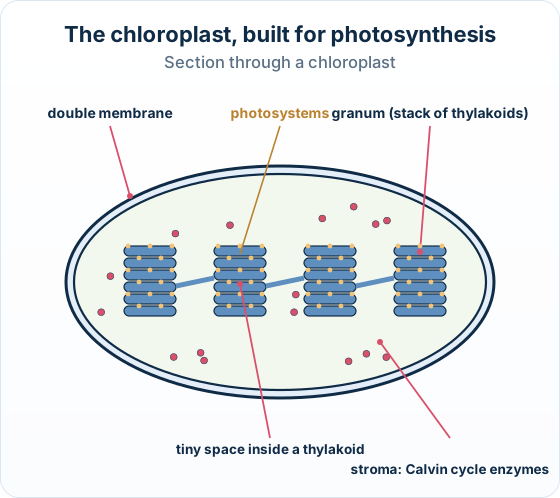
A section through a chloroplast: a double membrane, thylakoids stacked into grana and joined by lamellae, photosystems on the thylakoid membranes, and the stroma dotted with Calvin cycle enzymes
The chloroplast, part by part.
Real example: leaves in the shade: Leaves that grow in deep shade have chloroplasts with taller grana, more thylakoids per stack, so they catch as much as possible of the little light that reaches them.

Free preview

This is the free notes preview

You're reading the free notes. Aimnova Pro unlocks the full study experience — and you can try it with your first topic free to keep:

  • FlashcardsLock in vocabulary and key terms with spaced repetition.
  • Practice questionsAnswer exam-style questions and get instant AI marking.
  • Mock exams & past-paper vaultSit full mocks and see exactly how examiners award marks.
  • Personalised study planA daily plan built around your exam date and weak areas.
Start Studying Free Full access to Aimnova Pro · cancel anytime
How it is asked: Expect a Paper 1A item on a labelled chloroplast (where the Calvin cycle or the light-dependent reactions happen), or an Explain on how the structure suits photosynthesis.
IB-style questionExplain[3 marks]

Explain how the structure of a chloroplast is adapted for photosynthesis.

Model answer plan

See the answer broken into clear points, with guidance on how each point earns marks.

Claim your free topic

Try an IB Exam Question — Free AI Feedback

Test yourself on Adaptations of the chloroplast for photosynthesis. Write your answer and get instant AI feedback — just like a real IB examiner.

Chloroplasts in the leaves of plants growing in deep shade have more thylakoids in each granum than chloroplasts in leaves in full sun.

how this helps the shade plant.
[2 marks]

Related Biology HL Topics

Continue learning with these related topics from the same unit:

2.1.1Chemical properties of carbon that allow diverse compounds2.1.2Production of macromolecules by condensation reactions2.1.3Digestion of polymers into monomers by hydrolysis reactions2.1.4Form and function of monosaccharides
View all Biology HL topics
Improve your exam techniqueCommand terms, paper structure, and mark-scheme tips for Biology HL
Previous2.4.4Adaptations of the mitochondrion for production of ATP by aerobic cell respirationNextFunctional benefits of the double membrane of the nucleus2.4.6

6 questions to test your understanding

Reading is just the start. Students who tested themselves scored 82% on average — try IB-style questions with AI feedback.

Start FreeView All Biology HL Topics