Compartments at Higher Level: The same statement as SL. At HL the double-membraned organelles (mitochondria, chloroplasts, nucleus) get their own pages next, and each shows how a small compartment helps its process.
Practise this as you read
- Discuss how membranes divide the cell into compartments.
- Describe the advantages, each with a named organelle.
Free preview
This is the free notes preview
You're reading the free notes. Aimnova Pro unlocks the full study experience — and you can try it with your first topic free to keep:
- FlashcardsLock in vocabulary and key terms with spaced repetition.
- Practice questionsAnswer exam-style questions and get instant AI marking.
- Mock exams & past-paper vaultSit full mocks and see exactly how examiners award marks.
- Personalised study planA daily plan built around your exam date and weak areas.
The big idea: A eukaryotic cell is not just one open bag of chemicals. Membranes divide it into separate spaces called compartments.
Key points
- Most compartments are the membrane-bound organelles (nucleus, mitochondria, lysosomes, and so on).
- Dividing the cell up like this is called compartmentalization.
Like the rooms of a house: Think of it like the rooms of a house: a kitchen, a bathroom and a bedroom each do a different job, kept separate by walls. Each organelle is a 'room' where one kind of job happens, kept separate by its membrane.
The eukaryotic cell is divided into membrane-bound compartments (nucleus, mitochondrion) — each a separate 'room' for different reactions. The prokaryote has no internal compartments, so all its reactions share one space.
Interactive diagram
Explore the labelled diagram, charts and maps for this topic in full study mode.
- Compartmentalization
- Dividing the inside of a cell into separate spaces (compartments), most of which are membrane-bound organelles.
- Compartment
- A separate space inside the cell, enclosed by a membrane, where particular reactions can take place on their own.
- Membrane-bound organelle
- An organelle surrounded by its own membrane (e.g. the nucleus, mitochondrion or lysosome), which creates a compartment separate from the cytoplasm.
- Cytoplasm
- The fluid filling the cell, outside the organelles; reactions that are not inside a compartment happen here.
Without compartments
- Every reaction happens in one shared space.
- Chemicals that should be kept apart would mix.
- Molecules needed for a reaction would be spread out and dilute.
With membranes
- Membranes solve both problems.
- They keep incompatible reactions apart.
- They gather the right molecules together in a small space.
Why a cell bothers to divide itself up: This is why eukaryotic cells, which are compartmentalized, can carry out many different processes at once.
Stop wasting time on topics you know
Our AI identifies your weak areas and focuses your study time where it matters. No more overstudying easy topics.
Compartments give a cell several clear advantages. They all come back to one idea: separating things lets each process run in its own best conditions, without interference.
The advantages of compartmentalization
- Separates incompatible reactions — reactions that would clash are kept in different spaces
- Concentrates enzymes and substrates together, so reactions happen faster
- Keeps harmful substances enclosed (e.g. digestive enzymes sealed inside lysosomes)
- Provides extra membrane surface area for membrane-bound reactions (folded membranes)
- Allows local optimum conditions — each compartment can keep its own pH or chemical mix
| Advantage of compartments | What it means | Example |
|---|---|---|
| Separates incompatible reactions | Reactions that would interfere are kept in different membrane-bound spaces | Digestive enzymes are sealed inside lysosomes, away from the rest of the cell |
| Concentrates enzymes and substrates | The molecules for one process are gathered in a small space, so reactions go faster | Respiration enzymes are concentrated inside the mitochondrion |
| Keeps harmful substances enclosed | Damaging chemicals are kept inside a membrane so they cannot harm the whole cell | Digestive enzymes stay inside the lysosome membrane |
| Provides extra membrane surface | Folded internal membranes give a large surface for membrane-bound reactions | The inner membrane of a mitochondrion is folded to increase its area |
| Allows local optimum conditions | Each compartment can hold its own pH or chemical conditions, best for its reactions | The inside of a lysosome is kept more acidic than the cytoplasm |
Structure reflects function: Here is the part the exam loves most. The number of an organelle a cell contains tells you about that cell's job.
Reading the cell
- If a cell does a lot of a particular process, it needs a lot of the organelle that carries out that process.
- So you can work backwards: see 'lots of organelle X' and conclude 'this cell does a lot of process X'.
Lots of an organelle…
- Many mitochondria
- Extensive endoplasmic reticulum / many ribosomes
- Large Golgi apparatus and many vesicles
- Many chloroplasts
…tells you the cell's job
- Releases a lot of energy (ATP) by respiration — e.g. a muscle cell
- Makes / processes a lot of protein and other molecules — e.g. a liver or gland cell
- Secretes a lot of material (modifies and exports it)
- Does a lot of photosynthesis — e.g. a leaf cell
| Cell has a lot of… | Because the cell does a lot of… | So this cell is specialised for… |
|---|---|---|
| Mitochondria | Aerobic respiration (releasing ATP) | Active jobs needing energy — e.g. a muscle cell |
| Rough endoplasmic reticulum / ribosomes | Making and processing proteins | Secreting protein — e.g. a gland cell making enzymes |
| Smooth endoplasmic reticulum | Making lipids and processing / detoxifying substances | Detoxification and metabolism — e.g. a liver cell (hepatocyte) |
| Golgi apparatus and vesicles | Modifying and exporting molecules | Secretion — e.g. a cell releasing hormones |
| Chloroplasts | Photosynthesis | Capturing light — e.g. a leaf palisade cell |
The reasoning the exam wants: When a question gives you an unusual feature of a cell (such as 'extensive ER'), do not just name it. Link the structure to a function.
Build the answer
Name the job
State what that organelle does.
Scale it up
Say the cell must do a lot of that job.
For example: lots of mitochondria → respires a lot → releases a lot of ATP → so the cell is very active.
An easy way to remember: More of an organelle = more of its job.
Count the organelle, then read off the job. That single sentence answers most structure-and-function questions.
The big idea: A compartment concentrates the enzymes and substrates of one process and keeps it apart from processes it would harm.
The points to remember
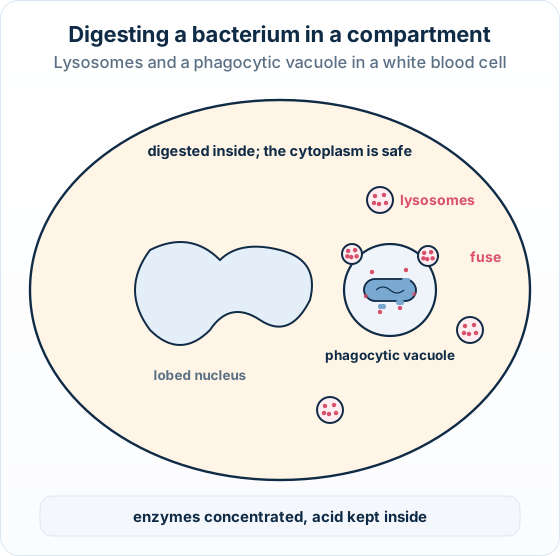
- Lysosomes are small sacs of digestive (hydrolytic) enzymes, sealed off by a membrane.
- A white blood cell takes in a bacterium inside a membrane sac, a phagocytic vacuole.
- Lysosomes fuse with the vacuole, and the bacterium is digested inside it.
- The enzymes are kept apart from the cytoplasm, so they do not digest the cell itself: incompatible processes are separated.
- In a small compartment the enzymes and their substrate are concentrated, so digestion is fast, and the compartment can keep its own conditions (acid pH).
- Small compartments also let concentration gradients build quickly, such as the proton gradient across the inner membrane of a mitochondrion.
Remember it as: Seal it in, speed it up, keep it apart.
Real example: Tay-Sachs disease: In Tay-Sachs disease one lysosome enzyme is missing, so a lipid that it should break down builds up inside nerve cells and damages them.
See how examiners mark answers
Answer exam-style questions with model answers. Learn exactly what earns marks and what doesn't.
How this is tested: The scoring move is always the same: link the structure to the function — say what the organelle does, then say the cell does a lot of that process.
What you may be asked
- Paper 3 (a favourite): a specialised cell with one striking feature. Suggest why it has that feature — for example, why liver cells (hepatocytes) contain extensive endoplasmic reticulum.
- Paper 1B: the same skill as a data question. You get a table or micrograph showing how many of an organelle different cells have, and you read off which cell does the most of a process.
Exam-style question — suggest why a liver cell has so much endoplasmic reticulum
Liver cells (hepatocytes) contain unusually extensive networks of endoplasmic reticulum (ER). Suggest why these cells contain so much endoplasmic reticulum. [1]
How to score the mark
- State what the ER does. The endoplasmic reticulum is where the cell makes and processes molecules — proteins, lipids, and where it processes / detoxifies substances.
- Link it to the cell's job. Liver cells carry out a lot of this work (making proteins, processing nutrients and detoxifying substances), so they need a large area of ER membrane to do it.
(Award the mark for connecting the extensive ER to the large amount of synthesis / processing / detoxification the liver carries out.)
Final answer
Liver cells do a great deal of synthesising, processing and detoxifying, so they need a large surface of ER membrane to carry out all of that work.
Why this scores: The mark is for the link, not the label. Naming 'ER' alone scores nothing.
You must connect the structure (lots of ER) to a function (lots of synthesis / processing / detoxification) that the cell does a great deal of.
Reading it the other way (data version): If the question were a table showing that liver cells have far more ER than skin cells, the same logic answers it: the cell with the most ER is the one that does the most synthesis and processing — the liver cell.
Structure and function point to the same answer from either direction.
| Cell has a lot of… | Because the cell does a lot of… | So this cell is specialised for… |
|---|---|---|
| Mitochondria | Aerobic respiration (releasing ATP) | Active jobs needing energy — e.g. a muscle cell |
| Rough endoplasmic reticulum / ribosomes | Making and processing proteins | Secreting protein — e.g. a gland cell making enzymes |
| Smooth endoplasmic reticulum | Making lipids and processing / detoxifying substances | Detoxification and metabolism — e.g. a liver cell (hepatocyte) |
| Golgi apparatus and vesicles | Modifying and exporting molecules | Secretion — e.g. a cell releasing hormones |
| Chloroplasts | Photosynthesis | Capturing light — e.g. a leaf palisade cell |
A four-mark Discuss, in the Paper 2 style:
Discuss the use of membranes for compartmentalization in eukaryotic cells.
Model answer plan
See the answer broken into clear points, with guidance on how each point earns marks.