Bilayers as barriers at Higher Level: The same statement as SL, used all through HL transport: gated channels, pumps and cotransporters exist because the bilayer holds ions back. HL data uses liposomes, the bubbles of bilayer used to carry drugs.
Practise this as you read
- Explain why ions and polar molecules hardly cross a bilayer.
- Read a log-scale chart of leakage or permeability.
Free preview
This is the free notes preview
You're reading the free notes. Aimnova Pro unlocks the full study experience — and you can try it with your first topic free to keep:
- FlashcardsLock in vocabulary and key terms with spaced repetition.
- Practice questionsAnswer exam-style questions and get instant AI marking.
- Mock exams & past-paper vaultSit full mocks and see exactly how examiners award marks.
- Personalised study planA daily plan built around your exam date and weak areas.
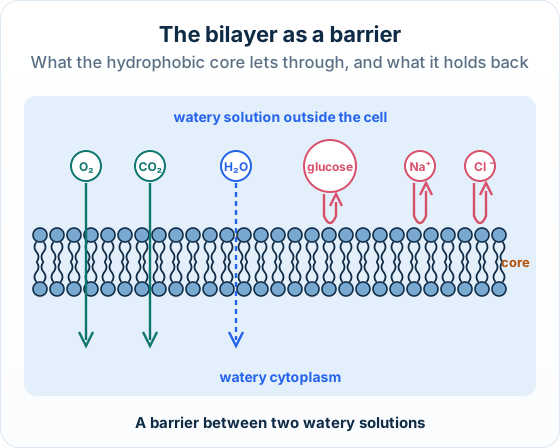
The big idea: The middle of a membrane is oily: hydrophobic hydrocarbon chains. Particles that are large, charged or polar cannot get through it, so the membrane keeps two watery solutions apart.
The points to remember
- The core of the bilayer is made of the hydrocarbon chains of the fatty acid tails: it is hydrophobic.
- It has a low permeability to large molecules, such as glucose and proteins.
- It has a low permeability to hydrophilic particles: ions (Na⁺, K⁺, Cl⁻) and polar molecules.
- Small, non-polar molecules, such as oxygen and carbon dioxide, pass through easily.
- So a membrane is an effective barrier between two aqueous (watery) solutions: the cytoplasm and the fluid outside the cell.
Remember it as: Small and non-polar slips through; large, polar or charged is held back.
Real example: myelin: Myelin is many layers of membrane wrapped round a nerve fibre. Its stacked hydrophobic cores stop ions leaking across, so it insulates the fibre.
Get feedback like a real examiner
Submit your answers and get instant feedback — what you did well, what's missing, and exactly what to write to score full marks.
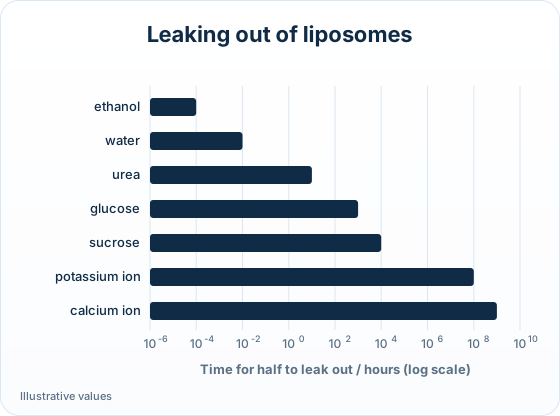
The big idea: Data questions show how fast different substances cross a bilayer with no proteins. Read the pattern: size first, then polarity and charge.
How to read it
- The scale is logarithmic: each grid line is 100 times more than the last.
- Small or non-polar molecules (ethanol, water) leak out in less than a second.
- Larger polar molecules (glucose, sucrose) take months; ions take thousands of years.
- So the longer the time, the lower the permeability: the bilayer is a barrier to ions above all.
Do not say water cannot cross: Water is polar, but it is very small, so a little does cross the bilayer. Say it crosses slowly.
How it is asked: This idea is the reason behind most transport questions: why a particle needs a protein to cross. It is asked as a short Explain, or with data on liposomes or artificial bilayers.
Myelin consists of many layers of membrane. Explain why myelin stops ions from leaking across the membrane of a nerve fibre.
Model answer plan
See the answer broken into clear points, with guidance on how each point earns marks.
And a two-mark data question:
Half the urea in a liposome leaks out in about 10 hours, but half the potassium ions take millions of years. Explain this difference.
Model answer plan
See the answer broken into clear points, with guidance on how each point earns marks.