Simple diffusion at Higher Level: The same statement as SL. At HL it is the baseline every other route is compared with: channels, pumps and cotransporters all move particles that cannot simply diffuse.
Practise this as you read
- Explain how the concentration gradient sets the rate of diffusion.
- Compare simple diffusion with the protein routes.
Free preview
This is the free notes preview
You're reading the free notes. Aimnova Pro unlocks the full study experience — and you can try it with your first topic free to keep:
- FlashcardsLock in vocabulary and key terms with spaced repetition.
- Practice questionsAnswer exam-style questions and get instant AI marking.
- Mock exams & past-paper vaultSit full mocks and see exactly how examiners award marks.
- Personalised study planA daily plan built around your exam date and weak areas.
The big idea: Some substances cross the cell membrane without the cell spending any energy. This is passive transport.
Two passive processes
- The two simplest passive processes are simple diffusion and osmosis
- Both happen because particles move from where there are more of them to where there are fewer
- They move down a gradient, all on their own
Simple diffusion (first panel): small, non-polar molecules slip straight through the phospholipid bilayer, down the concentration gradient — no protein and no ATP needed.
Interactive diagram
Explore the labelled diagram, charts and maps for this topic in full study mode.
- Passive transport
- Movement of a substance across a membrane that does NOT require the cell to use energy (ATP). It happens down a gradient.
- Concentration gradient
- A difference in concentration between two regions — a higher concentration on one side of the membrane and a lower concentration on the other.
- Simple diffusion
- The net movement of small or non-polar particles down their concentration gradient, passing directly through the phospholipid bilayer.
- Osmosis
- The net movement of water molecules across a partially permeable membrane, from a region of higher water potential (more dilute) to a region of lower water potential (more concentrated).
- Partially permeable membrane
- A membrane that lets some substances through (such as water) but not others; the plasma membrane is partially permeable.
Net movement is the key word: Particles are always moving in both directions. Diffusion and osmosis describe the net (overall) movement — the direction in which more particles travel.
Net movement is from high concentration to low for diffusion, and from dilute to concentrated for water in osmosis. It stops being net once both sides are equal.
See how examiners mark answers
Answer exam-style questions with model answers. Learn exactly what earns marks and what doesn't.
Not everything can slip straight through the membrane. The bilayer has a hydrophobic (water-hating) core, so what gets through by simple diffusion depends on the molecule.
Pass **directly through the bilayer**
- Small, non-polar molecules — such as oxygen (O₂) and carbon dioxide (CO₂)
- Lipid-soluble molecules — such as steroid hormones
Cannot pass through the bilayer
- Large or charged particles
- They need a protein instead (covered in 2.3.3)
| Type of molecule | Crosses the bilayer by simple diffusion? | Why |
|---|---|---|
| Small non-polar (O₂, CO₂) | Yes — easily | Small and not repelled by the hydrophobic core |
| Lipid-soluble / steroid (e.g. oestradiol) | Yes | Non-polar, so it dissolves into the hydrophobic core and passes through |
| Water (small but polar) | Slowly on its own; quickly via aquaporins | Polar, so it is slowed by the hydrophobic core; aquaporins give it a fast route |
| Large or charged (glucose, ions) | No | Too large, or repelled by the hydrophobic core — they need a protein |
Why non-polar molecules pass straight through: The middle of the bilayer is made of fatty acid tails, which are non-polar / hydrophobic.
A non-polar molecule (like a steroid hormone or O₂) is not repelled by this core — it dissolves into it and slips out the other side.
A polar or charged particle is repelled by the hydrophobic core, so it cannot use simple diffusion.
Osmosis — water moves toward the concentrated side: Water is small but polar, so it diffuses across the membrane slowly on its own. This special case of diffusion is called osmosis.
How osmosis works
- Water moves from where the solution is more dilute (more water, higher water potential) to where it is more concentrated (less water, lower water potential)
- Many cells also have aquaporins — protein channels that let water cross much faster
- Osmosis is still passive and still moves water down its gradient
- Water potential
- A measure of how 'free' the water in a solution is to move. Pure water has the highest water potential; adding solute lowers it. Water moves from higher to lower water potential.
- Aquaporin
- A channel protein in the membrane that allows water molecules to cross quickly. It speeds up osmosis but does not change its direction, and uses no ATP.
Osmosis in an animal cell: in a hypotonic solution water enters and the cell swells (and may burst); in an isotonic solution there is no net movement; in a hypertonic solution water leaves and the cell shrinks.
Interactive diagram
Explore the labelled diagram, charts and maps for this topic in full study mode.
Rate of diffusion depends on the gradient: The steeper the concentration gradient, the faster the net diffusion. The size of the gradient is the one asked about most.
What changes the rate
- If a cell is using up oxygen inside, and the outside oxygen concentration is raised, the difference across the membrane is larger — so oxygen diffuses in faster
- Temperature (faster-moving particles) raises the rate
- The surface area of the membrane raises the rate
- A thicker membrane lowers it
Simple diffusion
- Moves small / non-polar molecules (O₂, CO₂, steroids)
- Straight through the phospholipid bilayer
- Down the concentration gradient (high → low)
- Passive — no ATP; faster when the gradient is steeper
Osmosis
- Moves water only
- Across a partially permeable membrane
- From dilute → concentrated (high → low water potential)
- Passive; aquaporins speed it up but use no ATP
An easy way to remember: Osmosis = the diffusion of water. Diffusion is for the dissolved particles; osmosis is the water itself moving the other way, toward the concentrated side, to even things out.
The big idea: Oxygen and carbon dioxide cross membranes by simple diffusion: they slip straight between the phospholipids, from where they are more concentrated to where they are less.
The points to remember
- Simple diffusion is the net movement of particles from a higher to a lower concentration: down the concentration gradient.
- Particles move at random, both ways; more cross from the crowded side, so there is a net movement.
- It is passive: no energy from ATP, and no protein is needed.
- Oxygen and carbon dioxide are small and non-polar, so they pass between the phospholipids.
- A steeper gradient gives faster net diffusion; when the concentrations are equal, net movement stops.
Remember it as: Crowded to empty, straight through, no energy.
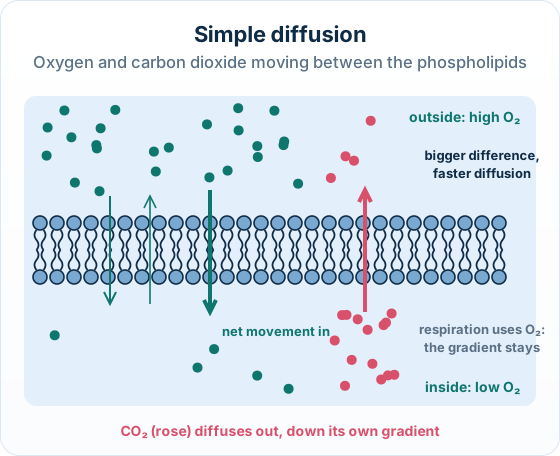
Real example: a working muscle: During exercise, muscle cells respire faster and use oxygen faster. The oxygen concentration inside falls, the gradient gets steeper, and oxygen diffuses in faster.
In a question about rate, describe the rate (faster, slower, stops), not just the direction.
Study smarter, not longer
Most students waste 40% of study time on topics they already know. Our AI tracks your progress and optimizes every minute.
How this is tested: Paper 1B data questions love membrane transport.
| Where | What you are asked | What scores |
|---|---|---|
| Paper 1B (data) | A cell (often an egg cell) is placed in a solution and its mass is measured over time; State the net direction of water movement | Read the trend: mass rising → water entering; mass falling → water leaving |
| Paper 1B, short Explain | How aquaporins assist water movement | Protein channels that let water cross faster |
| Paper 1A | Match a molecule to its route | A non-polar steroid hormone crosses via the phospholipid bilayer, not a protein |
| Paper 2, Explain | How the external oxygen concentration affects the rate of oxygen diffusion into a cell | A steeper gradient gives faster diffusion |
Exam-style question — read the net direction of water movement from data
A cell is placed in a salt solution. Over the next four minutes its mass steadily decreases. State the net direction of water movement across the plasma membrane, and explain what this tells you about the solution. [3]
How to score all three marks
- Read the trend. The cell's mass decreases, so it is losing water — water is moving out of the cell.
- State the net direction. The net movement of water is out of the cell, across the plasma membrane, by osmosis.
- Explain what it means. Water moves toward the more concentrated solution, so the outside solution must be more concentrated (lower water potential) than the cell — it is hypertonic to the cell. (Mark 1: water moves out. Mark 2: by osmosis / down the water-potential gradient. Mark 3: outside solution is more concentrated / hypertonic.)
Final answer
Net water movement is OUT of the cell (mass falls), by osmosis, because the outside solution is more concentrated (hypertonic / lower water potential) than the cell.
Why this scores full marks: It uses the data (mass falling → water leaving), names the process (osmosis) and explains the cause (the outside is more concentrated).
A common slip is stating the direction but never linking it to the water-potential difference — the 'explain' mark needs that cause.
| Feature | Simple diffusion | Osmosis |
|---|---|---|
| What moves | Any small or non-polar molecule (e.g. O₂, CO₂, a steroid hormone) | Water molecules only |
| Direction | Down the concentration gradient (high → low) | From higher water potential to lower (dilute → concentrated) |
| Across what | Straight through the phospholipid bilayer | Across a partially permeable membrane |
| Uses a protein? | No — molecules pass between the phospholipids | No (faster through aquaporin channels, but still passive) |
| Uses energy (ATP)? | No — it is passive | No — it is passive |
A three-mark Explain on rate, in the Paper 2 style:
Explain why oxygen diffuses into muscle cells faster during exercise than at rest.
Model answer plan
See the answer broken into clear points, with guidance on how each point earns marks.