The big idea: A protein's shape is written in its sequence. The order of amino acids decides where each R-group ends up, and so how the chain folds.
The points to remember
- The primary structure is the sequence of amino acids, set by the gene.
- In water, the chain folds so hydrophobic R-groups end up inside and hydrophilic ones outside.
- R-groups that meet form hydrogen bonds, ionic bonds and disulfide bonds that hold the fold.
- So the sequence, and the precise position of each amino acid, decides the 3-D shape: the conformation.
Remember it as: Sequence → R-group positions → bonds → shape.
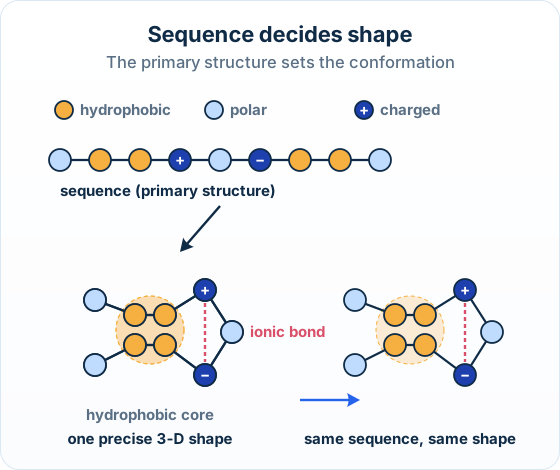
Real example: human insulin made by bacteria: Bacteria given the human insulin gene make a chain with exactly the human sequence. It folds into the same shape as insulin made in the pancreas, so it works in people with diabetes.
Free preview
This is the free notes preview
You're reading the free notes. Aimnova Pro unlocks the full study experience — and you can try it with your first topic free to keep:
- FlashcardsLock in vocabulary and key terms with spaced repetition.
- Practice questionsAnswer exam-style questions and get instant AI marking.
- Mock exams & past-paper vaultSit full mocks and see exactly how examiners award marks.
- Personalised study planA daily plan built around your exam date and weak areas.
The big idea: Even very large proteins fold the same way every time, because each amino acid sits in the same place in every copy.
The points to remember
- The same sequence always folds into the same shape: protein structures are precise, predictable and repeatable.
- That is why every copy of an enzyme has the same active site.
- Change one amino acid and its R-group changes, so the bonds and the fold can change.
- A changed fold can mean a protein that works less well, or not at all.
Remember it as: Same sequence, same shape; new sequence, maybe a new shape.
Same sequence
- Same R-groups in the same positions
- Same bonds form
- Same 3-D shape, same function
One amino acid changed
- A different R-group at one position
- Some bonds change
- The shape and function may change
Practice with exam-style questions
Answer exam-style questions and get AI feedback that shows you exactly what examiners want to see in a full-marks response.
How it is asked: A four-mark Explain linking the sequence to the tertiary structure, and questions on what a single change in sequence does.
After synthesis, globular proteins fold into their final tertiary structure. Explain the relationship between the sequence of amino acids and the tertiary structure.
Model answer plan
See the answer broken into clear points, with guidance on how each point earns marks.
And a two-mark Outline on a change in sequence:
Outline how a change to one amino acid in a protein's sequence can change its function.
Model answer plan
See the answer broken into clear points, with guidance on how each point earns marks.