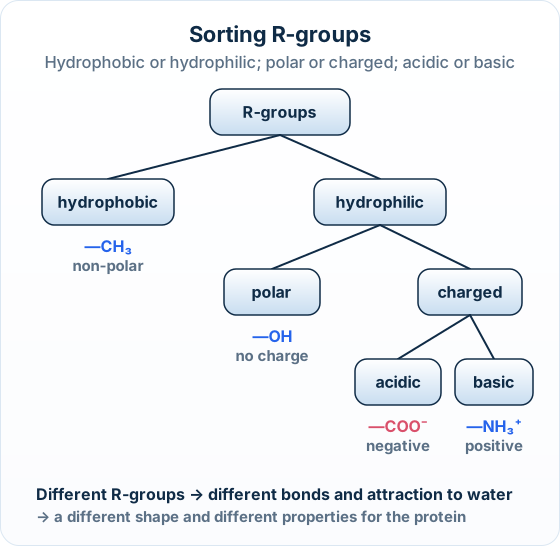
The big idea: Twenty amino acids means twenty different R-groups. Sort them by how they behave with water and by charge, and you can predict what they do in a protein.
The points to remember
- The R-group is the only part that differs between amino acids, and R-groups differ in their chemistry.
- Hydrophobic R-groups are non-polar: water does not attract them.
- Hydrophilic R-groups are attracted to water. They are either polar (no charge) or charged.
- Charged R-groups are acidic (lose H⁺, become negative) or basic (gain H⁺, become positive).
Remember it as: Phobic or philic; polar or charged; acid minus, base plus.
Real example: sickle-cell haemoglobin: In sickle-cell anaemia, one charged R-group in each beta chain of haemoglobin is replaced by a hydrophobic one. The haemoglobin molecules stick together and the red blood cells bend into a sickle shape.
Free preview
This is the free notes preview
You're reading the free notes. Aimnova Pro unlocks the full study experience — and you can try it with your first topic free to keep:
- FlashcardsLock in vocabulary and key terms with spaced repetition.
- Practice questionsAnswer exam-style questions and get instant AI marking.
- Mock exams & past-paper vaultSit full mocks and see exactly how examiners award marks.
- Personalised study planA daily plan built around your exam date and weak areas.
Start Studying Free Full access to Aimnova Pro · cancel anytime
The big idea: The protein's backbone is the same in every protein. Its R-groups are what make each protein different in shape and behaviour.
The points to remember
- Hydrophobic R-groups cluster together, away from water.
- Polar R-groups form hydrogen bonds with water and with each other.
- Charged R-groups form ionic bonds with R-groups of the opposite charge.
- So the order of R-groups decides how the chain folds, whether it dissolves, and what it can bind.
Remember it as: R-groups decide the fold, the fit and whether it dissolves.
| R-group | Water | Bonds it can form |
|---|---|---|
| Hydrophobic (non-polar) | repelled | hydrophobic interactions |
| Polar (uncharged) | attracted | hydrogen bonds |
| Acidic (negative) | attracted | ionic bonds, hydrogen bonds |
| Basic (positive) | attracted | ionic bonds, hydrogen bonds |
Hydrophilic is not the same as charged: Every charged R-group is hydrophilic, but not every hydrophilic R-group is charged: polar R-groups are hydrophilic with no overall charge.
Know your predicted grade
Take timed mock exams and get detailed feedback on every answer. See exactly where you're losing marks.
Try Mock Exams FreeYour first topic is free to keep • No credit card required
How it is asked: A two-mark Describe on how amino acid diversity gives proteins many forms, and questions that ask you to sort an R-group by its chemistry.
IB-style questionDescribe[2 marks]
Describe how the diversity of amino acids gives proteins a broad range of forms.
Model answer plan
See the answer broken into clear points, with guidance on how each point earns marks.
And a two-mark Deduce on a charged R-group:
IB-style questionDeduce[2 marks]
An R-group contains a carboxyl group, COOH. Deduce the charge it carries in a cell and the type of bond it can form.
Model answer plan
See the answer broken into clear points, with guidance on how each point earns marks.