Speciation at Higher Level: The same statement as SL. At Higher Level the topic goes on to the kinds of isolation, adaptive radiation, barriers to hybridization and polyploidy: all of them start from this idea of one species splitting.
Practise this as you read
- Outline why speciation is the only way new species appear.
- Distinguish speciation from gradual change in one species.
Free preview
This is the free notes preview
You're reading the free notes. Aimnova Pro unlocks the full study experience — and you can try it with your first topic free to keep:
- FlashcardsLock in vocabulary and key terms with spaced repetition.
- Practice questionsAnswer exam-style questions and get instant AI marking.
- Mock exams & past-paper vaultSit full mocks and see exactly how examiners award marks.
- Personalised study planA daily plan built around your exam date and weak areas.
The big idea: A species is a group of organisms that can interbreed and produce fertile offspring.
Speciation
- Speciation is the splitting of one species into two separate species.
- It happens when two populations stop interbreeding — they become reproductively isolated — and then change in different ways until they can no longer breed together.
- Species
- A group of organisms that can interbreed and produce fertile offspring.
- Population
- A group of the same species living in the same area at the same time.
- Speciation
- The formation of a new species from an existing one.
- Reproductive isolation
- When two populations can no longer interbreed to produce fertile offspring.
The test for one species: Two organisms belong to the same species only if they can interbreed AND their offspring are fertile.
A horse and a donkey can mate, but their offspring (a mule) is sterile — so they are different species.
How to test whether two forms are the same species: Suppose you find two similar-looking forms and you are not sure whether they are one species or two. Looking alike is not evidence — you need a breeding (crossing) test.
The breeding test
Interbreed
Try to interbreed them.
Check the offspring
Check whether their offspring are fertile — that is, whether the offspring can themselves go on to reproduce.
Same species
- Fertile offspring are produced
Different species
- No offspring at all
- Or only sterile offspring (like a mule)
- Fertile offspring
- Offspring that are themselves able to reproduce.
- Sterile offspring
- Offspring that cannot reproduce.
| Breeding test result | What it tells you |
|---|---|
| They interbreed and the offspring are fertile | Same species |
| They cannot produce any offspring | Different species |
| They produce offspring, but the offspring are sterile (e.g. a mule) | Different species |
Tested as 'suggest further evidence': If a question shows you two similar forms (for example two salamander or two beetle forms) and asks you to suggest how to gather further evidence that they are the same or different species, the expected answer is the breeding test: attempt to interbreed them and check whether the offspring are fertile.
Say what each result would mean
- Fertile offspring ⇒ same species
- No offspring or sterile offspring ⇒ different species
Allopatric speciation: a new river splits one population into two (still one species, no gene flow across the barrier). Over many generations the isolated groups diverge until they can no longer interbreed — two species.
Interactive diagram
Explore the labelled diagram, charts and maps for this topic in full study mode.
Feeling unprepared for exams?
Get a clear study plan, practice with real questions, and know exactly where you stand before exam day. No more guessing.
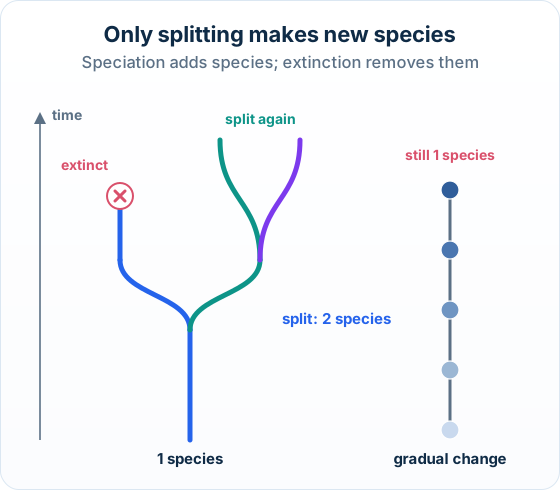
The big idea: New species appear only when an existing species splits into two. This is the only way new species have ever appeared.
The points to remember
- Speciation = one species splitting into two or more species.
- It is the only way new species have appeared.
- Speciation increases the number of species on Earth.
- Extinction decreases it: the number of species is set by the two together.
- Gradual change in one species over time is evolution, but it is not speciation.
Remember it as: Split adds one; extinct takes one.
Real example: polar bears: Polar bears split from a population of brown bears in the far north. Both species still live today: the split added a species rather than turning one into the other.
One more trap to avoid:
Changing is not splitting: If one species slowly changes over many generations, there is still one species at a time. Only a split into separate populations that can no longer interbreed makes a new species.
How this is tested: Speciation is tested on Paper 1A (multiple choice) and in a Paper 2 Explain question.
Paper 1A
- Often tests the species concept (interbreed + fertile offspring)
- Or asks for the consequence of a barrier splitting a population (reproductive isolation)
Paper 2
- Asks you to Explain how a new species forms after a population is split
- Put the steps in order: barrier → isolation → mutation + natural selection → divergence → no longer interbreed
Exam-style question — lizards split by a new river
A single population of lizards lives across a valley. A new river forms and divides the valley, separating the lizards into two groups that can no longer reach each other. Explain how this could lead to the formation of two separate species. [4]
How to score all four marks
- Isolation. The river is a geographic barrier that stops the two groups interbreeding, so there is no gene flow between them — they are reproductively isolated.
- Different variation and conditions. Mutation produces different new alleles in each group, and the two sides of the river have different environments / selection pressures.
- Natural selection drives divergence. In each group, natural selection favours different alleles, so over many generations the two gene pools become more and more different.
- Answer the command term (Explain): eventually the two populations have diverged so much that they can no longer interbreed to produce fertile offspring — so they are now two separate species.
Final answer
The river reproductively isolates the two groups (no gene flow); mutation gives different alleles and the two sides have different selection pressures; natural selection makes the gene pools diverge; eventually they can no longer interbreed to produce fertile offspring, so two species have formed.
Mark the order, not just the words: The marks go to the sequence: barrier → isolation (no gene flow) → mutation + different selection → divergence → can no longer interbreed.
An answer that lists 'natural selection' and 'isolation' with no order usually drops marks.