Evolution at Higher Level: The same statement as SL. At Higher Level the same idea returns as the gene pool and allele frequencies, so learn the definition with all three words: heritable, population, generations.
Practise this as you read
- Define evolution in one sentence.
- Explain why a change in one lifetime is not evolution.
Free preview
This is the free notes preview
You're reading the free notes. Aimnova Pro unlocks the full study experience — and you can try it with your first topic free to keep:
- FlashcardsLock in vocabulary and key terms with spaced repetition.
- Practice questionsAnswer exam-style questions and get instant AI marking.
- Mock exams & past-paper vaultSit full mocks and see exactly how examiners award marks.
- Personalised study planA daily plan built around your exam date and weak areas.
The big idea: Evolution is the change in the heritable characteristics of a population over generations.
Three words do the heavy lifting
- Heritable — the feature must be passed on in the genes, not learned or caused by lifestyle.
- Population — evolution happens to a whole group, never to a single individual.
- Over generations — it builds up across time, not within one lifetime.
Underneath: Underneath, this is a change in allele frequency — how common each version of a gene is in the group.
Evolution IS…
- A change in a population over time
- A change in heritable (genetic) features
- A shift in how common each allele is
- Something that takes many generations
Evolution is NOT…
- A single organism changing during its life
- A learned skill or a tan from the sun
- An individual 'trying' to adapt
- Something that finishes in one generation
Evolution at the genetic level: the dark allele is rare in generation 0 but common many generations later. That rise in allele frequency in the gene pool IS evolution — no single individual changed colour.
Interactive diagram
Explore the labelled diagram, charts and maps for this topic in full study mode.
One-line definition to memorise: Evolution = a change in the heritable characteristics of a population over generations (a change in allele frequency).
Practice with exam-style questions
Answer exam-style questions and get AI feedback that shows you exactly what examiners want to see in a full-marks response.
Within any population, individuals vary — some are taller, darker, faster or more resistant to a disease.
From variation to evolution
Variation is heritable
A lot of this variation is heritable: it comes from the alleles (gene versions) an organism carries and can pass to its offspring.
More offspring
If individuals carrying one allele leave more offspring than others, that allele becomes more common in the next generation.
The population shifts
Over many generations the make-up of the whole population shifts. That shift is evolution.
Vary, more offspring, allele more common: evolution.
- Evolution
- The change in the heritable characteristics of a population over generations.
- Heritable characteristic
- A feature controlled by genes that can be passed from parents to offspring.
- Population
- All the members of one species living in the same area that can interbreed.
- Allele
- One particular version of a gene (e.g. a gene for fur colour can have a dark allele and a light allele).
- Gene pool
- All the alleles present in a whole population.
- Allele frequency
- How common a particular allele is in the gene pool (its proportion).
So the deepest, most precise way to state what is changing is the allele frequency in the gene pool. If dark-fur alleles make up 30% of a population now and 70% several generations later, the population has evolved — even if no single animal ever changed colour.
The classic exam trap: An individual organism does not evolve. A mouse that grows a thicker coat in a cold winter has not evolved — that is just a response within its lifetime, and a thicker coat grown from the cold is not heritable.
Evolution is something that happens to the population across generations, through a change in allele frequency.
| Statement | Evolution? | Why |
|---|---|---|
| A beetle population becomes mostly green over 50 generations | Yes | Heritable change in the whole population over generations |
| A bodybuilder builds big muscles by training | No | Not heritable; one individual, one lifetime |
| A bacterial population becomes resistant to an antibiotic | Yes | Resistant alleles become more frequent across generations |
| A plant grows taller in richer soil | No | An environmental response, not a genetic change passed on |
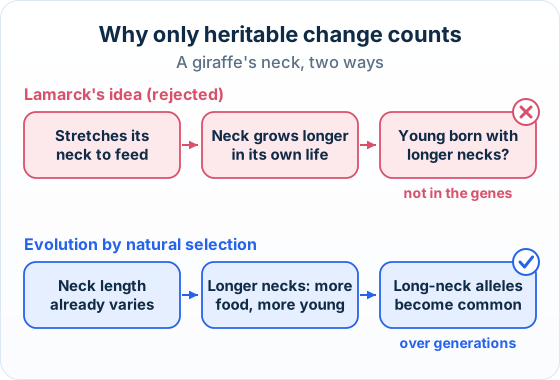
The big idea: Only heritable change counts. A change gained during one lifetime is not in the genes, so it is never passed on: this is why Lamarck's idea was rejected.
The points to remember
- Lamarck (1809) said changes gained in a lifetime, such as a stretched neck, are passed on.
- Changes acquired during life, such as big muscles or a scar, do not change the genes.
- So they are not inherited and are not evolution.
- Darwin's natural selection works on heritable variation that is already there.
- Evolution by natural selection is a theory: it explains and predicts a huge range of observations.
- It can never be formally proved, but it is very unlikely ever to be falsified.
Remember it as: Gained in a lifetime, gone with the lifetime.
Real example: Weismann's mice: In the 1880s August Weismann cut off the tails of mice and bred them for five generations. Every young mouse was still born with a normal tail: a change made to the body during life is not inherited.
Why is it still called a theory, with so much evidence? Science cannot prove an idea true for all cases. It is accepted as a pragmatic truth: it fits every test so far.
Not 'evolved to' or 'needed to': Do not write that an organism changed because it needed to. Variation is already there; natural selection only changes how common each allele is.
Feeling unprepared for exams?
Get a clear study plan, practice with real questions, and know exactly where you stand before exam day. No more guessing.
How this is tested: The definition of evolution is tested on Paper 1A and Paper 2.
Paper 1A (multiple choice)
- You pick the correct definition of evolution
- The right answer always mentions a population (not an individual) and a heritable / genetic change over generations
Paper 2
- A short Define / State question can ask you to write the definition out in your own words
- Worth 1–2 marks
Exam-style question — define evolution
Define the term evolution. [1]
How to earn the mark
- Identify the command term. 'Define' means give the precise meaning — a short, exact sentence, no example needed.
- Include the non-negotiable words. A correct definition must say it is a change in heritable characteristics, of a population, over generations.
- Answer the command term. Evolution is the change in the heritable characteristics of a population over generations (a change in allele frequency).
Final answer
Evolution is the change in the heritable characteristics of a population over generations (a change in allele frequency in the gene pool).
What earns the mark: Any answer that contains all three ideas — heritable change, in a population, over generations — scores. Phrasing it as a change in allele frequency is the gold-standard version.
Answers that only describe one individual changing, or that leave out heritable, do not earn the mark.