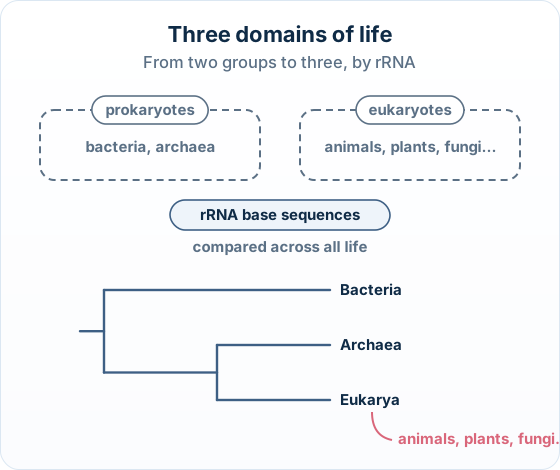
The big idea: All organisms are classified into three domains: Bacteria, Archaea and Eukarya. The evidence came from ribosomal RNA.
The points to remember
- Before 1977, life was split into prokaryotes (no nucleus) and eukaryotes.
- In 1977 Carl Woese and George Fox compared the base sequences of rRNA from many organisms.
- The prokaryotes fell into two very different groups: Bacteria and Archaea.
- Archaea turned out to be more closely related to eukaryotes than to bacteria.
- The domain became a new level above the kingdoms: a revolutionary reclassification.
Remember it as: Bacteria, Archaea, Eukarya: B-A-E.
Real example: methane makers: Woese's first archaea were methanogens: microbes that make methane, living in places such as marshes and the stomachs of cattle. They looked like bacteria, but their rRNA was very different.
Free preview
This is the free notes preview
You're reading the free notes. Aimnova Pro unlocks the full study experience — and you can try it with your first topic free to keep:
- FlashcardsLock in vocabulary and key terms with spaced repetition.
- Practice questionsAnswer exam-style questions and get instant AI marking.
- Mock exams & past-paper vaultSit full mocks and see exactly how examiners award marks.
- Personalised study planA daily plan built around your exam date and weak areas.
Start Studying Free Full access to Aimnova Pro · cancel anytime
The big idea: rRNA works across all of life because every organism has ribosomes, and its base sequence changes very slowly.
The points to remember
- Every living cell makes ribosomes, so every organism has rRNA to compare.
- The rRNA base sequence changes very slowly, so even very distant groups can be lined up.
- Differences in rRNA show how long ago groups split, so they show the deepest branches of life.
- Archaea have no nucleus, like bacteria, but share some features of eukaryotes.
- Many archaea live in extreme places such as hot springs and salt lakes; many live in soil and oceans too.
Remember it as: Every cell has ribosomes; rRNA changes slowly.
Watch the wording:
Not 'DNA' in general: The evidence for the three domains is the base sequence of ribosomal RNA, not just 'DNA' or how cells look.
Memorize terms 3x faster
Smart flashcards show you cards right before you forget them. Perfect for definitions and key concepts.
Try Flashcards FreeYour first topic is free to keep • No credit card required
How it is tested: Paper 1A: which evidence established the three domains, or which cladogram shows them. Learn the shape: Bacteria branch first; Archaea and Eukarya are sisters.
IB-style questionIdentify[1 mark]
Which evidence was used to classify all organisms into three domains? A cell wall structure; B the presence of a nucleus; C base sequences of ribosomal RNA; D the type of nutrition.
Model answer plan
See the answer broken into clear points, with guidance on how each point earns marks.
Reading the trees: In a three-domain cladogram, the node joining Archaea and Eukarya is more recent than the one joining them to Bacteria.