The big idea: The ideal classification follows evolution: every member of a group evolved from one common ancestor.
The points to remember
- In the ideal classification, every group is a clade: a common ancestor and all its descendants.
- Such a classification is called natural: it shows how organisms really are related.
- An artificial group, such as 'trees', is built on one convenient feature.
- Trees evolved in several separate lineages, so 'trees' is not a clade.
- Only a natural group lets you predict other features of its members.
Remember it as: Same ancestor, same inherited features.
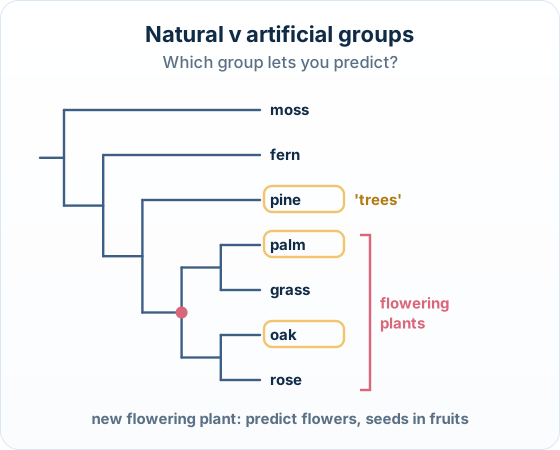
Example: why 'trees' fails: Pine, palm and oak are all trees, yet a palm is more closely related to grass than to a pine or an oak. Knowing that a plant is a 'tree' tells you little else about it.
Free preview
This is the free notes preview
You're reading the free notes. Aimnova Pro unlocks the full study experience — and you can try it with your first topic free to keep:
- FlashcardsLock in vocabulary and key terms with spaced repetition.
- Practice questionsAnswer exam-style questions and get instant AI marking.
- Mock exams & past-paper vaultSit full mocks and see exactly how examiners award marks.
- Personalised study planA daily plan built around your exam date and weak areas.
Start Studying Free Full access to Aimnova Pro · cancel anytime
The big idea: Characteristics are inherited from the common ancestor, so they are shared within a clade. Find a feature in one member, and you can predict it in its relatives.
The points to remember
- Members of a clade share characteristics inherited from their common ancestor.
- So a newly found member can be expected to have the clade's features.
- Research on one member can apply to its relatives: mice and humans are both mammals.
- Classification by ancestry also records evolutionary history: who descended from whom.
Remember it as: Know the clade, predict the member.
A real prediction that was tested:
Real example: feathered dinosaurs: Birds belong in a clade with the dinosaurs that walked on two legs. So feathers, a bird feature, were predicted in those dinosaurs, and fossils of feathered dinosaurs were found in China from 1996.
Use predictions with care:
Predict, not prove: A prediction from the clade is a good guess to test, not a certainty: a member can lose a feature, as snakes lost their legs.
Practice with exam-style questions
Answer exam-style questions and get AI feedback that shows you exactly what examiners want to see in a full-marks response.
Try Practice FreeYour first topic is free to keep • No credit card required
How it is tested: A Paper 2 extended question: explain how evolutionary relationships and cladograms support classification. Plan eight separate points before you write.
IB-style questionExplain[8 marks]
Explain the advantages of classifying organisms by their evolutionary relationships, and how cladograms show these relationships.
Model answer plan
See the answer broken into clear points, with guidance on how each point earns marks.
One idea per sentence: Eight marks need eight separate points. Name the cladogram parts: root, node, terminal branch, clade.