The big idea: The traditional system places every species in a fixed ladder of ranks, each rank inside the one above.
The points to remember
- Above the kingdoms sits the domain.
- Then, from widest to narrowest: kingdom, phylum, class, order, family, genus, species.
- Each group at one rank is a taxon (plural taxa), such as the family Canidae.
- Every taxon holds one or more taxa of the rank below.
- The genus and species together make the binomial name: Canis lupus.
Remember it as: King Philip Came Over For Good Soup: kingdom to species.
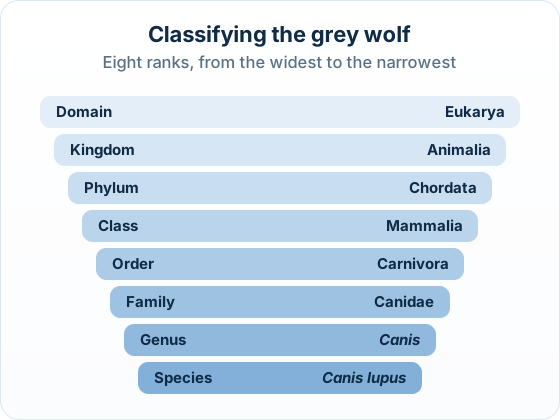
Example: the wolf and the dog: The domestic dog and the grey wolf share every rank down to the genus Canis: so close that the dog is often treated as a subspecies of the wolf.
Free preview
This is the free notes preview
You're reading the free notes. Aimnova Pro unlocks the full study experience — and you can try it with your first topic free to keep:
- FlashcardsLock in vocabulary and key terms with spaced repetition.
- Practice questionsAnswer exam-style questions and get instant AI marking.
- Mock exams & past-paper vaultSit full mocks and see exactly how examiners award marks.
- Personalised study planA daily plan built around your exam date and weak areas.
Start Studying Free Full access to Aimnova Pro · cancel anytime
The big idea: Evolution produces a branching tree with endless gradations. A fixed ladder of ranks cannot always follow it.
The points to remember
- Ranks can cut a clade in two: class Aves (birds) is set apart from class Reptilia, yet birds evolved from reptiles.
- Ranks are arbitrary: where an order ends and a family begins is a judgement, not a fact.
- Taxa of one rank are not equal: a family of beetles may be far older than a family of mammals.
- Some organisms fit no rank neatly: Euglena has chloroplasts like a plant but swims and eats like an animal.
- Cladistics groups organisms into unranked clades instead: a change of approach that is a paradigm shift.
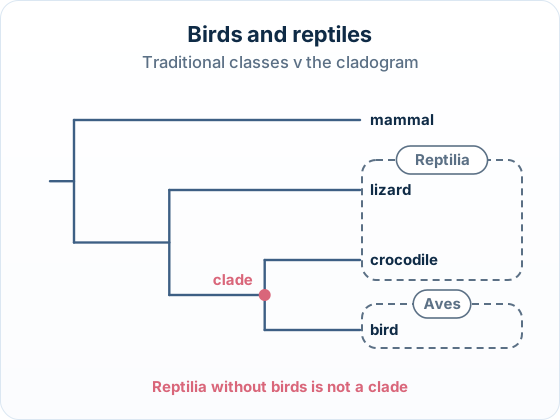
Real example: crocodiles and birds: Crocodiles share a more recent common ancestor with birds than with lizards, yet the traditional ranks put crocodiles and lizards in one class and birds in another.
In an answer:
Name the mismatch: Do not just say the hierarchy is 'old'. Say what it gets wrong: its ranks do not always match the pattern of divergence in evolution.
Know your predicted grade
Take timed mock exams and get detailed feedback on every answer. See exactly where you're losing marks.
Try Mock Exams FreeYour first topic is free to keep • No credit card required
How it is tested: Paper 2 shows an organism's classification as a table with gaps: name the domain and the missing rank. Learn the ranks in order.
IB-style questionIdentify[2 marks]
The garden snail is classified as: Domain ......; Kingdom Animalia; Phylum Mollusca; Class Gastropoda; ...... Stylommatophora; Family Helicidae; Genus Cornu; Species aspersum. Identify the domain and the missing taxon.
Model answer plan
See the answer broken into clear points, with guidance on how each point earns marks.
Ranks, not names: 'Missing taxon' asks for the rank (order, family), not the group's own name.