aımnova
DashboardMy LearningCrash CoursesStudy Plan

Aimnova site navigation

Stay in the loop

Get the latest study resources and updates

New features, study tips and exam insights — straight to your inbox.

IB Diploma

  • IB Past Papers
  • IB Study Notes
  • IB Question Bank
  • IB Mock Exams
  • IB Revision

IB Subjects

  • IB Math AA
  • IB Math AI
  • IB Economics
  • IB Business Management
  • IB Physics
  • IB Biology
  • View all IB subjects→

IB Past Papers

  • IB Math AA HL Past Papers
  • IB Math AA SL Past Papers
  • IB Math AI HL Past Papers
  • IB Math AI SL Past Papers
  • IB Economics HL Past Papers
  • IB Economics SL Past Papers
  • IB ESS Past Papers
  • View all past papers→

Study Resources

  • Study Notes
  • Question Bank
  • Mock Exams
  • Crash Courses
  • Flashcards
  • Revision Guide
  • Exam Skills
  • Command Terms
  • Grade Calculator
  • Exam Timetable 2026

Aimnova

  • Features
  • Pricing
  • For Teachers
  • For Schools
  • For Parents
  • About Us
  • Blog
  • Contact
aımnova

IB study, practice and feedback built around the real exam.

TermsPrivacyCookies·© 2026 Aimnova. All rights reserved.c90f7ab

Aimnova is not affiliated with or endorsed by the International Baccalaureate Organization (IB).

NotesBiology HLTopic 1.7Need for classification of organisms
Back to Biology HL Topics
1.7.13 min read

Need for classification of organisms (Biology HL)

IB Biology · Unit 1

IB exam ready

Study like the top scorers do

Access a smart study planner, AI tutor, and exam vault — everything you need to hit your target grade.

Start Free

Contents

  1. 1Why classify living things?
  2. 2What classification makes possible
  3. 3Exam-style question (step by step)
The big idea: Life is far too diverse to study one species at a time. Classification turns millions of species into a manageable system.

The points to remember

  • About two million species have been named, and there are probably millions more not yet described.
  • Classification puts organisms with shared features into the same group.
  • Groups sit inside larger groups, so every species has a place in one system.
  • Each species also gets one scientific name that biologists everywhere use.
Remember it as: Too many to list: group them.
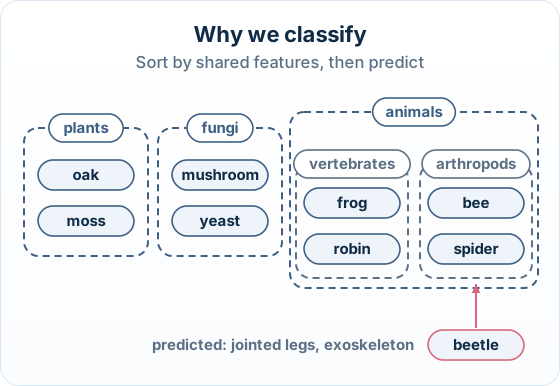
Eight name tiles (oak, moss, mushroom, yeast, frog, robin, bee, spider) boxed into plants, fungi and animals; animals split into vertebrates and arthropods; a beetle tile placed in arthropods
Group, group again, then predict.
Example: a new find: A student finds a beetle they have never seen. Placing it with the arthropods already tells them it has jointed legs and an exoskeleton, before they look closely.

Free preview

This is the free notes preview

You're reading the free notes. Aimnova Pro unlocks the full study experience — and you can try it with your first topic free to keep:

  • FlashcardsLock in vocabulary and key terms with spaced repetition.
  • Practice questionsAnswer exam-style questions and get instant AI marking.
  • Mock exams & past-paper vaultSit full mocks and see exactly how examiners award marks.
  • Personalised study planA daily plan built around your exam date and weak areas.
Start Studying Free Full access to Aimnova Pro · cancel anytime
The big idea: Once organisms are classified, a lot of further study becomes easier: finding, naming, predicting and comparing them.

The points to remember

  • Identify organisms: keys and names work because organisms are already sorted.
  • Predict features: members of a group share characteristics, so a new member can be predicted.
  • Search for useful substances: relatives of a useful species may contain the same compounds.
  • Study evolution and conservation: which groups exist, how many species each has, which are at risk.
Remember it as: Classify once, study faster ever after.

A real case of prediction paying off:

Real example: the Pacific yew: The cancer drug paclitaxel (taxol) was first found in the bark of the Pacific yew. Knowing that yews form one group, chemists turned to a related yew, the European yew, whose needles are now used to make it.

Keep in mind:

Groups are made by people: Classification is a tool. As evidence grows, groups can be changed, which you will meet in the next micro-topics.

Stop wasting time on topics you know

Our AI identifies your weak areas and focuses your study time where it matters. No more overstudying easy topics.

Try Smart Study FreeYour first topic is free to keep • No credit card required
How it is tested: A short Outline question: why classification is needed, and what it makes possible. One reason per mark, each with its effect.
IB-style questionOutline[2 marks]

Outline two reasons why biologists classify organisms.

Model answer plan

See the answer broken into clear points, with guidance on how each point earns marks.

Claim your free topic
Give the benefit: 'To organise them' is too vague: say what classification lets biologists do, such as identify or predict.

Try an IB Exam Question — Free AI Feedback

Test yourself on Need for classification of organisms. Write your answer and get instant AI feedback — just like a real IB examiner.

Biologists estimate that most species on Earth have not yet been described.

two reasons why organisms are classified.
[2 marks]

Related Biology HL Topics

Continue learning with these related topics from the same unit:

1.1.1Water as the medium for life1.1.2Hydrogen bonds from the polar covalent bonds in water1.1.3Cohesion of water and its consequences for organisms1.1.4Adhesion of water to polar or charged materials
View all Biology HL topics
Improve your exam techniqueCommand terms, paper structure, and mark-scheme tips for Biology HL
Previous1.6.98Archived: recognising the major groups (withdrawn)NextDifficulties classifying organisms into the traditional hierarchy of taxa1.7.2

4 exam-style questions ready for you

Students who practice on Aimnova improve their scores by 15% on average. Get instant feedback that shows exactly how to improve your answers.

Practice Now — FreeView All Biology HL Topics