aımnova
DashboardMy LearningCrash CoursesStudy Plan

Aimnova site navigation

Stay in the loop

Get the latest study resources and updates

New features, study tips and exam insights — straight to your inbox.

IB Diploma

  • IB Past Papers
  • IB Study Notes
  • IB Question Bank
  • IB Mock Exams
  • IB Revision

IB Subjects

  • IB Math AA
  • IB Math AI
  • IB Economics
  • IB Business Management
  • IB Physics
  • IB Biology
  • View all IB subjects→

IB Past Papers

  • IB Math AA HL Past Papers
  • IB Math AA SL Past Papers
  • IB Math AI HL Past Papers
  • IB Math AI SL Past Papers
  • IB Economics HL Past Papers
  • IB Economics SL Past Papers
  • IB ESS Past Papers
  • View all past papers→

Study Resources

  • Study Notes
  • Question Bank
  • Mock Exams
  • Crash Courses
  • Flashcards
  • Revision Guide
  • Exam Skills
  • Command Terms
  • Grade Calculator
  • Exam Timetable 2026

Aimnova

  • Features
  • Pricing
  • For Teachers
  • For Schools
  • For Parents
  • About Us
  • Blog
  • Contact
aımnova

IB study, practice and feedback built around the real exam.

TermsPrivacyCookies·© 2026 Aimnova. All rights reserved.c90f7ab

Aimnova is not affiliated with or endorsed by the International Baccalaureate Organization (IB).

NotesBiology HLTopic 1.6Diversity of eukaryote genomes
Back to Biology HL Topics
1.6.93 min read

Diversity of eukaryote genomes (Biology HL)

IB Biology · Unit 1

Smart study tools

Turn reading into results

Move beyond passive notes. Answer exam-style questions, get AI feedback, and build the skills that earn top marks.

Get Started Free

Contents

  1. 1Genome diversity at Higher Level
  2. 2Genomes differ in base sequence
  3. 3Genomes differ in size
  4. 4Exam-style question (step by step)
Genome diversity at Higher Level: The same statement as SL. At HL, sequence differences between species are the basis of cladograms and the molecular clock, so be sure that more differences means more distant relatives.

Practise this as you read

  • Outline two ways eukaryote genomes differ.
  • Compare variation within and between species.

Free preview

This is the free notes preview

You're reading the free notes. Aimnova Pro unlocks the full study experience — and you can try it with your first topic free to keep:

  • FlashcardsLock in vocabulary and key terms with spaced repetition.
  • Practice questionsAnswer exam-style questions and get instant AI marking.
  • Mock exams & past-paper vaultSit full mocks and see exactly how examiners award marks.
  • Personalised study planA daily plan built around your exam date and weak areas.
Start Studying Free Full access to Aimnova Pro · cancel anytime
The big idea: Genomes differ in their base sequence, and they differ far more between species than within one species.

The points to remember

  • Every eukaryote's genome has its own base sequence.
  • Within one species, genomes are almost the same: a few SNPs differ.
  • Between species, the base sequences differ much more.
  • The more closely related two species are, the fewer differences they have.
Remember it as: Within a species: a few letters. Between species: many.
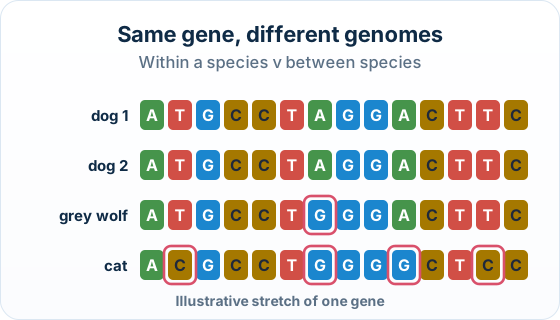
Four rows of coloured DNA bases from the same gene: dog 1, dog 2 identical, grey wolf with one base circled, cat with four circled
Within a species: few differences. Between species: many.
Real example: dogs, wolves and cats: Dogs descend from wolves, and the two differ in very few bases. Dogs and cats belong to different families of carnivores and differ in far more.

Stop wasting time on topics you know

Our AI identifies your weak areas and focuses your study time where it matters. No more overstudying easy topics.

Try Smart Study FreeYour first topic is free to keep • No credit card required
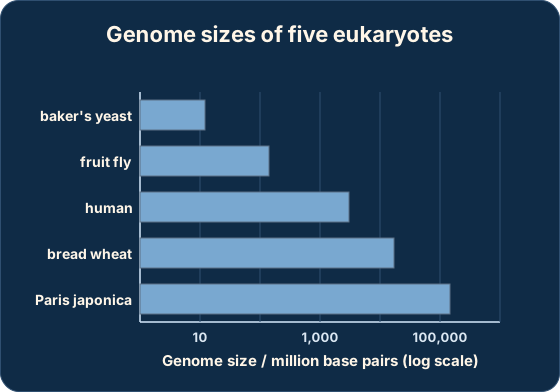
The big idea: Genomes also differ in size: genome size is the total amount of DNA, counted in base pairs.

The points to remember

  • Genome size = the total amount of DNA, measured in base pairs.
  • Eukaryote genome sizes range from about 12 million base pairs (baker's yeast) to about 149 billion (the plant Paris japonica).
  • Much of a large genome is DNA that does not code for proteins.
  • So genomes vary in two ways: in size and in base sequence.
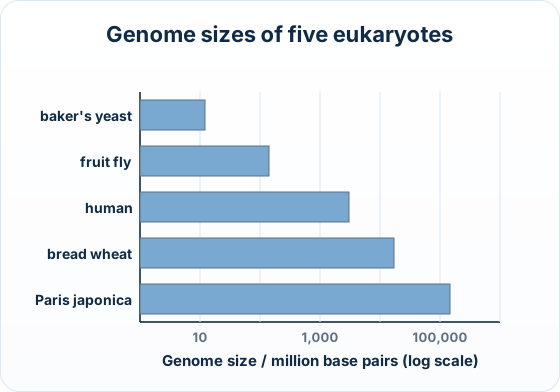
Bar chart, log scale: baker's yeast 12, fruit fly 140, human 3100, bread wheat 17 000 and Paris japonica 149 000 million base pairsBar chart, log scale: baker's yeast 12, fruit fly 140, human 3100, bread wheat 17 000 and Paris japonica 149 000 million base pairs
Each bar is ten times longer per step: genome sizes span more than 10 000 times.
Size is not the number of genes: Genome size counts all the DNA, coding or not. A big genome does not mean many more genes.
How it is tested: Paper 1A can ask in which two ways genomes vary, or compare differences within and between species.
IB-style questionOutline[2 marks]

Outline two ways in which the genomes of eukaryotes differ from each other.

Model answer plan

See the answer broken into clear points, with guidance on how each point earns marks.

Claim your free topic
Use the comparison word: Write 'much larger between species than within a species', not just 'they are different'.

Try an IB Exam Question — Free AI Feedback

Test yourself on Diversity of eukaryote genomes. Write your answer and get instant AI feedback — just like a real IB examiner.

Biologists comparing the genomes of a sea urchin, a pine tree and a human found many differences.

two ways in which the genomes of eukaryotes differ from each other.
[2 marks]

Related Biology HL Topics

Continue learning with these related topics from the same unit:

1.1.1Water as the medium for life1.1.2Hydrogen bonds from the polar covalent bonds in water1.1.3Cohesion of water and its consequences for organisms1.1.4Adhesion of water to polar or charged materials
View all Biology HL topics
Improve your exam techniqueCommand terms, paper structure, and mark-scheme tips for Biology HL
Previous1.6.8Unity and diversity of genomes within speciesNextComparison of genome sizes1.6.10

4 exam-style questions ready for you

Students who practice on Aimnova improve their scores by 15% on average. Get instant feedback that shows exactly how to improve your answers.

Practice Now — FreeView All Biology HL Topics